
Episode #281
Laura Orlando: PFAS, Sewage Sludge, And Poisoned Farms
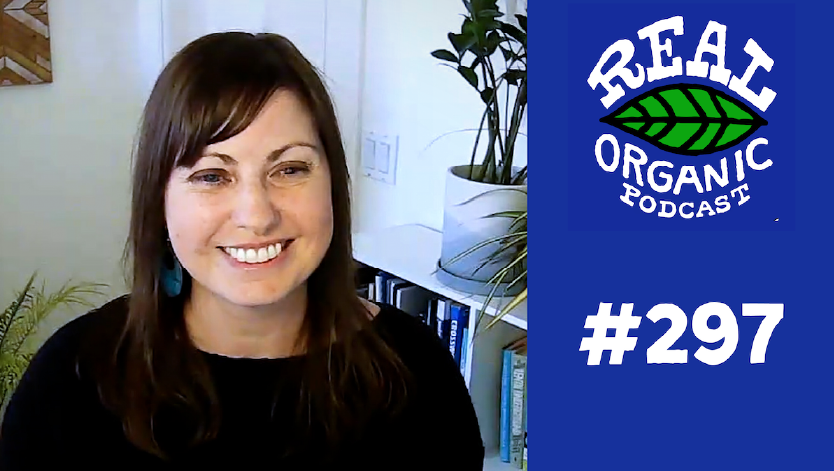
Laura Orlando lays out the case against PFAS sewage sludge with unusual clarity, arguing that what is promoted as a beneficial fertilizer is in fact a toxic waste product loaded with forever chemicals, microplastics, heavy metals, pharmaceuticals, and other industrial contaminants. Drawing on her work with Just Zero, and the growing sludge-free land movement, she explains how wastewater treatment creates this hazardous byproduct, why spreading it on farmland is a disposal practice rather than a farming practice, and why farmers are too often left holding the risk.
Laura Orlando’s interview has been edited and condensed for clarity:
You can subscribe and download episodes of our show through your favorite podcast app, our YouTube channel, or stream the audio-only version here:
Dave Chapman interviewed Laura Orlando at Long Wind Farm in October, 2025
Dave Chapman 0:00
Laura, welcome to the Real Organic Podcast. I’m talking today with Laura Orlando. Laura, hello, thank you. You’re visiting my farm. This is wonderful. I just thought we’d take the opportunity to turn a visit into an interview.
Laura Orlando 0:14
I’m happy to be here. Thanks.
Dave Chapman 0:15
I first heard of you through Abby and the work that you have done around the spreading of sewage sludge. You have an organization?
Laura Orlando 0:31
Yes, a couple of them.
Dave Chapman 0:32
Okay, tell us.
Laura Orlando 0:35
Abby’s a friend, a teacher, and a mentor in my life. I learned about the juggernaut that is sewage and sewage treatment from Abby. My background, I’m a civil engineer. I had my book learning about such things, but book learning’s one thing. It’s another thing to look around and experience what’s happening in the world. What’s happening in the world of sewage is not good.
Laura Orlando 1:15
I work with Abby in an organization called the Resource Institute for Low Entropy Systems (RILES), and I also advise and consult with other organizations, including one called Just Zero, a national nonprofit working on waste-related issues. I teach at the Boston University (BU) School of Public Health.
Dave Chapman 1:40
Great. Sewage is not a sexy or exciting topic to most people.
Laura Orlando 1:52
Boy howdy, it’s just not.
Dave Chapman 1:54
It’s like they don’t even want to think about it. But if we look back historically, when we started coming up with public sewage systems in cities, I think that was a leap forward.
Laura Orlando 2:09
Boy, it depends where you come at it. First came water into cities, primarily to fight fires, because our cities were made of wood. Think of Chicago in the Great Chicago Fire. Once water came in, in the 1840s and 1850s, Benjamin Franklin put in his will money to build one of the very first public water systems in Philadelphia. Once water came to populated areas, people said, “What else can I do with this?”
Laura Orlando 2:48
Water can move waste. It’s not a good idea ever to mix human excreta or animal manure with water, but that’s what we did, because what it can do is carry it away. Now you have a lot of people sedentary in a city, and there are diseases such as cholera, which is Vibrio cholerae, a bacteria that thrives in water. It dies in soil. It’ll die in soil in a few days. It can thrive in water for months.
Laura Orlando 3:26
You drink the water with that bacteria in it, you get cholera. There were cholera epidemics in cities in Europe, across the world, and in the United States, where people were drinking water with the bacteria in it. If you move that away, you’re resolving a huge public health problem. But away is always somewhere else.
Dave Chapman 3:57
Okay. In my mind, in the old days, the rivers were the sewage system.
Laura Orlando 4:04
That’s right, they were the receivers of sludge water
Dave Chapman 4:05
The receivers of the sewage water. This river that we’re sitting next to, the Connecticut River, when I came here 45 years ago, there was still some human sewage floating in that river. They were working very hard to clean up, and they have, and it includes industrial dumping into the river too. They’ve done a great job of cleaning up the Connecticut, but they haven’t done a great job of dealing with that waste in many places in a responsible way.
Laura Orlando 4:40
We have to interrogate what cleaning up means, and what we’re cleaning up. When we talk about sewers 100 years ago and now, but let’s stick to right now. Sewers followed water. It started with water being piped into cities to deal with firefighting and drinking water. Next thing you know, flush toilets came along. Next thing you know, we’re flushing into where? Pipes to the nearest body of water: the Connecticut River, the Mississippi River, the Atlantic Ocean, and Lake Michigan. The nearest body of water.
Laura Orlando 5:21
There was an old adage, which is still used incorrectly that, ” The solution to pollution is dilution.” There were choices made. Should we try to clean up the sewage; clean it up, deal with pathogens? That is what that primarily meant, or is it the drinking water guys’ issue?
Laura Orlando 5:45
Those decisions were made that, “Yeah, let’s just treat the water we drink. You can dump the sewage into the receiving body of water without doing anything to it, and then let the people downstream worry about it.”
Dave Chapman 5:59
We have to mention now that the sewage, which 300 years ago was basically manure, now is a great deal of industrial waste.
Laura Orlando 6:10
It’s primarily industrial waste. A mistake is to think of sewage in modern sewer systems as only human waste. It’s not. It’s every commercial and industrial facility that’s in that city or cities. In Boston, the Boston sewage system, which is located in the city of Boston, services 43 communities.
Laura Orlando 6:41
Whatever goes down the drain goes to the wastewater treatment plant, and what goes down the drain is hospitals, and road runoff. Any industrial facility in the sewer, they are using that system to discard their waste, whatever it is. There are really very few rules about what goes down that drain.
Dave Chapman 7:09
This, for me, is a huge thing, just because, before we were talking about sewage sludge, when I started to learn about this, and it took me a while to understand how important this was, I was thinking about human waste, but most of what is going through the water treatment plant is not human waste. Is that right?
Laura Orlando 7:29
That’s correct. The waste that is carried, say, from a factory, is carried by water, and it goes through the sewage pipes into, at least in the United States, a sewage treatment plant, which is also called a wastewater treatment plant, and is sometimes called a publicly owned treatment works. That wastewater treatment plant is focused, and this is a really important part of the story, on the human waste, on the human excreta. On the nutrients, and on the pathogens that could be in it.
Laura Orlando 7:29
The job of the wastewater treatment plant – hey actually have permits that outline this – is to try to reduce the nutrient load, because nutrients, nitrogen, for instance, in soil for growing plants and such, corn loves it; water, not so much. Those nutrients can change the aquatic ecosystem.
Laura Orlando 7:49
It can cause eutrophication. Those nutrients can use up all the oxygen in the water, and so you have a completely different aquatic ecosystem with no life, or different life, or plants growing.
Dave Chapman 8:44
An example that people would understand is the dead zone in the Gulf of Mexico, where all this agricultural runoff, which is laden with pesticides but also with fertilizer. It’s the fertilizer that’s actually creating the largest wave of death.
Laura Orlando 9:04
Dead means no oxygen in that circumstance. Then the other thing is pathogens. Our guts can carry pathogens that, if other people drink them or eat them, or have them on their hands – I used cholera earlier as an example – you can get cholera, and it can kill you.
Laura Orlando 9:27
The wastewater treatment plant is trying to reduce the pathogen load, and they use essentially bleach to do that. At the end of the process, sodium hypochlorite, usually. They just dose it, let it sit there for a while, and then release it. The systems themselves can be complicated, because they may be dealing with millions and millions of gallons of wastewater coming into them, but they are not…
Laura Orlando 9:56
The chains and the different processes in the wastewater treatment plant, they’re processes that are not new. They’re trying to deal with nutrients and pathogens, not the chemical load, not the synthetic chemicals that are going down the drain in millions and millions of pounds. Any treatment is incidental, meaning, if it goes up into the air, it volatilizes. Sometimes it transforms into something worse. It’s a giant chemistry set.
Dave Chapman 10:31
By and large, people don’t think about this because they go, “Well, I’m drinking the water. I don’t seem to be getting sick. My kids are doing okay.” Some places that’s not true, and they know that their kids are getting sick. California, where they’ve pumped the aquifer so deep that they’re pumping up arsenic-laced water, and they know that that’s very dangerous.
Dave Chapman 10:56
But they don’t think about that, and in most of America, they don’t think is that there’s a problem here. I heard about this as a real problem when I started to hear about it hitting farms. Tell us what’s the end product of the water treatment plant.
Laura Orlando 11:21
Look, I don’t want raw sewage going into the Connecticut River or Lake Michigan where I grew up, and wastewater treatment has prevented that. But what happens is that the treatment process creates two products: the treated wastewater, which is still discharged into a receiving body of water. It’s called the effluent, or treated wastewater.
Laura Orlando 11:49
You’re not going to find bits of plastic, sneakers, tennis balls, or feces. That’s not what’s going to be discharged. You’re going to have a reduced nutrient load, which is a really good thing to the water.
Laura Orlando 12:27
You’re not asphyxiated on all the life in the water…
Laura Orlando 12:04
Exactly, which is a good thing. You’re also dealing with those pathogens, where cholera, dysentery, and typhoid are gone.
Laura Orlando 12:20
They are the real problems and they’re doing a good job of dealing with those problems.
Laura Orlando 12:22
That’s right, they are. You have two products: you have the treated wastewater, and then you have a residual – you have an unwanted byproduct – which is a liquid, semisolid, solid, and it’s called sewage sludge. The better they treat that wastewater, the worse the sewage sludge is. I’ll use microplastics as an example.
Laura Orlando 12:47
So synthetic clothing, fleece, polyester sheds plastic. That’s one source, not the only source by any means. Where does all that wash water go from your washing machine? It goes into the sewer, at least in urban environments. Those microplastics, the wastewater treatment plant migrate into the solids – 99% of them migrate into the solids, which is the sewage sludge.
Laura Orlando 12:47
Sludge is reliably full of nano- and microplastics. Unbelievable amounts, which we’re not talking about. We do know that microplastics in soil are not good for plants. It prohibits photosynthesis. It’s not good for the life of the soil, and yet sewage sludge is promoted as a beneficial fertilizer. It’s not only microplastics, but that’s an example of one of the unwanted contaminants in the sewage stream that makes its way over to the sewage sludge.
Laura Orlando 12:47
If there’s a chemical or contaminant that is hydrophobic – it doesn’t like water, doesn’t want to be in water – it’ll find those solids, and it’ll migrate over there. Those solids aren’t feces; they’re the bodies of bacteria that are used in what’s called the secondary treatment process in wastewater treatment to gobble up all those nutrients, to try to reduce what’s called the biological oxygen demand, which is really just the putrescible matter in this whole system.
Laura Orlando 12:47
As those bodies slough off, and the microplastics and all of that, that creates this semisolid that has been moved away from that treated wastewater, and you end up… Boston ends up with around 300 tons a day of it.
Dave Chapman 14:54
Just so I understand a little better, is this essentially a composting process, in the sense that you’re making it highly aerobic in the treatment, and so you’re breaking things down, and you’re ending up with a waste product, because what you’re putting into your compost pile, your compost vat, is not a very good ingredient?
Laura Orlando 15:15
Boy, I don’t like the word compost…
Dave Chapman 15:22
I understand. That’s our friend. That process….
Laura Orlando 15:27
It’s an interesting way to think of it. That’s right. Municipal wastewater treatment plants inject pure oxygen. They’re huge energy users – just colossal energy users – because they’re injecting pure oxygen into this environment so that they can support oxygen-loving bacteria that will deal with these nutrients. But then that bacteria sloughs off, and now you have this material.
Dave Chapman 16:01
Does it heat in the process? Is it warm?
Laura Orlando 16:03
No. But there are some wastewater treatment plants, not all in Massachusetts, something like 140 wastewater treatment plants. Five of them have anaerobic digesters that are used to reduce the volume of sewage sludge. That’s their purpose.
Laura Orlando 16:21
An anaerobic digester at a wastewater treatment plant is very expensive, so the largest ones tend to have them. They can reduce the sludge volumes by about 50%, which is not a bad idea, because we’re not quite there yet, but sludge is always toxic. It’s always loaded with chemicals.
Dave Chapman 16:40
It’s basically toxic waste.
Laura Orlando 16:42
It is toxic waste. Toxic and hazardous waste.
Dave Chapman 16:46
That’s right, highly hazardous. We’ve got microplastics. I know we’ve got some other doozies in there that are common. It is not like some exceptional thing…
Laura Orlando 16:56
None of this is exceptional. The family of chemicals that’s on many people’s radar screen right now are PFAS, per- and polyfluoroalkyl substances. They’re also called “forever chemicals.”
Dave Chapman 17:11
I can’t even pronounce it when I’m reading, so thank you. PFAS, and there’s like 2,000 chemicals in that family.
Laura Orlando 17:18
Brominated flame retardants, heavy metals, pharmaceuticals, estradiol, for instance, anticonvulsive medications, steroids, all reliably in sewage sludge, because, remember, sewage treatment does not treat those things. Some of it, like caffeine – we excrete a lot of caffeine – is not hydrophobic. It tends to go into the water column. None of this is either/or. For instance, you can find PFAS in the treated wastewater. It’s also in the sewage sludge.
Laura Orlando 18:05
PFAS is a family of compounds, 15,000 and counting. The one thing the chemicals have in common is one fluorine bond and one carbon bond. Why is that important? It’s not found in nature. It came out of a lab, DuPont, to be specific. We don’t know how to break that bond. That’s where the word “forever chemical” comes from.
Dave Chapman 18:33
If you put your PFAS in a farm’s compost pile, and you get lots of biological activity and heating and all that, it doesn’t affect it.
Laura Orlando 18:43
You can heat it up to 500 degrees, and it doesn’t affect it.
Dave Chapman 18:50
This is very important. It doesn’t biodegrade.
Laura Orlando 18:50
It does not biodegrade. It can transform into other PFAS. You can have the building blocks, fluorotelomers, for instance. You have some fluorine, some carbons, they get together, they have a party; the next thing you know, you have Teflon. That party can happen in your soil or in the wastewater treatment plant.
Laura Orlando 19:11
Where this is really key for farms and farmers and gardeners is you put sewage sludge onto your soil. It is promoted as a beneficial fertilizer by the federal government and by every state but Connecticut and Maine, which ban what’s called the land application of sewage sludge.
Laura Orlando 19:34
There are federal regulations that say, “Oh, if there’s that many heavy metals or this many pathogens, you have to land apply it differently.” It doesn’t say you can’t. But these chemicals are PFAS, for example – the steroids and all the rest – but I’m going to focus on PFAS, because they don’t go away. You add them to your soil and they stay.
Dave Chapman 19:58
The wastewater treatment plants are producing a highly toxic substance. It’s an inevitable byproduct of the process that they’re following.
Laura Orlando 20:11
Not quite. They are passive receivers where PFAS… Every state uses millions of pounds of PFAS, say in the metal plating industry, the textile industry, certainly on our clothes, but it’s their industrial sources of PFAS. It’s in our packaging. Landfill leachate goes to wastewater treatment plants. Landfills, when it rains or snows, that water percolates through the landfill, which is loaded with everything we use in our society, and it leaches chemicals.
Laura Orlando 20:11
Many landfills are now lined with plastic. They all leak, but they’re lined and so millions of gallons are collected, and it’s either piped directly to the wastewater treatment plant or, more often, trucked. Remember, I talked about the wastewater treatment plant only dealing with nutrients and pathogens. All of the chemicals in that landfill leachate, of which PFAS is high on the list in high concentrations, end up in the sewage sludge, much of it, and some of it in the treated wastewater.
Laura Orlando 21:27
The wastewater treatment plants receive the PFAS, and then you’re correct, they also can make PFAS from the building blocks. You can find 10 to 20 times more PFAS coming out of a wastewater treatment plant than going in, which is terrifying.
Dave Chapman 21:45
This is an unintentional construction of more PFAS. But by adding these toxic ingredients that are the building blocks of the different 15,000 substances, they’re now making more.
Laura Orlando 22:00
That’s right. They’re making, for instance, PFOA and PFOS, which we hear a lot of ballyhoo about trying to phase out in the United States. They’re being made in the wastewater treatment plant. By the way, they need to be regulated as a family of chemicals, because they’re all bad – bad for our health in a myriad number of ways, causing cancer, thyroid problems, immune troubles, high cholesterol. The list goes on and on about how very, very small concentrations of PFAS can cause damage to people’s health, and not good for plants either.
Laura Orlando 22:56
There is no safe level in terms of ingesting PFAS. The level that is safe is zero, and that is well established in terms of risk assessments, etc. The idea that the federal government in all 50 states say, “Well, this stuff’s great to put on your farm,” I think it’s criminal.
Dave Chapman 23:21
The science is clear. It’s not complicated in terms of whether this is toxic or not.
Laura Orlando 23:28
We’re in a bit of a situation where smoking is good for you. There are advocates that industry pays them to say, “Hey, this isn’t so bad.” Like the tobacco playbook; it’s used in many ways. We see it with glyphosate and with the pesticide industry. This is another piece of that.
Laura Orlando 23:54
The economic story is that sludge is produced by wastewater treatment plants. All of them produce a lot of sludge. The biggest ones produce the most sludge. Something like 90% of the sewage sludge is produced by maybe 200 wastewater treatment plants in the country, out of 17,000, because they’re the big ones: LA, Seattle, New York, Boston.
Laura Orlando 24:21
The surrounding communities are often hooked up to the same wastewater treatment plant or a handful of plants. The sludge has to be hauled away.
Dave Chapman 24:32
What do they do with it? Many dump truck loads every day.
Laura Orlando 24:36
Many thousands of dump trucks. There’s a handful of corporations that went, “Hey, wait a minute. We want these contracts.” So multi-million-dollar contracts are written to haul this stuff away. What’s the cheapest thing you could possibly do with it? Dump it on somebody’s farm. To tell them, “It’s free. It’s beneficial. Use it on your farm.”
Laura Orlando 25:07
They get the multi-million-dollar contract to haul it away. The wastewater treatment plant goes, “That’s gone.” Then you’ve got a federal rule that’s broken. They’re called Part 503. That says what’s safe with regard to the land application of sewage sludge, and it’s always been about a haul-and-dump operation. That’s the cover the corporations use.
Laura Orlando 25:34
Companies like Casella, there’s one called Synagro. That’s a Goldman Sachs company. Gives you a sense of the money. Many of them are probably privately held. Denali Water is another one. They haul this stuff away. Sometimes they put it into a landfill. Sometimes they further process it, for instance, pelletizing it so it looks uniform, or, God forbid, they compost it, meaning it’s a sludge-derived compost.
Laura Orlando 26:05
Add some sawdust and wood chips. Call it a compost. Get landscapers to take it, bag it. You can find this stuff in Home Depot, etc., in bags. You should always look on a label if it says “residuals” or “biosolids,” or there’s an ingredient you don’t recognize, don’t buy it. There’s some companies like Costa Maine; they don’t touch this stuff. It’s like knowing your farmer; know your composter. It’s really important.
Laura Orlando 26:39
Especially with PFAS, because there is no known technique to get it out of the soil. There’s work being done in Maine. Maine is a beacon on this issue right now. They’ve done the right thing. In 2022, they passed a state law that bans the land application of sewage sludge and sludge-derived products.
Dave Chapman 27:05
Why is Maine a beacon? How did that happen? Tell me.
Laura Orlando 27:10
I think it’s the farmers. Maine had been promoting the land application of sewage sludge for decades.
Dave Chapman 27:20
The state of Maine.
Laura Orlando 27:21
Yeah, just like the states across the country are doing now, with the support of the federal government through every administration, Republican and Democrat. In 2019, the straw that broke the camel’s back is Fred Stone. He’s a multigenerational dairy farmer from Arundel, Maine, and he had allowed for the land application of sludge on his dairy farm because the state told him it was a good fertilizer.
Laura Orlando 27:58
He says, “I have a certificate. They signed it and they said, ‘This stuff’s good; it’s safe.'” He found out that his land was poisoned with PFAS.
Dave Chapman 28:13
How did he find that out?
Laura Orlando 28:15
I’m not sure. I don’t know that piece. You’ll have to interview Fred.
Dave Chapman 28:20
Okay.
Laura Orlando 28:21
He’s had generations of cows. What do you do? I think he tested his milk initially, is what happened, and he found high levels of PFAS in it. Now, at the time, Maine had no rules around PFAS in milk, but Fred had a moral compass and integrity to say, “Hey, wait a minute. I can’t give this milk to people to drink.”
Laura Orlando 28:58
He rang the alarm bell and got his state rep, and got a lot of other people looking at this, and the state said, “Okay, we have to see how big of a problem this is.” They created a PFAS task force, and they found out it’s a huge problem.
Laura Orlando 29:20
Now, there are farmers who are in state government. Bill Plucker is one of them. He’s an organic farmer, and he helped write the law that banned the land application. When I testified years ago about this, I can’t remember, 2020–2021, I was talking to an organic farmer on the Natural Resources Committee.
Laura Orlando 29:50
That makes a difference, because they understood what it means to poison your soil and poison it with something called a forever chemical. They not only banned land application, but they started testing programs around the state, and also money for research to figure out, like, “Okay, now what? What do we do?” The University of Maine is doing a lot of this work.
Laura Orlando 30:15
This is one of the most important parts. I think every ban, and I hope it’s national, in state by state, until we have a federal ban on land application of sewage sludge, is support for farmers – financial support, immediate income replacement, and mental health support. To find out that land you’ve been tending for maybe decades, or maybe you just got started as a farmer, organic or otherwise, is now not useful…
Laura Orlando 30:58
I think now they’ve tested a few hundred farms. An important part of the backstory is we don’t know where sewage sludge goes. Some of it has a permit, and so that’s what Maine did. They said, “Oh, we know where some of it goes, and we’ll look there.” Some of it, like if you add lime to it, or you compost it with wood chips, if you can reduce the pathogens and the odor, you don’t have to say where it goes. It becomes a different class – so-called Class A and B – nothing to do with its toxicity, but everything to do with the regulatory environment.
Laura Orlando 31:50
So 100 tons of processed sewage sludge comes out of the Boston area every day. It’s pelletized, so it means it’s heated. They never have to report where that goes. It goes to 13 states and Canada. But we don’t know where. We don’t know what farms. But Maine said, “Well, we know where some of this went, and we’re going to go test.”
Laura Orlando 32:19
Of course, they found high levels of PFAS in wells and soil, highly variable. Maybe the farm only put the sewage sludge on hay fields. It was the hay fields where they found the contamination, which makes a lot of sense.
Dave Chapman 32:40
A cow eating that hay, the PFAS will show up in that cow’s milk. Thus, if you drink that milk, it will show up in the body.
Laura Orlando 32:51
That’s correct. But cows and lactating animals will shed the PFAS. If you can hang on to your herd and dump that milk, your herd will recover from it. That’s what we learned from the work that Misty Brook Farm did. They had contaminated hay from sewage sludge. They were able to trace that…
Dave Chapman 33:21
That was hay they actually bought in.
Laura Orlando 33:23
They brought it.
Dave Chapman 33:24
It wasn’t on their land. That was hay they bought to feed their cows.
Laura Orlando 33:27
Yeah. They said, “Listen, we’re going to see what happens here.” Unfortunately, the same thing happens with breastfeeding a child. Maine said, “We’re going to look at these farms and we’re going to see where it is.” They found it all over the place. They found contamination every place. They said, “Well, we’re going to support the farmers.”
Laura Orlando 33:51
They started with 60 million dollars – I think they’re up to $100 million – and then we’re going to do the research to show what can we grow? What’s the difference with grasses? What’s the difference with hay? What happens to corn? How can we keep these farms in business?”
Laura Orlando 34:11
Fred has a solar array on his farm. The contract is that if, in 30 years, they can figure out ways, we can figure out how to get the PFAS out of his soil, the contract is they’ll take those solar panels away. He happens to have gravel. He says, “I’ve been able to piece things together to support my family.”
Laura Orlando 34:34
Maine is looking at the problem square on. They’re saying, “How do we support our farms? How do we support our farmers? How do we make sure this stuff doesn’t keep polluting?” That’s why I call them a beacon. They’re learning. They keep learning. They’re not denying the problem. What you find is in every other state is denial, or they’re trying to pass the buck, or they lie about it.
Dave Chapman 33:24
Certainly lying about it seems to me to be obviously criminal activity. Who first learned that PFAS was a dangerous substance?
Laura Orlando 35:13
The chemical companies who made it – 3M and DuPont – knew decades ago that the bond couldn’t be broken, and they knew it was really dangerous to life. It was known. I’m probably butchering his last name, but Rob Bilott was one of the first people who got… There was a New York Times cover article about DuPont.
Laura Orlando 36:04
Rob is a lawyer, and he spent time on his grandparents’ farm, I think, in Ohio. He represented chemical companies, is my understanding. This is years ago, a decade ago, I’m not sure, somewhere in there. He got a call from a farmer near his grandparents’ property who said, “Hey, I’ve got sick cows. I think it’s chemical contamination.”
Laura Orlando 36:35
Rob looked into it, and he did the discovery. He was able to get from DuPont documents that said DuPont knew all along how poisonous this family of chemicals are, and he really established that. The movie “Dark Waters” goes into this a little bit. It’s a little bit of his story.
Dave Chapman 36:58
it’s a gripping movie; it’s not a boring documentary. It’s really arresting.
Laura Orlando 37:09
Yeah. It’s a chemical of convenience. It’s really good at keeping oils from getting… It’s used in packaging. It’s in firefighting foams for fuel fires, AFFF – aqueous film-forming foam. It encapsulates the flame and puts it out. There are other things that will do that. But in that firefighting foam, it goes into the Connecticut River. It goes into your well. Every airport practice…
Dave Chapman 37:52
Into the firefighters.
Laura Orlando 37:53
It goes into the firefighters and into the soldiers who are using it on military bases. Military bases, firehouses, and airports are hot spots for PFAS. Landfills are hot spots. Wastewater treatment plants are hot spots.
Laura Orlando 38:11
These chemicals weren’t around. They were made in the 1940s. It really got cranking in the 1960s and 1970s. Now we’re cranking out millions of pounds of them. We need to turn off the spigot, and we can stop making these things to begin with.
Dave Chapman 38:30
I agree. But of course, this is truly Goliath that we’re facing because there’s a lot of money involved. These are the biggest companies in the world. They already knew that they were putting out a dangerous, toxic substance, and they kept it a secret. They kept it a secret even internally. They were like, “Don’t talk to Joni about this.” It’s going to be a hard thing to suggest that these 15,000 chemicals should no longer be used, that are used in almost everything.
Laura Orlando 39:08
I think it’s an important thing to say, “Look, we know this is one of the things we need to do.” There’s a lot of chemicals we can put on this list that we need to stop. We need to sunset them. We need them not in our world. They are anti-life. In terms of the sludge story, there’s no need to put sewage sludge on land. That’s a disposal practice. That is not a farming practice. That is not a fertilizer practice. This is a disposal practice.
Laura Orlando 39:48
Because we know that sewage sludge is always contaminated with PFAS and thousands of other chemicals that are dangerous to human health and to healthy ecosystems, we need to reduce the volumes of sludge, which is important and doable, and we need to contain it. We need to put it in landfills that are properly designed. Maybe we need sludge-only landfills. They’re called monofills.
Laura Orlando 40:28
There are engineers who know how to do that. We can compact it, we can properly line it, we can properly deal with the leachate. These are engineering problems. We can’t just make it go away right now because of the baked-in systems we have, like sewers, like everything goes down the drain, but we can look the problem square in the face. You cannot make sewage sludge safe.
Laura Orlando 40:55
Remember, it’s not human waste. You can compost human waste and make a wonderful product out of it, and usable fertilizer and soil amendment, but you can’t do that with sewage sludge. Even if you turn off the spigot for PFAS and we begin to address the profound chemical poisoning that we have in this country, you’ll never have clean sludge.
Laura Orlando 41:30
It’s connected to industry. It is the pollution sink. Wastewater treatment plants are the pollution sink for our society in urban environments.
Dave Chapman 41:44
It’s like the darkest parts of our subconscious.
Laura Orlando 41:47
Yeah, the underground. Talk about “don’t ask, don’t tell.” You don’t see it. Then we use these words like “treatment,” “clean,” and “safe.” We have regulations, and it’s a pacifier that keeps us asleep when we need to wake up to a problem that’s hard to face, like you started. It’s not sexy, but it doesn’t have to be a spreading problem. It doesn’t have to be a problem that gets bigger and bigger and bigger. That’s what we’re making it.
Dave Chapman 42:30
The solutions to this, even the short-term solutions, without changing the waste stream, but just how do we deal with the sludge that we’re producing, are going to be expensive to do it in a responsible way.
Laura Orlando 42:43
It’s already expensive. I need to say billions of dollars are being given to Goldman Sachs, Casella, and Denali…
Dave Chapman 42:52
Who’s billions? Who’s paying for this?
Laura Orlando 42:54
Our billions. The taxpayer. This is all taxpayer money.
Dave Chapman 42:58
How much are the industries paying to deal with the waste that they created?
Laura Orlando 43:02
I think the more they put in, they get breaks. That’s a good place to look and punish the polluters and make the people adding the poisons pay a little bit more. But right now, this is on the backs of the taxpayers – the total cost of this – and it shouldn’t be that way.
Laura Orlando 43:28
The wastewater treatment authorities, usually it’s like authorities. The wastewater treatment plants, they say, “Hey, listen, we’re just passive receivers. We didn’t make this stuff,” which isn’t quite true.
Dave Chapman 43:41
Not on purpose, but they are making it.
Laura Orlando 43:43
They are making it. “Okay, you’re a passive receiver; be a proactive knower of what they know: the sewage sludge is just loaded with toxins – PFAS, and all the rest.” It’s tested in many places, and this is incontrovertible. Don’t tell us it’s safe and spread it all over.
Laura Orlando 44:07
Wear the white hat here, not the black hat, and let’s really protect public health and protect our farms and stop claiming that this stuff is good – good for soil and people. That’s just a lie.
Dave Chapman 44:26
We essentially have these three different pools of problem. One is the production of the toxins. One is the treatment of the toxins. The first one is just criminal, and the second one is…
Laura Orlando 44:42
The linguistic treatment.
Dave Chapman 44:45
Yes. They’re treating some aspects of it, but others are completely only consolidating the problem. Then the third one, which is almost mob activity, which is that “We’re paying you something. Take it away. We don’t want to think about it. Don’t tell me where you put it.”
Laura Orlando 45:05
Yeah, that’s it. That’s the piece making this… The story, we can fix that. Maine’s fixed it. They’re still producing sludge. I’m not saying they’ve made their sewage sludge go away, but we can have a happy ending to a piece of this story by banning the land application of sewage sludge. Do not allow it to be put on land as a fertilizer or a soil amendment.
Laura Orlando 45:41
Do not allow sludge-derived products to be sold to the unsuspecting public and to landscapers. Let’s contain this toxic product, and we know how to do that. Landfills – I’m not a big fan of landfills. I don’t want one next door to my house. But 30% of what goes in landfills is food waste. Another 20 to 30%, depends.
Laura Orlando 46:13
I’m talking about municipal landfills – your town landfill. Cardboard, bottles, and cans, we actually know how to recycle those things. Pass bottle bills, recycle the cardboard, keep the food waste out of the landfill; compost it. Those are things we can do to put the stuff that needs to go in the landfill there without adding more landfills.
Dave Chapman 46:45
Laura, it strikes me that part of this is a public education campaign so that people understand what’s going on and so that they can perhaps deal more responsibly with their own waste stream. People get things in bottles and cans and boxes.
Laura Orlando 47:04
Support bottle bills.
Dave Chapman 47:05
They have food waste. Well, that’s the next thing. One is, what do you do with your bottles and your cans? But a lot of this, ultimately, one way or the other, it’s going to be run by government. I don’t see this as just something where each person can personally deal with this. They’re not in charge of this…
Laura Orlando 47:25
This is not a lifestyle issue.
Dave Chapman 47:27
It’s not a lifestyle, exactly.
Laura Orlando 47:29
Don’t blame the public. Don’t say, “Oh gosh, you ate something with PFAS in it, and you’re causing this problem.” The PFAS going into the sewer is not from people, that’s the problem; it’s from industry – millions and millions of pounds.
Dave Chapman 47:52
In your vision of how to move forward, we’re going to have to organize to impact government and to change the regulations and the enforcement of the regulations around this manufacturing process?
Laura Orlando 48:10
Firstly, let’s change Part 503, which is part of the Clean Water Act. It’s the regulation that allows for the land application of sewage sludge. Let’s change that rule to say land application is no longer allowed. That would affect every permit in the country for wastewater treatment plants. It wouldn’t allow them to spread sewage sludge.
Laura Orlando 48:33
Then, sure, we have to take a hard look at the chemical poisoning that’s happening in the United States. Again, this is incontrovertible. Chemicals are innocent until proven guilty here. Europe is ahead of us on this. They have a chemical policy of guilty until proven innocent. I’m not saying everything’s rosy there, but they’re ahead of us on chemical policy, and there’s a lot we can learn.
Laura Orlando 49:03
But I think wastewater treatment plants should remain publicly owned. We should really think about expanding sewers. Sewerage is a broken system. The idea that something’s going to be carried by water and dumped somewhere else, that idea has played out, and it has not worked. We are in the mess we’re in right now because of sewers. What are we going to do in the next century?
Laura Orlando 49:41
I think we really have to think hard about how… Source separation is key here: industrial waste and human waste. But we have these baked-in systems in our cities – baked-in sewer, this path dependency. We have this existing infrastructure. We have to think about what we’re going to do with that, how we’re going to handle what comes out of the wastewater treatment plant.
Laura Orlando 50:09
Then, moving forward, when cities expand or communities are thinking about what they want to do in terms of handling their waste stream, I think we have to be a lot smarter about the different technologies that we use and not create problems along the way.
Dave Chapman 50:32
Right now is the federal government moving in a positive direction to fix this problem?
Laura Orlando 50:39
No, it is not moving in the right direction. The federal government continues to support the land application of sewage sludge. In January 2025, a draft risk assessment was published by the EPA. It came out of the Biden administration, and it looked at two PFAS compounds: PFAS and PFOA. They’re the most studied of the PFAS compounds in terms of what they do to human health.
Laura Orlando 51:02
This risk assessment looked at the land application of sewage sludge and what would happen on a farm if a farmer ate, for instance, one egg a day for a number of years. One egg, and they didn’t look at any other PFAS contamination in that farmer, whether they already had PFAS in their blood or anything else from their field that had received sewage sludge – a hen that foraged in a sludged field. They found that that risk was really high for that farmer getting cancer, thyroid disease, having immune problems, etc.
Laura Orlando 52:04
When that sewage sludge had one part per billion of PFOS or PFOA in a single application, it often has 15 parts per billion. I know these numbers maybe don’t mean anything to people, but sewage sludge reliably will have much higher concentrations.
Laura Orlando 52:27
In this risk assessment, they said, “Well, if it’s 15, it’s 15 times. It’s linear. It’s 15 times the trouble for that farmer.” People like me, it really got my attention, and it got other folks’ attention, like, “Hey, wait a minute. This is the first time we’ve had the federal government weighing in, saying there’s serious risk to people eating this food.”
Laura Orlando 52:53
We’re in the process right now, but there’s been a real effort to suppress that risk assessment. Right now, there’s a poison pill in the House appropriations bill that could be debated any day now that says no appropriations – no money can ever be spent on this risk assessment moving forward. It’s like a rider in the bill that says, “Nope, you can never spend money, ever, ever, to implement the guidance related to this risk assessment.”
Laura Orlando 53:30
What does that mean? There are very powerful lobbyists. I mentioned companies named Synagro, Casella, and Denali. They’re all part of this cabal that can pick up the phone and get a rider like this put into a bill, which helps squash the science and, more importantly, the action that would prevent the harm. It’s an old story. Money picks up the phone, the politician answers, bad politics comes out of it. The public suffers.
Laura Orlando 54:14
But we’re working to stop it. We have a new coalition. It’s formed at Churchtown Dairy. It’s called the Coalition for Sludge-Free Land, and there’s about 40 organizations in it right now. We’re working together at the local, regional, state, and federal level in the capacity that each organization can contribute. We’re building community, which is always better to fight these things in community. We’re learning from each other.
Laura Orlando 54:53
For instance, we commented on this risk assessment, we’ve had webinars, we’re trying to educate the public, we’re working at a state-by-state basis with different coalitions to help educate people about sludge writing laws, getting very engaged in the actual writing of the laws, helping people pick up the phone. Call us, and we’ll let you know if the laws could be tweaked a certain way to be more effective.
Laura Orlando 55:27
We’re going to try to counter that phone call that Synagro makes. We want coalitions like ours to be able to make the phone call and say, “Hey guys, there’s another part of this story.” I really strongly feel it has to be farmer-centered. This is a story about wrecking farms: wrecking farmers’ health, and wrecking their opportunity to make a livelihood.
Laura Orlando 55:57
You spread glyphosate on your farm, or you buy a farm that’s a conventional farm and it’s loaded with glyphosate, you can remedy that. There’s lots of ways to support soil health and soil ecology and all the rest. When you put this family of chemicals in your soil, there’s not much you can do, at least that we know right now.
Laura Orlando 56:25
This is a crisis for American farms. As much as 70 million acres of land in the United States may have received sewage sludge. I think that could be even greater. I think the thing to do is say, “Okay, let’s just stop it.” It’s the farmers. You should be able to go to Oklahoma or Connecticut or Vermont and buy a farm.
Laura Orlando 56:56
Now I think you have to test your well and test your soil for PFAS. I think you have to understand not just who farmed this land, but how it was used. Is there any record that shows that sludge was spread? Sometimes you’re just going to ask the neighbors – they’ll know – and at the end of the day, I think you have to do some testing and know, because this is something that no matter how good of a farmer you are, you cannot remediate it.
Laura Orlando 57:26
That’s dumping the problem on the farmer. It’s a heart problem too. It’s a tragedy. I think farming is the backbone of this country. Let’s not try to break it with yet another trouble.
Dave Chapman 57:54
Laura, this is a lot. I didn’t warn people at the beginning that it is going to be a challenging conversation. It is a challenging conversation because it’s numbing – the scale of it. But I love your fight, that we can do this and that we are doing it.
Laura Orlando 58:14
The spreading of sludge is prohibited in the National Organic Program, and as we know, we need to make that better and tougher and have the support of our organic farmers. I just want to thank the Real Organic Project for stepping up and being an important voice in joining the fight.
Dave Chapman 58:34
Thank you very much, and thank you for taking this time.
Laura Orlando 58:38
Thank you so much, Dave.
Dave Chapman 58:39
All right.
More Podcasts
View All Podcasts ➔