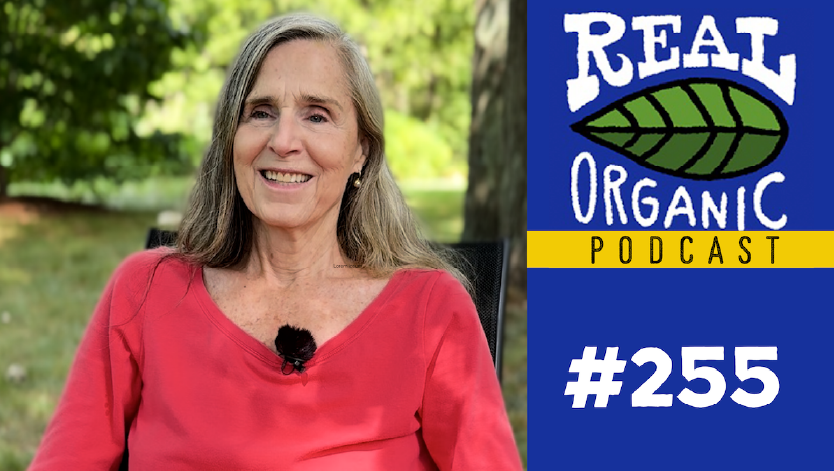

Episode #265
Maria Rodale: Family Lore And Organic Farming Trials
Maria Rodale joins us to connect personal history with field-scale evidence, starting with how her grandfather J.I. Rodale’s health quest led him to champion living soil and publish Organic Gardening and Farming in the early days of the movement and finishing up with her dad Bob’s rganic farming trials – which have become one of the most important, and most misunderstood, parts of the modern organic story. Maria explains what these long-running trials suggest about resilience, carbon, and farm viability, while also naming the social and economic forces that keep many growers stuck in the chemical paradigm, even when the science points elsewhere.
Our Maria Rodale interview has been edited and condensed for clarity:
You can subscribe and download episodes of our show through your favorite podcast app, our YouTube channel, or stream the audio-only version here:
Dave Chapman interviewed Maria Rodale online in the winter of 2025:
Dave Chapman 0:00
Welcome to the Real Organic Podcast. I’m talking today with Maria Rodale. Maria, you are part of the most famous family in organic farming in America. Your grandfather, J. I. Rodale, really brought organic farming to the United States from England. Of course, there had been organic farming in this country, but as a political movement, he was the first.
Dave Chapman 0:33
Can you tell me, out of the annals of family history, how he came to become an organic champion?
Maria Rodale 0:41
I would love to, but first, let me just say it’s great to be here and be talking with you on the Real Organic Project Podcast.
Dave Chapman 0:49
Thank you.
Maria Rodale 0:52
He was very curious about everything and also determined to break the health curse of his family, which was a lot of people dying very young of heart attacks and other illnesses. He went on a healing journey to figure out how to be healthy.
Maria Rodale 1:23
He read a lot of books, and it wasn’t until he read Sir Albert Howard’s book that he made this connection in his brain that how you grow food determines how healthy the food is, and then how healthy you are.
Maria Rodale 1:39
He also, at the same time, wanted to get rich. He was a poor Jewish guy from the Lower East Side of Manhattan. He wanted to get out of Manhattan and make a lot of money. He read Horatio Alger and John D. Rockefeller. He wanted to make his mark in the world.
Maria Rodale 2:02
He started by buying a farm in Connecticut. Then, because he married my grandmother, and she was from Pennsylvania, they ended up settling in Pennsylvania, also for economic reasons, because he and his brother had an electronics business. During the Depression, labour and buildings were cheap in Emmaus, Pennsylvania.
Maria Rodale 2:32
He started experimenting. He started eating food that he grew himself, and he started to feel better, and that’s when he said, “I want to launch a magazine called ‘Organic Gardening and Farming,'” which he did in 1942.
Dave Chapman 2:54
In the organic movement, that’s early. When did Albert Howard’s first book come out? I think that was “An Agricultural Testament.”
Maria Rodale 3:05
I think it was in the 20s or 30s.
Dave Chapman 3:09
It had to be late 30s, I think. I’m curious, how did your grandfather find Albert Howard? Did he read a book?
Maria Rodale 3:18
He read about it in British Health magazine, and that’s how he found out about the book. He was a voracious reader and always exploring. He read Sir Albert Howard’s book. Then he started corresponding with him, so that Sir Albert Howard was part of the launch of “Organic Gardening and Farming” magazine. One of my grandfather’s greatest regrets was that he never got to meet him.
Dave Chapman 3:52
Never got to meet him in person.
Maria Rodale 3:55
Yeah. There were other parts of the movement happening in and around Pennsylvania. The Pfeiffer Institute with biodynamic agriculture was happening as well, but it was the act of publishing a magazine that spread the word that really made him the leader of that movement.
Dave Chapman 4:24
I’m curious; did he connect with Pfeiffer Institute?
Maria Rodale 4:30
As I’ve told you, I’m writing a history of the organic movement in America, and this is something I have not quite pinned down yet, so I have no evidence of it as of yet.
Dave Chapman 4:42
It’s just interesting how these early people wove together or didn’t, and developed almost in isolation. Do you happen to know if he connected with Lady Eve Balfour?
Maria Rodale 4:57
I don’t think in person, but he definitely revered her book. Her book, “The Living Soil,” didn’t come out until after Organic Gardening and Farming magazine started publishing. I think that was published in 1943 or 1944. They were all fast friends, probably by correspondence than in person.
Dave Chapman 5:25
That book is out of print now, and I was thinking Rodale Press ought to reprint it, because somebody wrote me – I cited it in the interview we released Sunday – and they said, “I can’t get the book. I’ve been hunting for it, and the only copy costs $240.” It was a very readable book, very interesting.
Maria Rodale 5:50
As you know, Rodale Press doesn’t exist anymore. The Rodale Institute is considering publishing books, but the nonprofit is what exists now, not the printing and publishing company.
Dave Chapman 6:06
I was going to go there at some point, so let’s just check in on that. I believe it was Hearst who bought Rodale Press. I didn’t know they dropped the name.
Maria Rodale 6:21
We changed the name of the company from Rodale Press to Rodale Inc in the early 2000s because we weren’t actually printing anything; we were just publishing, and we were also getting into digital and things like that.
Maria Rodale 6:36
But we sold the publishing company in 2018 to Hearst, and they kept the magazines and then sold the books to Penguin Random House. Rodale Books still exists at Penguin Random House.
Dave Chapman 6:55
Things keep moving around. Just to go back to – I’m not even sure how you pronounce it. I’ve read it so many times. Emmaus?
Maria Rodale 7:05
Emmaus.
Dave Chapman 7:06
Going back to Emmaus, where J. I. and your grandmother – and I don’t know her name. What was her name?
Maria Rodale 7:14
Anna.
Dave Chapman 7:14
Where they had a small farm, and then they decided to start a magazine, both to spread the gospel and also to make some money – to make a living.
Maria Rodale 7:27
Yeah. My grandfather and his brother set up the electrical factory in Emmaus. He actually started publishing other magazines and books before he published Organic Gardening and Farming. He wanted to be a gentleman publisher. But Organic Gardening and Farming was the first magazine that really had a mission, made a difference, and stuck around for a long time.
Dave Chapman 7:59
He became a famous spokesperson. He went out and spoke at a lot of places. I told you before we started that Eliot Coleman told me that he testified very eloquently to Congress about the Delaney Clause, which is a rule that they cannot include carcinogenic substances as ingredients for processing. Yet, of course, they do. The clause has been ignored quite a bit since then.
Dave Chapman 8:34
What was that like? How old were you when he died?
Maria Rodale 8:38
I was nine when he died. What’s been interesting is not only was I only nine when he died, but during the greater part of my life, I was focused on the business, not the organic industry. Writing this book has been really like putting all the pieces together and learning about the things that I didn’t know about.
Maria Rodale 9:04
You’re not born knowing what your parents knew or what your grandparents knew; you have to study it. I remember him as a person, less than a public figure.
Dave Chapman 9:19
What was he like as a person?
Maria Rodale 9:21
He was funny and rude – he wasn’t afraid to say what he thought. He was not a gardener or a farmer. He was always in a suit or shirt sleeves. He just was filled with joy, laughter, and lots of crazy ideas. I grew up on his organic farm, and it was just a magical, wonderful place to grow up.
Maria Rodale 10:02
They were artists. Also, my grandmother was a painter. There was a sculpture garden, beautiful landscaping, and lots of music and art that filled the house. It wasn’t like they were hippies. They were not hippies.
Maria Rodale 10:18
In fact, at first, they were appalled by the hippie movement, until they realized that they were helping them spread the word. Then my grandfather fell in love with them.
Dave Chapman 10:30
That’s interesting. What appalled them at first?
Maria Rodale 10:34
The same thing that appalled most adults – long hair, dirty…
Dave Chapman 10:43
It certainly exploded Organic Gardening and Farming. When I was a kid, my best friend’s mom had an organic garden. She read Organic Gardening and Farming every issue, which was pretty similar to the last issue. But from that, she became a very good gardener, and she grew incredible food.
Dave Chapman 11:12
I was amazed when I look back that as a teenager, as a 16-year-old, we loved the food that she served us. They were who they were, and they made dinner kind of a sacred space, and they really paid attention to eating good food, and not in a heavy way, it was just delicious.
Maria Rodale 11:32
That’s something that I think has been an area of misperception about the organic and health movement. It’s always been getting co-opted by different sects, whether it’s the hardcore health nuts, who don’t want any fat or anything, even vegetarians.
Maria Rodale 12:03
Not that there’s anything wrong with any of these groups, but the original concept was delicious food grown as locally and organically as possible. So they weren’t vegetarians, and they weren’t eccentric in what they ate; they just wanted it really fresh, clean, and good.
Dave Chapman 12:36
Fresh, I get. Local, I get. Clean is more complicated. Obviously, without pesticides on it. But I think it also meant to him, because certainly that was in the magazine a lot: that living soil, how that soil was fertilized, had a lot to do with how the food turned out.
Maria Rodale 12:57
Yeah, absolutely. I don’t think hydroponics was invented back then, so it was all about the soil. He really was more concerned about health than actually gardening and farming. When he launched Prevention magazine in 1950, that magazine took off right away and became very profitable.
Maria Rodale 13:25
Organic Gardening and Farming magazine almost never made a profit in its long life, but it was mostly the passion project of my father. My father was the one who was like, “We can’t shut this magazine down.” The most important thing to my grandfather was health, and to him, that meant no added chemicals, pesticides, or fertilizers, and also supplementing when necessary for nutrition.
Dave Chapman 14:02
He did a lot of supplements, didn’t he.
Maria Rodale 14:05
He was a big vitamin taker.
Dave Chapman 14:11
I believe he also was a pretty strong anti-vaxxer.
Maria Rodale 14:19
I haven’t found evidence that he was an anti-vaxxer. I have found evidence that he questioned them, yeah, but definitely we were all vaxxed. This was not like the hill he was going to die on. He was really against fluoride, not because fluoride itself was the issue, but because it was artificial fluoride that was being put in waters.
Maria Rodale 14:43
He didn’t question that fluoride was important for healthy teeth, but he was very upset when the government was putting artificial fluoride into water.
Dave Chapman 14:56
He was looking for as much as possible a natural diet, unprocessed foods, not agricultural chemicals, and to him, this was the path to health.
Maria Rodale 15:10
Yes.
Dave Chapman 15:11
Now, he did not live to be an old man, but…
Maria Rodale 15:14
He died in 1971; he was 73 years old. He lived longer than all his siblings.
Dave Chapman 15:23
All his siblings, indeed.
Maria Rodale 15:25
Except maybe one. I think there was one woman who lived longer than him.
Dave Chapman 15:29
What age was his father when he died?
Maria Rodale 15:33
Fifty years old.
Dave Chapman 15:35
I come from a similar place. My father was 42 years old when he died. He was a farmer and it seemed awfully young.
Maria Rodale 15:45
His brother, who was his best friend and business partner, actually died of a heart attack at 54 years old, so this was a real fear for him.
Dave Chapman 15:55
Sure. J. I. did pretty well considering the family history.
Maria Rodale 15:59
Yeah.
Dave Chapman 16:02
Can we talk a little bit about your dad? Does the world call him Bob or Robert?
Maria Rodale 16:08
Bob.
Dave Chapman 16:09
I thought so, but I didn’t want to assume. What was your relationship like with him at first?
Maria Rodale 16:20
By the time he died, we were very, very close and very aligned in our thinking. Growing up, he was missing a lot of the time because he was traveling. He was an Olympic skeet shooter. He was off around the world, training for shoots and winning world championships.
Maria Rodale 16:49
Most of our vacations were at gun clubs. If we went on an actual vacation, he always had to go home early because he didn’t want to leave the business. He was a little anxious and not as present, but that was the era also.
Maria Rodale 17:15
Then once I got through my horrific teen years, that is when we started to connect intellectually and spiritually. He was really exploring spiritual stuff. In fact, I just found a postcard he sent me while I was in boarding school.
Maria Rodale 17:40
What I didn’t know, what I learned from interviewing Eliot Coleman for my book, was that Eliot had taken my father and a couple of other people on a tour of organic gardens in Europe. This was a postcard I got and didn’t realize what it was. It was from his trip in Europe.
Maria Rodale 18:03
He was like, “The Europeans are very spiritual about organic farming. Remind me to tell you about body dowsing when I get home.” I don’t ever remember him telling me about body dowsing.
Dave Chapman 18:21
That was actually a famous trip. It wasn’t just a couple of other people; it was USDA scientists. Your dad was the volunteer driver for the entire trip because he liked to drive. They weren’t just visiting gardens; they were visiting big farms, and the scientists were blown away because there was the living proof, undeniable, that this worked. They had to rethink everything.
Maria Rodale 18:46
I didn’t know about that till I heard it from Eliot, because I was off in boarding school.
Dave Chapman 18:55
Your dad was building the business into a much bigger business in that time.
Maria Rodale 19:02
Building the business, definitely. Then really his priority was proving that organic farming was a viable way to farm. That’s when he started the farming systems trial at the Rodale Institute in 1980, and that was his true passion.
Dave Chapman 19:23
What came of those trials? Tell me about them. I know about Lady Eve’s trials; tell me about Bob Rodale’s trials.
Maria Rodale 19:32
Lady Eve’s trials were really important, but they weren’t scientifically, independently verifiable. My father was very obsessed with getting it as scientific as possible. He hired Dick Harwood, who was a PhD out of one of the land-grant universities, and they set up this side-by-side study.
Maria Rodale 19:59
Originally, it was called the transition study because he wanted to study how long it takes for an organic farm to heal – to become safe, and get rid of all the chemicals, because the farm he bought had been chemically farmed for a long time. Then after about five years of that, he realized, “Okay, it takes three years.”
Maria Rodale 20:26
That’s where he came up with the concept of regeneration, because he saw that “organic farming is actually regenerating, not just the soil, but the people who are working on it, the biodiversity is all regenerating.”
Maria Rodale 20:43
It’s still actually going on today. Come visit at the Rodale Institute. We’ve expanded it to include, obviously, GMOs, because we want to compare best-practice chemical farming to best-practice organic. We have no-till versus low-till plots. We’re testing tillage.
Maria Rodale 21:07
Then we also have what I call vegan organic, which is green mulches versus animal manure or brown mulches and fertilizers. We’re doing all these variables and testing the water as it runs off. From this study, people have come from all around the world to see it and to learn from it, and it’s been replicated around the world as well in other places.
Maria Rodale 21:37
We were one of the first to discover that organically farmed soil stores more carbon than chemical soil. It is definitely more resilient in times of drought and flood because the soil is more absorbent. It’s alive, of course, and it’s also more profitable for farmers. Come visit.
Dave Chapman 22:09
Yeah, I would love to, Maria. I’m curious about the last point, because, of course, that’s a bit of a crusher. I know lots of organic farmers who are desperately struggling. I also think, if it’s more profitable, why doesn’t everybody go there?
Maria Rodale 22:29
This is the area that’s been most interesting to me personally, and which I examined in my book, “Organic Manifesto: How Organic Food Can Heal Our Planet, Feed the World, and Keep Us Safe,” because I wanted to understand if it works, why aren’t people doing it.
Maria Rodale 22:45
I actually did focus groups because – my background is in business, marketing, and strategy – so I was like, “Let’s do focus groups with chemical farmers to find out what’s stopping them.” The first thing I found out is that chemical farmers are the most focused group of people in the country. You have to pay them to show up, and preferably feed them to show up, because they get so many invitations from chemical companies and things like that.
Maria Rodale 23:22
What I learned is that they are so emotionally plugged in to the ad campaign, “We have to feed the world, and the only way to feed the world is through chemicals,” and they’re surrounded by a system that is all they know how to do.
Maria Rodale 23:41
When you ask them, “Where do you get your information about farming?” they say, “Well, from my chemical dealer.” They’re literally in a bubble that is hard for them to get out of. The only time that they actually do get out of it is when somebody in their family gets sick and they start to question.
Maria Rodale 24:08
Then, for a lot of these guys, especially the older men, they don’t want to feel like their whole life was spent doing something bad. There’s the science, but the emotion is what really drives behavior. That’s our challenge – to get through on an emotional level to everyone.
Dave Chapman 24:34
Obviously, the people promoting that bubble, building that bubble, are making a great deal of money out of it. It is their whole livelihood. It is their profit. I see a lot of people in the organic movement, and they are doing this because they want to do the right thing. They want to do something good.
Dave Chapman 25:01
I’m not saying that people who are chemical farmers don’t want to do the right thing, but I’m saying they’re being convinced by people who, I ultimately think, don’t care about that. They care about making money.
Maria Rodale 25:14
Yeah. They feel like they’re feeding the world. That’s their “I feel good about myself and what I’m doing.” But at the end of the day, it’s their financial livelihood. They’re also stuck in that financial life because a lot of them have a lot of debt, and the bankers aren’t willing to finance switching to organic because they see that as very high risk.
Maria Rodale 25:51
They also don’t understand Economics 101, which is that the more you grow of a commodity, the lower the price. It’s this hamster wheel that you can’t get out of.
Dave Chapman 26:09
There seems to be a very big difference between the farmers and all of the businesses that support that system with the inputs, the equipment, the chemicals; they’re very different. You say that the big justification for all of that is that we’re feeding the world. Are they?
Maria Rodale 26:30
No, not at all. They’re feeding cars, obesity, and their wallets.
Dave Chapman 26:45
Maria, are you familiar with the Nature article that says basically that organic farming is bad for the climate, and chemical farming is better because it’s more intensive, and so you can allow more land to be rewilded?
Maria Rodale 27:09
The one thing that I have seen over and over again, both in my real life and in the research, is that the chemical industry will put so much money and effort into buying research and ad campaigns to convince people, whether it’s on social media or in journals, that they’re doing the right thing – organic is bad.
Maria Rodale 27:37
It’s so classic, and it’s almost funny, but it’s not funny because people get confused. That’s just one of their tactics. It’s like the cigarette companies, and it’s the exact same tactic.
Dave Chapman 27:54
“The Merchants of Doubt.” There’s a wonderful quotation: a tobacco executive said, “Doubt is our product.” As long as they could keep enough public doubt about whether cigarettes were actually killing you, they could keep going just as they were. Finally, the dominoes just fell, and they couldn’t.
Maria Rodale 28:26
I feel like we’re getting close to that tipping point with organic in that there is so much cancer happening. I was just talking with Art Cullen from Iowa. He’s a reporter and Pulitzer Prize–winning author from Iowa. Iowa has the second-highest cancer rate in the country, and Kentucky has the highest rate. Their water is polluted. It’s a disaster. At what point do people just say, “Enough?”
Dave Chapman 29:11
Yeah, we’ll find out. We haven’t quite hit it yet.
Maria Rodale 29:20
Hopefully after they read my book, which won’t come out for another two years, but still.
Dave Chapman 29:32
Let’s go to the Twinkie debate for a minute.
Maria Rodale 29:35
The Twinkie debate?
Dave Chapman 29:37
The Twinkie debate. There was a famous interchange between two people on the National Organic Standards Board, Gene Kahn, founder of Cascadian Farms, and Joan Dye Gussow. They were both members of the National Organic Standards Board during this period. It was quite a while ago.
Dave Chapman 29:57
Joan said, “You can’t have an ‘organic’ Twinkie. Organic means whole food. It means something that’s healthy. It doesn’t mean just having ingredients that happen to be certified as organic.” Gene said, “I reject that completely. Organic is not your mother, and it should be able to compete on junk food as well as on whole food.” Do you have an opinion about that?
Maria Rodale 30:29
I really do, because I grew up with so many mixed messages around food and denial of things. I didn’t even know what a Twinkie was till, I think, that conversation happened. I was not allowed to have a lot of things, but then I also had a lot of things. There was not a clear sense of what is good and what is bad.
Maria Rodale 31:02
Chemicals are bad, but also sugar is bad, but then it’s not bad. It was very chaotic. I definitely, as a child who felt denied candy, wanted to taste everything. I wanted to know, what is this thing? How good is it?
Maria Rodale 31:30
In Pennsylvania, we don’t have Twinkies as much as we have TastyKakes. TastyKakes are awesome. As I’ve grown up, what I’ve realized is that they’re two separate things. There’s chemicals that go into how we grow food, how we tend lawns and golf courses. They are all the same, bad chemicals that should be eradicated.
Maria Rodale 32:00
Then there’s health, which is a very different thing and a very personal thing. Now that I’m grown up and I’ve got kids and grandkids, a little bit of sugar, a little bit of organic cake, great. But it’s not the end of the world. That’s what I meant by in the early days, there were a lot of these factions. I think each person’s body is, on some level, unique and needs to find its own definition of health.
Maria Rodale 32:44
For some people, that’s veganism; for some people, that’s paleo. It really is a personal decision. I think whole grains are great and people should eat them, and vegetables are great and people should eat them, but everything should be organic. Does that make sense a little?
Dave Chapman 33:12
It does make sense, Maria, but I’m trying to think about the challenge that we face. The challenge that we face is an overwhelmingly bad food system in which the majority of the food that we eat is ultra-processed. It’s almost unthinkable to me, because I don’t eat almost anything that would qualify as ultra-processed.
Dave Chapman 33:34
That’s, as you say, my personal choice. I don’t try to push that on the people I love and hang out with, but I do see that what is going on is not just innocent. It’s not just about personal choice. That’s the great line of defense. We’re not trying to take away people’s personal choice.
Dave Chapman 33:54
Actually, they are. They are trying to control what people eat. They’re not doing it by making it illegal to eat whole food, but they’re doing it by how they control the food system.
Maria Rodale 34:06
I definitely agree with that, which is why, if you want to eat a Twinkie, you should make it from scratch using organic ingredients. But the reality is, a lot of people don’t have access to real healthy food. The processed stuff is the only thing that they can really afford.
Maria Rodale 34:37
In fact, I was watching the documentary “King Corn,” and it was done a while ago, over ten years ago, I think. But the guys in the film actually went and found Earl Butz in his retirement home. They were like, “Are you happy with how things turned out?” He goes, “Absolutely, because what we were trying to do was make food as cheap as possible, and we succeeded. Food is as cheap as possible.”
Maria Rodale 35:12
Unfortunately, most people think about food in terms of money more than in terms of quality. For a lot of people, that’s all they can afford. It’s a whole systemic dilemma that we’re in.
Dave Chapman 35:29
Absolutely. I would be suspicious of the idea that bad food is cheaper. I think it’s cheaper because we, the taxpayers, subsidize it.
Maria Rodale 35:39
Exactly. But you have to realize, if you’re on a very tight budget and you’re going to the supermarket or Dollar Tree for your food…
Dave Chapman 35:49
You have very few choices. But I do think that the reason the choices you’re offered are so bad is because, as a society, we’re supporting the bad food. We make the corn so cheap because we pay them to grow it that way.
Maria Rodale 36:13
Yeah, it’s terrible.
Dave Chapman 36:18
The question is, how can we change the food system so that it is not the low-cost choice?
Maria Rodale 36:31
Are you asking me for my opinion on that?
Dave Chapman 36:33
Sure. Go ahead, Maria.
Maria Rodale 36:38
That’s the huge question. It’s a combination of political change, economic change, but it all starts with… This is what I think my grandfather and father understood most: that it’s individual people changing. When individual people understand what needs to happen and how to do it, we’re unstoppable. That’s what changes the world.
Maria Rodale 37:14
That’s why that confusion is so dangerous, just like you said, doubt. I’ve been doing a lot – again, a lot – of talking with just regular moms and regular people, and like, “Oh, what do you think of organic?” They’re so confused about it because they get all these mixed messages.
Maria Rodale 37:34
At the end of the day, it’s about trust, and how can people trust their food? But with the political situation the way it is now, how can we trust anything?
Dave Chapman 37:54
Yeah, I agree, but it will never be simple, because there’s too much money to be made by challenging organic. We just have to give up the idea that it’s not fair, or that they shouldn’t do that. The tobacco companies did what they did because they were making gazillions of dollars. There are other people making even more gazillions of dollars.
Dave Chapman 38:22
Although tobacco did move into ultra-processed foods in a significant way when it became illegal for them to promote them quite so adamantly in the US, they switched to Twinkies. That’s with the change.
Dave Chapman 38:36
Let’s change the channel just for a minute. Let’s talk about the great certification debate. Now, it’s not such a public debate right now, although I seem to be getting a great deal of news about it. But I interviewed Patrick Holden. I don’t know if you know Patrick, but he was called one of the Young Turks in the Soil Association.
Dave Chapman 39:00
Lady Eve Balfour was the founder and the person most respected. It was her opinion that there should not be organic certification. She thought that that would undercut and even demean organic because it would become so tarnished by economic forces trying to manipulate what counts as organic.
Dave Chapman 39:29
Patrick had the opposite point of view, which is that if we are going to change the world, we have to make this something that is available to most people, and to do that successfully, and to get into the stores and make it so people can get the food they want, we need certification.
Dave Chapman 39:49
I take the point of view that they were both right. I’m curious what your response would be.
Maria Rodale 39:59
What I’m finding in my research is that there’s a lot of people in the organic movement who see – and I would put what Lady Eve’s comments were, by the way, I have a daughter named Eve, named after Lady Eve, so I’m a fan – organic as more of a spiritual-like purity. It’s not just about the soil; it’s about the whole way of life, and a way of being in the world. I’m all for that. That’s great.
Maria Rodale 40:43
But I’m also a businesswoman, a mom, and a pragmatist. I know how hard it was to get that label, and it’s not perfect, but for the average person, that label is essential. That label is what has moved the movement forward faster than almost anything. I would say, actually, the things that people talk about the most, a couple of things, is what moved the movement forward.
Maria Rodale 41:21
One was Silent Spring, the book. The second was the alar campaign, which I was involved with back before the label. Then the third was actually having a label. These are the things that push us forward, and each thing that pushes us forward gets us a little bit closer to a better world and a more perfect world.
Maria Rodale 41:47
But I don’t want a perfect world for just the Lady Eves on their estates or even the Eliots on his perfect farm; I want it for everybody. That takes a very diverse way of thinking about the whole movement. Actually, diversity is a fundamental benefit of organic. Organic soil is diverse. An organic landscape is diverse.
Dave Chapman 42:20
I don’t think you’ll get much disagreement about that. But let’s go a little bit deeper. Certainly, part of the success of organic is because large corporations have come in and embraced it.
Maria Rodale 42:43
Because people have asked for it. The market is there.
Dave Chapman 42:47
The market is there. Driscoll’s is a perfect example. Over 70% of the organic berries sold in America come from Driscoll’s. Organic is less than 30% of what Driscoll’s sells, so the rest – about 70% – is chemical berries, with all the problems.
Dave Chapman 43:13
You’ve got a company, but 70% is clearly a monopoly. What’s wrong with that? Because we go, “Great, look at that.” You can go and get organic berries in virtually any supermarket in America now. It’s amazing. You can probably get organic blueberries in any large supermarket in Kansas or Mississippi. It’s amazing. It’s not just this coastal elite thing.
Dave Chapman 43:44
But the reason that hydroponic is certified as organic is because of Driscoll’s, in my opinion, and I was there watching it happen. As Zephyr Teachout said, “The problem with making a deal with the devil is that you won’t like what happens next, and it won’t be organic anymore. It will be something else.”
Dave Chapman 44:09
That’s my question: is this dream of your grandfather, your father, and you in danger of being lost because we’re successful?
Maria Rodale 44:26
Absolutely not. Now let me speak as a businessperson, and also from a lot of farmers I know. There’s this concept of testing. You don’t just say, “This is what I’m going to do, and I’m going to do it all on all my acres, or on all my business. I’m going to test – I’m going to test into this market. I’m going to experiment…” so you don’t risk your whole business.
Maria Rodale 45:00
You want to be cautiously optimistic and test that things are viable or not and that they’re going to continue to make money. A lot of farmers I know who are transitioning start with a few dozen or a few hundred acres out of their thousands. Then they say, “Oh, okay, I can now see how to make this happen.”
Maria Rodale 45:26
The fact that Driscoll’s is a monopoly has nothing to do with organic. That has to do with business, economics, and other things. My issue with Driscoll’s is actually probably more how they treat their workers than whether it’s hydroponic or not.
Maria Rodale 45:47
So two things. One, my granddaughter is coming over next week, and my daughter said, “Can you pick up some strawberries?” Because that’s what she wants on her birthday cake. I’m going to buy the Driscoll’s strawberries because that’s all that is available. I’m going to buy them organic because I don’t want chemicals in her precious little body. I don’t care if it’s hydroponic; I just don’t want those chemicals in her little body.
Maria Rodale 46:21
I think I’ve also mentioned to you in the past that this is what the Regenerative Organic label that the Rodale Institute created with Dr. Bronner and Patagonia is all about, which is ensuring that workers, fair wages, human rights, animal welfare, and soil are part of the whole process. The Regenerative Organic label is soil-based. That’s progress. We’re making progress.
Maria Rodale 46:53
I think my grandfather would be stunned to see how far we’ve come. Even my father. They never walked into a Whole Foods. They didn’t know what Amazon was. That doesn’t mean those are good outcomes, but they’ve changed how people have access to things, and they’ve enabled more people to have access to things.
Dave Chapman 47:20
Okay. Let me ask you, you wrote “Organic Manifesto: How Organic Farming Can Heal Our Planet, Feed the World, and Keep Us Safe.” About 14 years ago, it came out. The same question I asked Michael Pollan, I’m asking a lot of people this question now: in those 14 years, has the food system gotten better or worse?
Maria Rodale 47:43
Both. I think there’s a lot of reasons why it’s both. Even just from a government regulation standpoint, like the lack of regulations on all food – not just organic – causes more foodborne illnesses and more chemicals. But on the positive side of that, I think more studies have come out. There are a lot of studies right now showing the damages from ultra-processed food that people are paying attention to. That’s bad, but good.
Maria Rodale 48:25
Then on the organic side, I was just in New York City last week and found out about a small little store called Happier. I never heard of it. A friend of mine told me, “Oh, you should go look at the store.” Sure, it’s exclusive, but everything was organic, and it was fully stocked. It was bigger than a health food store, smaller than a Trader Joe’s on Canal Street. It was packed, and the food was great.
Maria Rodale 49:07
There are things happening all the time that would have never happened 14 years ago. That’s happening all across the country, I think. In 14 years, farmers markets have exploded. They were just starting back then.
Dave Chapman 49:30
I see this from the perspective of my farm, and it’s much worse. Not even not better; it’s much worse because I’m losing access to market after market after market. You said the only ones I could get were from Driscoll’s. Well, that’s right. That’s the impact of a monopoly.
Dave Chapman 49:50
That’s not because everybody says, “I want Driscoll’s;” that’s because Driscoll’s makes a deal with the supermarket saying, “If you want our strawberries, you will not carry competition.” I experienced it with tomatoes, selling into stores, and suddenly they don’t want our tomatoes because they got too many tomatoes.
Dave Chapman 50:10
The other nine pints of little guys they get are all from one company, and they’ve made a deal with that store, “If you want our tomatoes, you won’t carry anybody else’s.”
Maria Rodale 50:24
I would say that’s not a function of organic working…
Dave Chapman 50:29
I didn’t ask if it was a function of organic; I asked, is the food system getting better or worse?
Maria Rodale 50:34
I would say that’s more of a business challenge. I think a lot of organic farmers are facing this, where you can’t just do one thing anymore, and you have to constantly be adapting and changing. To make a living, you can’t just grow tomatoes anymore. You have to figure out ways.
Maria Rodale 51:03
Maybe it’s the Real Organic Project tomato sauce that then gets into supermarkets or things like that, so there has to be this constant innovation and evolution that happens on all sides. That’s just business 101, really.
Dave Chapman 51:23
I’m mourning the loss of capitalism, amazingly, Maria. Imagine that, because it’s not where I came from, but as I’ve come to learn more about it, I wouldn’t say that I’m a great proponent of capitalism, but I would say that what we have is not capitalism.
Dave Chapman 51:41
It’s not; it’s monopoly. It’s growing monopoly, growing oligarchy, and growing reduction of diversity and choices in the marketplace. That’s true of organic, which is getting bigger and bigger in its sales, but the choices, I believe, are getting less and less.
Maria Rodale 51:59
I would respectfully and politely disagree because, as a shopper, and as… We have a very wonderful, small, but seven or eight store chain in Pennsylvania called Kimberton Whole Foods. It is not related to Amazon-owned Whole Foods. It is their own thing. They were whole foods before Whole Foods was Whole Foods.
Maria Rodale 52:26
I was talking to Terry Brett, who is the owner and founder of that, and I said, “I am an Olympic shopper. That is my sport. I will go to six or seven different stores and farm stands to get what I think is the best in every place.”
Maria Rodale 52:49
That is a challenge for me because I cannot just go to one place. But the choices that I can have as somebody who loves food, loves to cook, and loves fresh organic foods are amazing. I grew up trying to buy this stuff…
Dave Chapman 53:13
Absolutely. There are things that, when I was a kid, you could not get in the supermarket. There was no such thing as whole wheat flour. There was no such thing as whole wheat bread. You still probably cannot get whole wheat flour or whole wheat bread, but you can get stuff labeled as such.
Maria Rodale 53:32
You can.
Dave Chapman 53:32
I know, but whole wheat flour is not whole wheat. They took out the germ because they need to bag it. It would degrade and become rancid. So if you want whole wheat flour, you pretty much have to grind it yourself, unless you happen to live close to somebody else who is grinding it. It is complicated.
Dave Chapman 53:49
That is exactly what I mean – these are complicated things. I do not believe that the bread you can buy tastes even vaguely like the best bread that can be made. It is just that bread is not available on store shelves.
Maria Rodale 54:04
Two of my daughters and I have gone gluten free because they get migraines, and I get acid reflux and cough. I think that is a function of the use of Roundup for desiccation on bread wheat, and the genetic breeding so that it is more productive, but it is not as digestible. This is why gluten free is everywhere. Who even eats bread anymore? Good for you. Lucky you.
Dave Chapman 54:47
I grind it, and I bake it, and it is delicious. I will bet you would be fine with it, and your daughters would be fine with it. That is an interesting question.
Maria Rodale 54:56
But unless you turn it into a business, I am not coming up to where you are to buy my bread…
Dave Chapman 55:02
I understand. So you gotta go gluten free.
Maria Rodale 55:04
…and I don’t have time to do it myself.
Dave Chapman 55:08
I get it. If you lived in Europe, those problems might evaporate. I talked to so many people who said, “Geez, I went to Europe, and suddenly I am not gluten intolerant. I can eat anything.”
Maria Rodale 55:20
I am seeing more and more Europeans who are going gluten free. I just saw on Instagram that a whole town in Italy is a gluten free town. Unfortunately, our chemical and bad breeding habits have spread around the world. We have to stop it.
Dave Chapman 55:43
Just to go back for a minute, you said something that was interesting to me – the three big turning points for organic, the things that were the big events. The first was “Silent Spring,” Rachel Carson’s transformative book.
Dave Chapman 55:59
The second was the Alar scare, in which people were getting sick from the apples that they were eating from a pesticide that was being sprayed on them. The third was certification. The first two involved scaring people. They were wake-up calls that things were not working as well as we had hoped.
Dave Chapman 56:27
One of the things that people say to me is, “You need to be more positive, Dave. You have got to reach for the stars instead of say, ‘we have got to get away from this demon that is chasing us.’” I have actually had this conversation with ROC, because they are very positive in their messaging, and I am not positive. I think there are some pretty bad things going on that people are not aware of.
Dave Chapman 56:58
The Merchants of Doubt have been very successful at confusing people, including about regenerative. Bayer loves regenerative. Syngenta loves regenerative. PepsiCo loves regenerative. If you are not going to call them out for that, then the word becomes meaningless. I am curious what you think about that. Do we have to face the hard truths?
Maria Rodale 57:28
What I did not say – one of the other founding moments – is the launch of Organic Gardening and Farming magazine. That was positive. It was not like, “Oh, we have to fight, fight, fight.” It was like, “No, just do this. Grow this. Eat this.”
Maria Rodale 57:54
My first job out of college, I was working for a progressive public relations firm in Washington, DC, that was anti-Contra, anti-nuclear, anti-everything. It was like fighting the good fight. Then halfway through the year, and my father told me I only had a year. I had to come back here. I was like, “Geez, where can I go to work that is for something instead of just against something?”
Maria Rodale 58:29
That is the moment I realized, “Oh, Rodale. Rodale Press, and Rodale Institute, is for something. It is for positive change.” There is always going to be negative, bad stuff, always. Look at just what has happened in the last 24 hours with shootings and stabbings?
Maria Rodale 58:58
People are terrible, and it is not just white people; a lot of people are terrible. All we can do is be the positive force of good. That is all we can do. That is work worth doing.
Dave Chapman 59:22
One last thing. I am just curious; Prevention, which I confess I have never read the magazine, was that relentlessly positive? Obviously, it is very positive in its message, just as Real Organic Project is very positive in its message. We are saying there is something better, it is very possible, and it is being done widely. I am just curious, was Prevention also calling out the things people should not do?
Maria Rodale 59:48
There are many different eras of Prevention magazine. The initial era was very, I would say, positive, but also balanced. Like, “Here’s what you should not do, but here’s what you can do, and here’s the research.” It was always very research-based. My grandfather wanted it to be like a medical journal for the people, so that it was understandable and easy to read.
Maria Rodale 1:00:17
But what happened later in its life – and I remember having this argument with the editor at the time – I was like, “Why aren’t you telling people to eat organic vegetables? You’re always like, eat fruits and vegetables. Why aren’t you telling them about eating organic?” He was like, “Well, we don’t want to scare them so that they do not eat any vegetables.” I was like, “Urgh.” There was definitely a disconnect there.
Maria Rodale 1:00:48
Then later, it became more of a weight-loss magazine, partly because that is what sold on the newsstand – that is what people bought. They wanted to read how to lose weight. One of the reasons I was glad to sell the company is because I did not want to be a part of that anymore. While we were publishing weight-loss information relentlessly, people were getting fatter than ever.
Maria Rodale 1:01:22
Something was not right. My heart was always on the organic and nature side of things. That was where I was passionate. I was never a runner or an athlete. Honestly, I am glad I do not own it anymore.
Dave Chapman 1:01:46
That is interesting. Everything always keeps changing. Sometimes it changes for the better or the worse, sometimes it just goes one direction or another. That is why I think it is so important that we be awake and aware so we can protect what is truly valuable and organic.
Dave Chapman 1:02:10
I think the organic movement is a great gift. It is such a valuable thing, but it can be lost. It is fascinating for me to look back at some of the twists and turns, even predating the word organic. The famous eco-fascism of Nazi Germany, where they embraced biodynamic practices. Not all biodynamic practitioners wanted to be embraced, so there was a big division in the community.
Dave Chapman 1:02:41
It is sort of everyone agreed about health and about food, but they did not agree about democracy and those little things like freedom. So good things can be used for bad purposes.
Maria Rodale 1:03:00
Right. Everything is very complicated and interconnected.
Dave Chapman 1:03:10
Yeah. When you said that about Prevention, evolving and leaving out organic, it reminded me of a lot of the modern food is medicine movement, which is wonderful. It is great. People are saying we need to get organized, and we need to figure out how to have an institutional response to ultra-processed foods, which are getting crammed down the throats of our kids to their detriment.
Dave Chapman 1:03:40
But they kind of leave organic out of it completely. When they just say, “Stop eating ultra-processed food. Eat whole foods. It is fine if it is chemically grown.” I get it – it is better, but it is not good.
Maria Rodale 1:03:57
I have very mixed feelings about the whole… I guess the way I would say it is, throughout history, as old as time, there have always been grifters who are selling miracle cures. That is just human nature. Even religion is sort of like that. Religion is like a miracle cure, of like, “You will get to heaven if you just give me money.”
Maria Rodale 1:04:42
A lot of what I think is why we are here on Earth is to sort through all that grift garbage and find what is real. What is real is good food grown organically with love, cooked with love, in balance, and it is local.
Maria Rodale 1:05:04
I remember hearing about a person in Italy saying that on one side of the mountain, they use butter for all their cooking because they had cows. On the other side, they used olive oil because they had olive trees. Where you are depends on what is really the most healthy thing for you, I think.
Maria Rodale 1:05:27
But you cannot force that on people. In a way, you have to seduce them into it, and nobody wants to be scolded to be seduced.
Dave Chapman 1:05:45
Good. Maria Rodale, thank you. We will work on, as Alice Waters said, the delicious revolution. Thank you very much for talking today.
Maria Rodale 1:05:58
You’re welcome. Thank you for all you’re doing. I appreciate it.
More Podcasts
View All Podcasts ➔