
Episode #263
Barbara Damrosch: A Life In The Garden
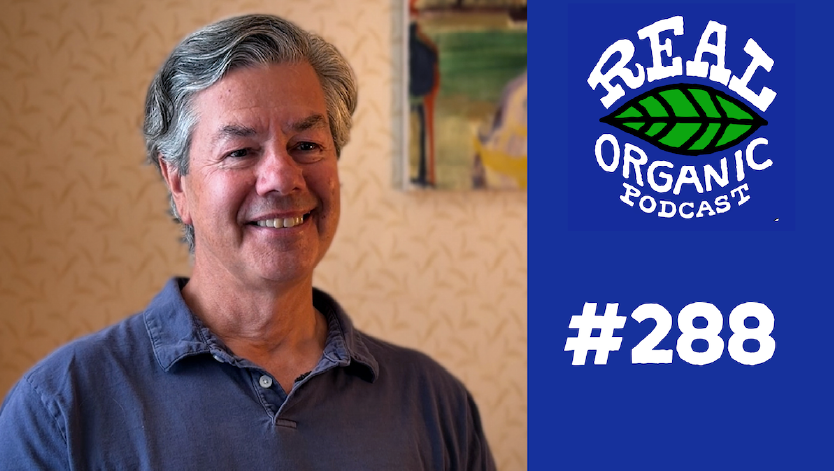
Barbara Damrosch’s new book A Life In The Garden is a conversation about growing real food the practical way: build soil, stay curious, and keep showing up in every season. Barbara’s work reached millions through her books, a long-running TV show (Gardening Naturally – still available on YouTube), and a weekly writing column for the Washington Post that forced her to explain gardening clearly – and to sometimes take on the politics behind “organic.” Here she shares some stories from her college years and life with husband Eliot Coleman.
Our Barbara Damrosch interview has been edited and condensed for clarity:
You can subscribe and download episodes of our show through your favorite podcast app, our YouTube channel, or stream the audio-only version here:
Dave Chapman interviewed Barbara Damrosch in Maine in the summer of 2025:
Barbara Damrosch 0:00
Welcome to the Real Organic Podcast. I am talking today with my longtime friend Barbara Damrosch. Barbara, I’ve been wanting to do this interview for a long time, and you’ve always put me off, but this time, I got you.
Barbara Damrosch 0:13
I don’t remember ever putting you off. Maybe I was away.
Dave Chapman 0:19
Good. We’re celebrating the release of your newest book, “A Life in the Garden: Tales and Tips for Growing Food in Every Season.” It came out last October. It’s interesting, because Linley wanted to do this interview because your earlier book, “The Garden Primer,” was the book that Linley bought when she was 12. It started her life of gardening and farming. She really read it. It’s all bespattered, and it’s been watered many times.
Barbara Damrosch 0:51
Oh, I love to see it all be splattered.
Dave Chapman 0:53
Yeah, it’s a book that is [inaudible 00:56] the life.
Barbara Damrosch 0:56
Yeah, it needs to go out into the garden with you.
Dave Chapman 0:58
It’s been in the garden. It’s great. When did “The Garden Primer” come out?
Barbara Damrosch 1:05
Oh, boy, 1988 I think 1988. It’s long time. Something like that.
Dave Chapman 1:15
You wrote another book in between?
Barbara Damrosch 1:20
Before “The Garden Primer,” I did “Theme Gardens,” but that was only ornamentals. It was more like landscaping with different themes, like a winter garden or a children’s garden, or something like all of those, which was fun.
Barbara Damrosch 1:37
At that time, I was making my living writing and also doing landscaping for people, landscape design. I had a business in Connecticut, so it was logical for them to approach me and say, “Would you write something?”
Barbara Damrosch 1:58
Then after “The Garden Primer,” Eliot and “I did a book together.” I’m not sure whether that would be a proper description. It was supposed to be… They called it “The Four Season Farm Gardener’s Cookbook,” but it wasn’t just a cookbook, because we wrote the part about how to grow.
Barbara Damrosch 2:26
We wanted a growing and cooking title, but they went with this. It was terribly misleading. I don’t think it even did very well, but people who like it, like it. Then that came along. The newish one is just about growing food. In “The Garden Primer,” you give everything from food to flowers, to houseplants, to the lawn. It’s all in there for a beginner, but this is for a beginner, and it’s just about growing food.
Barbara Damrosch 3:06
I have this mission to get people to try growing their own food. I know there are certain obstacles. If you live in a city, you’ve got to find some kind of community garden setup. Or, if you don’t have a yard, maybe somebody down the road or down the block has one, and you can share the work and the food. There are ways around it. You have to want to do it.
Barbara Damrosch 3:32
I think once you start doing it, a lot of people get really hooked. Part of it is the food itself, because there are certain flaws, I should say, in our food system. It’s a bit industrial. You don’t always know what’s in your food. You can go to a farmers market and find an organic grower, or somebody you trust, somebody whose farm you’ve looked at. That does help.
Barbara Damrosch 4:01
But it’s even better, I think, when something is right out there. You can pick that lettuce and pick that tomato, put it right into your meal, and enjoy it. Also, enjoy the fact that it gets you outside and helps keep you fit. It’s not as hard work as people think.
Dave Chapman 4:21
It’s wonderful work. It’s interesting because, of course, you have been a partner in Four Season Farm for many years. You made your living selling vegetables to people who weren’t growing their own.
Barbara Damrosch 4:33
Yeah, I know. Exactly. I often say, “I have nothing against going down and getting your food at the farmers’ market.”
Dave Chapman 4:41
That’s right. Can we go back just a little bit? You mentioned your landscaping career, but before that, you were a college professor?
Barbara Damrosch 4:57
Yes. “Professor” is a little exaggerated. I taught at four colleges, and it wasn’t until the fourth that I even got to the stage of instructor, because I was a grad student. I was making money doing that and also getting my teaching chops bettered.
Barbara Damrosch 5:24
I was teaching English and comparative literature. I did it first at the Police Academy in New York, Cooper Union, Middlebury College, and Columbia College. I got around, but I was also writing. I was writing, writing, writing. I eventually decided I liked writing better than teaching. I was even making money writing in New York. I’d write for all sorts of different magazines. Whoever would buy my idea, I would write for. That was kind of cool. I liked that.
Barbara Damrosch 6:02
But one day, I was visiting my mother. My parents had retired. I eventually left New York and moved to Connecticut to grow my own food. I’d read the Nearing book, “Living the Good Life: How to Live Sanely and Simply in a Troubled World,” and I was hooked. I just kept having this image, being in the dentist’s office, trying to think of something pleasant – it would be picking my own tomatoes. I did that, and I was there for quite a while, and that’s when I did all the landscaping.
Barbara Damrosch 6:37
Eventually, I took it all up to Maine, where I wanted to grow food. I had worked part time at a farm that grew its own food, so I was already into it a bit and growing my own food in Connecticut, but I wanted to do it on a larger scale. I couldn’t afford to buy land in Connecticut – not that I could have afforded to buy land in Maine either – but my parents had retired up there.
Barbara Damrosch 7:12
In July 1991, after my father had died that February, my mother was alone in Blue Hill, Maine. I went up to visit her and decided that it was also a great opportunity to meet Helen Nearing, my idol, one of my mentors.
Barbara Damrosch 7:32
A friend of mine brought me over to Helen’s place. At first, we didn’t think she was home, but then we heard two voices behind her house, in her greenhouse. We went back there, and there was Helen, and there was this guy named Eliot Coleman, tying up her tomato plants. Later, she was surprised to hear that I had actually come to see her, because Eliot and I were like – that was 34 years ago – and we’re still like this, farming together.
Barbara Damrosch 8:15
The farm was already there. It had been started many years ago with his first wife, Sue. She worked like crazy with him. She was wonderful, a pioneer like him, and they did a great job. Eventually, he wound up back here after having gone to Vermont – it’s a long Eliot story – and having farmed there too.
Barbara Damrosch 8:52
But he was restarting this farm, and we decided to rename it Four Season Farm because his book, “Four-Season Harvest: Organic Vegetables from Your Home Garden All Year Long,” had just come out. It was very much based on the fact that it was a four-season farm. He had been a real pioneer in winter growing.
Dave Chapman 9:16
I remember I was there with him in Vermont. We were doing all these experiments with potting soils and different kinds of crop protection. Of course, we had glass cold frames back then. It was before they invented so much use of plastic in floating row covers.
Barbara Damrosch 9:36
Yeah, that’s right. Although the floating row covers were a great innovation.
Dave Chapman 9:40
Oh yeah. It all worked remarkably well. But this was preheated shift.
Barbara Damrosch 9:48
Well, the thing I like about it is it fits in with my whole philosophy of gardening. It’s all there, and you have to set the stage and then stand back – do your bit and not get in its way, “it” being nature. If you’re going to grow food, you want to harmonize yourself with the fact that there are certain things that do very well in summer.
Barbara Damrosch 10:15
They need heat. They need heat to make flowers and fruits. Things like lettuce, for it does okay, but in an enormous percentage of the U.S., it’s difficult to grow delicate greens in the middle of the heat of summer. We don’t get that kind of heat in Maine, except occasionally. I love the idea of adjusting your crop to the season, and then using mechanical means to change it a bit, tweak it a bit, and make it not quite maybe like North Carolina.
Dave Chapman 11:02
Yeah, I know. In California, it’s interesting. When Alice talks about eating locally year-round, I go, “Well, I hope you like meat if you’re doing that in Vermont, because without some kind of greenhouse, that’s what you get for half the year.”
Dave Chapman 11:20
But of course, we’ve all used greenhouses, and you’ve been pioneers in season extension, and it’s really changed. Now it’s amazing. There almost isn’t a vegetable farm that doesn’t have some hoop houses.
Barbara Damrosch 11:37
We used to go on on book tours or or lecture trips. Everywhere we went, we’d see Eliot’s little 30 inch beds with the 12 inch paths. Everybody was reading his book. It was really important.
Dave Chapman 11:50
Yeah, the book moved a lot of people. Just to say Linley said that actually, barbara’s farms were famous than Eliot’s farms.
Barbara Damrosch 11:59
At the time, in a way, I was, but that was because of TV. Also, “The Garden Primer” spoke to the home gardener as much as to the farmer – in fact, more so. His readership was farmers, mostly. The other thing is that I got asked to be on a show called “The Victory Garden,” which had been going for a long, long time.
Barbara Damrosch 12:27
I did all the hosting for New England. I would go around and find places that might be good for us to shoot, and then I would be the person who interviewed the gardener or the farmer.
Barbara Damrosch 12:40
I was doing that, and I was into maybe my second year of it, I think, when I met Eliot. At the same time, somebody connected with it said, “Listen, I want to start a TV show that’s just you.” I said, “Well, I’ll do that on two conditions.
Barbara Damrosch 12:40
One, that I have a co-star here named Eliot,” and they knew who he was. They’d actually done a piece on him when he was in Vermont at The Mountain School, when he ran that farm. Then I said, “I also would like to have control over the set.”
Barbara Damrosch 12:40
They were going to build a garden for me somewhere in Boston. I said, “No, I want to plant what I want and harvest it, and all of this on camera.” They visited this area, this place, and they said, “Yeah, that’ll work.” That’s what we did. We did that for 52 episodes, I think it was.
Dave Chapman 13:47
Yeah. How often did they come out?
Barbara Damrosch 13:52
It was on the Learning Channel, so I don’t know what the schedule was, but they would rerun it and rerun it. They’re still rerunning it on YouTube. You’ll get these old things. I have long hair down to my butt. We look at it and we say, “Oh, my God. We were so much better looking.”
Dave Chapman 14:19
It’s amazing. Isn’t it?
Barbara Damrosch 14:20
It is.
Dave Chapman 14:23
On top of that, you also you had a column in The Washington Post.
Barbara Damrosch 14:29
Oh, that was really important. When I did, I guess it was “Theme Gardens,” the first book. No, it was when we did the second edition of “Theme Gardens,” updated it. I was doing the book tour. I went through DC and was interviewed by Adrian Higgins, who was a wonderful guy from England who was the garden editor of the…
Barbara Damrosch 15:01
We were at a coffee shop together, and “Theme Gardens” sat there, and we never even touched it. He said, “Okay, Barbara, how can we get people to grow food?” I said, “Boy, am I with you there. That’s a good question.” Then finally, I guess a year went by. This was about 2003 that we met.
Barbara Damrosch 15:36
Then maybe in 2004, he came up here, and he spent the weekend here. I thought he wants to meet Eliot. He wants to see the farm, and then the last day, just as I’m about to drive him to the airport, he said, “The reason I’m here, by the way, is I would like you to write a column about growing your own food.” I said, “Yes!” I did that for years.
Dave Chapman 16:02
That was basically about growing food. It was a weekly column in the Washington Post?
Barbara Damrosch 16:08
Yes, every Monday I had to turn this in
Dave Chapman 16:12
I recall sometimes it got a little political.
Barbara Damrosch 16:16
Oh, it got a little political, yeah.
Dave Chapman 16:19
I know you did an article. One column was about the hydroponic invasion of organic. Was there pushback from the editors about that? Gardening is so apolitical, and yet food is very political.
Barbara Damrosch 16:37
Yes, I got pushed back. Quite often, I got pushed back.
Dave Chapman 18:10
They wanted it to be something safer.
Barbara Damrosch 18:11
Sometimes I’d get little emails or phone calls about, “We just like the ones about your adventures in the garden and, you know, all of that without the politics.” But it’s sort of ingrained in me to be that way. I was always that way, a little bit assertive about my opinions.
Barbara Damrosch 16:19
Well, I would say that you had a part that was very activist. You told me last night about your arrests back in the day protesting the Vietnam War. Was it the last one where they put you in the slammer?
Barbara Damrosch 17:36
The first time I was picked up, I was at Columbia College. I was a grown-up, a mother, and faculty. I taught at Columbia College on a teaching fellowship, so it had been much more of an undergrad scene, seizing buildings and trying to stop the war.
Barbara Damrosch 17:46
It was sort of a complicated situation, where Columbia was part of some think tank that was of a military nature, where they were doing research into winning wars, and so it was a vulnerable spot. Plus, they were sort of throwing their weight around in the city by wanting to put up a gym for the college in a public park.
Barbara Damrosch 17:46
It was in a diverse neighborhood. It was something that was important to the people who lived there. That was part of the protest.
Barbara Damrosch 17:46
They got a whole bunch of them seized buildings. SDS, the Student Democratic Society. It was setting all this up. I was kind of back from it as a mom and all of this, but one day, after not giving enough legal rights to some of the people who had been arrested, there was a second seizure of Hamilton Hall. I went in, and I got put there.
Dave Chapman 17:46
You got arrested.
Barbara Damrosch 17:46
I got arrested, yeah. I had a sitter. My sister was there babysitting. I took advantage of it. Eventually, I had to go through a series of pretrial hearings. It was very tedious. I’d have to go downtown and downtown and downtown. One day, they broke for lunch, and I asked a cop, “When do we come back?” He said, “Two o’clock.”
Barbara Damrosch 17:46
I come back at two o’clock, but the judge says, “You’re an hour late.” I said, “But…” “Nope. I don’t care. You’re late, and I’m going to do it right now.” I said, “But my lawyer is not here. You have to wait till my lawyer is here.” “Nope, young lady, you cannot play with me the way you played with Columbia. Put her in the house of detention.”
Barbara Damrosch 17:35
Instead of going to a precinct house this time, I went into a real cell with people who really couldn’t understand why I was there. I tried to explain Columbia under the think tank, but it was a strange situation. I was not there long.
Dave Chapman 17:47
You said there was one student who was also there.
Barbara Damrosch 19:21
Oh, yeah. She was a Maoist. She was truly tedious. She was an undergraduate. She kept reading from Chairman Mao’s Little Red Book, and they’re all going, “What?”
Dave Chapman 20:55
Okay. You spent a day in a place that was a bit scary.
Barbara Damrosch 21:02
No, I wasn’t scared.
Dave Chapman 21:05
It wasn’t scary, just different.
Barbara Damrosch 21:05
It was different. I thought it was fascinating. There were people there who had committed murders and things like that.
Dave Chapman 21:13
That was a wild time. It was wild because there was a war, and because there was a powerful response to the war.
Barbara Damrosch 21:23
Yes, there was.
Dave Chapman 21:27
When we were talking about it last night, you said it was part of this whole movement of the whole world.
Barbara Damrosch 21:32
Yeah, we used to talk about “the movement.” It’s not quite that way right now. People have champions for this thing and that thing and that thing. But for us, there was the movement, and it was everything from “Let’s get out of Vietnam” to “You should have natural childbirth.”
Barbara Damrosch 22:00
Everybody’s rights were important. It took part with the civil rights movement, which had begun on its own, and all of these things kind of funneled together.
Dave Chapman 22:14
Women’s rights really happened then, just as an explosion.
Barbara Damrosch 22:20
Yeah. It had been going for years.
Dave Chapman 22:20
Of course, but it exploded into the culture.
Barbara Damrosch 22:31
It exploded big time. It really became part of the culture. We still have a way to go, everybody, but it made huge steps for a lot of people.
Dave Chapman 22:45
I think that it’s really important for me. I was in the same era, and for me, organic was embedded in that. That was part of that.
Barbara Damrosch 23:04
Oh, of course it was.
Dave Chapman 23:04
It wasn’t like just, “Oh, we’re going to have organic food.” It was part of this transformation that we were – that was going on. I can’t say we were attempting; we were a part of.
Barbara Damrosch 23:09
Anything that was more corporate than personal was on the list as something worth rethinking. Obviously, the whole food movement was part of that.
Dave Chapman 23:25
For you, before that, you had thought about food a bit, even as a young person. You wrote beautifully in your book – the book is beautiful – about going down to Louisiana.
Barbara Damrosch 23:40
My mother was from Louisiana, a little town. Her parents had grown up on farms. They weren’t farmers. She taught piano, and he worked in a bank, but they grew their own food, all of it. It was delicious and wonderful. I loved the fact that they were doing that. I would go out and pick stuff myself.
Barbara Damrosch 24:06
I’d gather flowers and see if I could do as good a job as my grandmother did for the Baptist church every Sunday, making bouquets. It was just a plaything for me. It was beautiful and warm. When we got the little Connecticut house when I was 8 or 10 years old or whatever, my father was a pediatrician, and he needed a place to get away from New York and medicine.
Barbara Damrosch 24:42
The thing my parents did was grow food and flowers too, it was an important part of it. I grew up having my own little garden, demanding it. I remember once when I was maybe 12 years old, I’d been given a tiny little place for a rock garden, and I really was not satisfied with that. I wanted a genuine vegetable garden.
Barbara Damrosch 25:11
My father was inside with some visitors, socializing. One of them looked out the window and said, “Doug, did you know that your daughter is hacking up your lawn?” He was supposed to provide me with a new space, but he never got around to it. So, I took matters into my own hands, or a mattock, as the case may be.
Barbara Damrosch 25:40
I’ve always loved a mattock because, again, it’s something where you use a natural force, namely gravity, because it’s heavy to lift, but you whack it down, and it’s all gravity that’s helping you. The same thing with the four-row seeder.
Barbara Damrosch 26:01
The grelinette.
Barbara Damrosch 26:03
The grelinette, the four-tine cultivator. You have this bar, then these two posts, and all these big, huge teeth. You go like this, but with your foot. The cool thing is that it’s just broad enough that you can leap on top of it. I can throw the great mass of my 90-pound body onto it with the help of gravity.
Dave Chapman 26:35
That’s right. Hey, 90 pounds is a lot of pounds coming down on the…
Barbara Damrosch 26:40
Better than nothing.
Dave Chapman 26:43
It’s interesting. It was just part of… If we’re lucky, there’s magic from some aspects of our childhood. It sounds like you had some, some gardening magic that was of the air that you were breathing. This special trip down to Louisiana to see these people that you love, and this is what you did there.
Barbara Damrosch 27:12
Yeah, it was so different from Manhattan.
Dave Chapman 27:14
Yeah, that’s where you were growing up. That’s pretty different. At what point did it occur to you that there was such a thing as organic gardening instead of using the bags of fertilizer?
Barbara Damrosch 27:32
I don’t remember any particular moment, but it’s when I first started going up to Connecticut… I guess I was aware of it when I was part of the movement, that being part of it. If I were living someplace other than New York City, I would probably be doing that. It was always sort of there in my mind that if I ever did get a garden or a farm, it would be organic, because it was not corporate. It was nature-friendly. It was just the right way to go.
Dave Chapman 27:33
Do you think that you first started to think about food before you started to think about farming?
Barbara Damrosch 28:28
I always thought about food. My family was sort of a foodie family. We all really, really thought it was important to have good food. My mother was a wonderful cook. My father had grown up the son of a terrible cook. We did not like to go visit her, but the Southern cooking that influenced our lives really was important, and I wanted to cook all the time.
Barbara Damrosch 29:03
I was constantly in there with my mother, asking, “Can I do that? Show me how to do this and do that?” When I finally got my first apartment and lived by myself – this was grad school – there were a lot of things I didn’t know, like how to work the oven. I would call her, but I started doing a lot there whenever I had the chance.
Barbara Damrosch 29:35
Then on into the rest of my life, I’ve… I was sort of into food before, sort of collecting cookbooks. I have an enormous cookbook collection. I don’t really use cookbooks that much. I just like to read them. In your garden, everybody has a different story.
Barbara Damrosch 30:08
But the growing was important, and the columns for the Post are what led to the book. It’s not an anthology of those. Anything I’ve used from there has been rewritten and reorganized.
Dave Chapman 30:24
The columns led to “The Garden Primer?”
Barbara Damrosch 30:26
No. It led to this new one, “A Life in the Garden: Tales and Tips for Growing Food in Every Season.” I was starting to write in a different way, even more personal than “The Garden Primer.” People thought it was personally written. The columns were even more so.
Barbara Damrosch 30:45
Every weekend, I’d say to Eliot, “Give me something. Think of anything fun, interesting, or sexy about cauliflower or whatever,” as I was always looking for another topic. What can I say? I had to come up with something.
Dave Chapman 31:07
You have to be relentless every week.
Barbara Damrosch 31:08
Every week, yeah.
Dave Chapman 31:10
I know, I understand. We have the Sunday letter, and now I only write half of them. It’s every other week. Linley does the others, but it is a challenge. I’m just thinking of that time when you were at Columbia and the movement was happening and all these things people were talking about.
Dave Chapman 31:33
Certainly, farmworkers’ rights was a big thing. They’re talking about race, gender, and food. Where did you get your food? Were there co-ops at that point?
Barbara Damrosch 31:49
No, not where I was living. You would go to natural stores, but they’d be more medicinals.
Dave Chapman 32:06
Vitamins.
Barbara Damrosch 32:07
Vitamins and supplements, because people weren’t gardening. Not really. Ultimately, I would like to see everybody having access. I think Alice Waters has been a wonderful force for this. Her whole Edible Schoolyard movement is fantastic.
Barbara Damrosch 32:37
We have a school garden here in our tiny, little town of Brooksville. A young woman who worked here started it. It’s got raised beds, and the children plant, cook with them and do all these things. It takes some effort on somebody’s part, but it could be built in.
Dave Chapman 33:08
Yeah, it’s great. It’s happening all over the country. Alice’s program alone has thousands of schools. It’s amazing how big it’s grown. When you were starting to cook, was it…? When you started to garden, when you left the city, that you really started to think about how the food was grown… I think Joan Gussow was very significant in making that connection.
Barbara Damrosch 33:39
Of course, she was.
Dave Chapman 33:41
Yeah. Could you talk about that – what Joan did with nutrition at Teachers College, Columbia University?
Barbara Damrosch 33:47
I’m trying to think. I did have dealings with Teachers College, where she taught. I don’t know whether it was about food, and I didn’t meet Joan, I don’t think. That was all sort of on hold. A lot of the people I would talk to recognized that as part of the movement, but it was so totally urban that they didn’t think it would apply to the forces that they were battling.
Barbara Damrosch 33:49
They didn’t realize that those same forces weren’t… Everybody wasn’t completely aware of what it had done to the food system in terms of chemicals, all sorts of additives, and how farmworkers were treated. The whole, the whole long thing.
Dave Chapman 34:34
The ultra-processed foods, which were really just getting started back then. Now it’s 60% of the diet.
Barbara Damrosch 35:01
It got better, actually.
Dave Chapman 35:01
I think for the mainstream, it hasn’t really gotten better. As Michael Pollan said, the awareness is greater. People are talking about these things, but the actual food system itself has not. I’m wondering, “When do we connect those two dots? When does our awareness create the shift in the actual food that’s being sold?”
Barbara Damrosch 35:34
Yeah, it’s hard. Pollan, of course, has made a huge difference. He’s been a real crusader. Everybody knows now that if it has all these words you can’t pronounce or spell written on the back of the jar, the bag, or the box, it’s not a good thing.
Dave Chapman 35:59
Did you get to know Joan?
Barbara Damrosch 36:01
Oh, yes.
Dave Chapman 36:03
Tell me about that.
Barbara Damrosch 36:03
We would go to the same conferences often, and she didn’t ever make it up here – a lot of people. God bless you for making it up here.
Dave Chapman 36:18
It’s a beautiful drive, but it is a ways up here. You get to Portland, Maine, you go, “Oh, I’m almost there.” No, no, no.
Barbara Damrosch 36:28
We went to her place and spent a little time with her garden that used to flood with the Hudson every now and then. I adored her. As I said, we would, we would run across each other at Stone Barns. Lots of places that we went to, speak or participate in some way, we’d see Joan
Barbara Damrosch 36:56
She was a kindred spirit. We loved her. I just thought what she was writing was wonderful, because she was in the educational field, and the more people in that venue that understand all of this, the better.
Dave Chapman 37:16
I think she was the first to suggest that there was a tremendous connection between nutrition, how the food was grown, and the system in which that is embedded. She was a systemic thinker.
Barbara Damrosch 37:32
Yes, with broad interests. She saw the whole picture. She was very much like Alice.
Dave Chapman 37:45
Okay. You left the city, and you went to Connecticut?
Barbara Damrosch 37:49
Connecticut, yeah.
Dave Chapman 37:51
You started to garden in earnest?
Barbara Damrosch 37:53
Oh, yeah. I had about maybe a 40 by 60 foot food garden to feed myself, my son, or whatever boyfriend was around too. But I worked at Mel Bristol’s place. This guy I told you about had a landscaping business, but also a farm. He had sheep, and his wife made cloth from their sheep and things like that. I hung out with people like that. He taught me a lot about gardening.
Barbara Damrosch 38:38
The guy who really gave me the most gardening advice was the produce manager at the supermarket in the Connecticut town where I lived. I would go in and ask him about a certain crop, and he would tell me, because he had some farming experience. It was cool.
Dave Chapman 39:00
That’s great. At that point right then, you farm in a, what I would say, in the tradition of deep, organic, very serious, and a deep understanding of all this life in the soil. You describe it beautifully in your book. That is a departure from the common practices of that time. That was something different.
Dave Chapman 39:26
When did that enter your life? Was that right away part of it? Or were you putting down a little NPK and maybe spraying some herbicides?
Barbara Damrosch 39:33
Yeah, I probably did use organic NPK. I really was working with Eliot, and both of us were… he probably was ahead of me on all of that. I was also very interested, just intellectually, with what goes on in the soil.
Barbara Damrosch 39:59
Again, this is part of my constant focus on letting nature do it and maybe guide it and find a place for yourself in it, but not try to take it over and beat it down into something simpler, easier, cheaper, or whatever.
Barbara Damrosch 40:27
It’s an incredibly complex thing going on in the soil, and you have to handle the soil in a certain way that you don’t destroy what’s going on. That’s one example. But everywhere you look, there’s something you shouldn’t do or you’ll mess up the natural world.
Dave Chapman 40:50
Yeah. That was already part of your…
Barbara Damrosch 40:56
Well, I read a lot.
Dave Chapman 40:57
I see that.
Barbara Damrosch 41:01
This entire wall of this large room is gardening books.
Dave Chapman 41:08
This is your office.
Barbara Damrosch 41:10
Downstairs there’s more. Then we have the stacks in that room, and that’s more on that topic.
Dave Chapman 41:22
Well, it’s beautiful because you’ve read a lot and you’ve written a lot.
Barbara Damrosch 41:25
I was a scholar – I was an academic. That’s what academics do. They’re bookish. You don’t have to be bookish to be a gardener. I just already was, so I read a lot about it.
Dave Chapman 41:37
You wrote about it too, and it touched many people. You paid it forward.
Barbara Damrosch 41:42
Yeah, I tried to. I thought that was important. The TV thing was another step there. Eliot didn’t like doing it at all, but he ended up being quite good at it. I had done it before, mostly on book tours, and then the Victory Garden. Book tours, they used to put you on TV in every city you went to, so I’d been in front of the camera a million times at that point.
Dave Chapman 42:18
Eliot talked about when Martha Stewart came and filmed something here because they had this filter they would put overhead so the sun wasn’t so harsh for the shot.
Barbara Damrosch 42:28
She had quite a crew.
Dave Chapman 42:28
Yeah. They called it the martial light.
Barbara Damrosch 42:29
That was the most professional crew that has ever been here. She’s great. She’s a good friend. She does things very well.
Dave Chapman 42:39
Yeah, that’s right.
Barbara Damrosch 42:40
I enjoyed working with her in a number of capacities.
Dave Chapman 42:44
She’s a tough woman, too. We were talking about tough women last night – about the ways in which… Claudia, my wife, wrote a book about “Women in Mathematics: The Addition of Difference (Race, Gender, and Science).”
Barbara Damrosch 43:05
Interesting. I’d like to read that.
Dave Chapman 43:04
Oh, it’s interesting. I know a lot about women mathematicians. She went back to earlier times and then Greece, going through these women. But she said that there was this thing where, when you were the first generation to come in…
Dave Chapman 43:15
The first women mathematicians in the 20th century, it was hard. You were alone. You were judged by everybody. Math was a very male-dominated world. Then the second generation, they came in and they could kind of get along, so they would be nice, and they could get along. It’s hard, but they had a different strategy.
Dave Chapman 43:51
Then you get ultimately to a generation where they go, “What are you talking about with the glass ceiling?” Half the mathematicians I know are women. It changes, and it’s beautiful.
Barbara Damrosch 44:13
I used to love math.
Dave Chapman 43:56
But that progression is everywhere – it’s in everything. I think I’ve seen this with young women who are like, “I’m not a feminist.” I go, “What do you mean you’re not a feminist?”
Barbara Damrosch 44:15
They don’t know what it was like.
Dave Chapman 44:19
Exactly, they don’t know.
Barbara Damrosch 44:22
They don’t know how bad it was.
Dave Chapman 44:24
That’s right. You came up in a world where it wasn’t so easy. I’m sure it wasn’t easy in academia. You were teaching in departments that were very male-dominated.
Barbara Damrosch 44:37
Horribly. Oh, yeah. I remember fighting hard. I remember having coffee with some total jerk student my age. He was into semiotics or something, a branch of literary criticism that I didn’t know that much about, and I didn’t care that much about. But we were having coffee, and I said, “Well, let’s find out some more.”
Barbara Damrosch 45:06
He said, “Oh, there’s nothing I could bother your pretty little head with.” I almost dumped the coffee in his lap. It was like that. Not everybody, but the people who really liked you, most of them wanted to sleep with you, which I don’t blame. I’m no saint.
Dave Chapman 45:46
Well, it’s not the impulse or desire that’s the issue; it’s more how it’s used.
Barbara Damrosch 45:52
Yeah, of course. There’s a time and a place for everything.
Dave Chapman 45:56
That’s right. Okay. You told me about a time that you went and talked to Tom Vilsack.
Barbara Damrosch 46:07
Oh, my God.
Dave Chapman 46:11
Our Secretary of Agriculture at the time.
Barbara Damrosch 46:14
I told you about that?
Dave Chapman 46:15
Yeah.
Barbara Damrosch 46:16
I’m trying to remember where we were. We were at some conference, and he spoke. I think Eliot spoke. I don’t think I spoke at that. I wish I could remember where it was, but there are so many places we did it. It’s hard to pin it down. But I didn’t like what he had to say, and I had some questions, and I ran down the corridor after him.
Barbara Damrosch 46:41
It was something about a hydroponic – that’s what it was. Oh yeah, no wonder I told you about it. It was like, “Okay, you’re going to still certify hydroponics?” He went, “{bubbles} Wait, it’s under discussion,” then continued to run for the elevator. He didn’t want to talk about it.
Dave Chapman 47:25
I appreciate you did that. They get stopped enough times in the hall, and they start to think, “Maybe I really do need to deal with this.”
Barbara Damrosch 47:34
If enough people speak up, and enough farmers see the light.
Dave Chapman 47:43
Yeah. One of the things that we learned after the fact in the Vietnam War is that all that protest was actually very effective.
Barbara Damrosch 47:52
Yes, absolutely. We did leave Vietnam.
Dave Chapman 47:56
That’s right. It was the relentless pressure of the protest that really changed the course. That was interesting to know that, in fact, they were listening. They didn’t like what they were hearing, but they were listening.
Dave Chapman 48:13
I’ll tell you a little story about how I saw it grow at Columbia University. I think it was probably 1968; seems to me everything happened in 1968. But at the end of the season, the school year, they would have all the diplomas and everything done at the Cathedral of St. John the Divine, which is just a few blocks from Columbia University. I think it’s the biggest cathedral in the world.
Dave Chapman 48:50
At that point, I’d been expelled, so I wasn’t in there. But there was going to be a protest march in the middle of it planned at a certain moment, and the way they arrived at that moment was that WBAI, which was the radical radio station in New York, was going to play Bob Dylan singing “The Times They Are a-Changin'”
Dave Chapman 49:23
At that point, everybody would leave the cathedral, and then would march from the cathedral about, I don’t know, five blocks; I forget how long, to a certain bridge that went over Amsterdam Avenue. I put myself on the bridge because I didn’t want to miss that.
Dave Chapman 49:44
All of a sudden, the doors flung open, and the first people to come out are either faculty or grad students or both, because they have their black robes on, but they have the special hood that’s a different color – something for biology, international affairs, or whatever. They had this colorful thing coming out.
Dave Chapman 50:13
Then students upon students upon students marched up to this bridge where I was standing. All along the side, there were crowds of people with little radios tuned to WBAI, with Dylan singing “The Times They Are a-Changin'”
Dave Chapman 50:35
It’s one of the sights that I cherish of all the things I’ve ever done. It was just amazing that I was there. That’s what you have to do. That took some doing, I’m sure, but it changed the course of things. It had its role.
Dave Chapman 50:58
All right. Eliot’s left, and I will have to leave, but before we close is there anything that you would like to say, Barbara. I always give people a chance to answer the question I didn’t ask.
Barbara Damrosch 51:13
No, I can’t really think of anything. What do you think? Are you hopeful? Are things changing still?
Dave Chapman 51:27
Yes. Joan asked me the same question. She asked if I was optimistic. I said, “No, I’m not optimistic, but I am hopeful.” We keep hope alive. I don’t know any better thing to do than what we’re doing, and what could be better than to come and visit you and Eliot, and this is all part of the movement.
Barbara Damrosch 51:54
The movement still moves…
Dave Chapman 51:55
The movement is still moving. I don’t think it’s the kind of thing that will ever be done in anybody’s lifetime; we just keep working.
Barbara Damrosch 52:07
My son and my grandkids are thoughtful of it.
Dave Chapman 52:12
Yeah, that’s great. We do it for them, and they’ll do it for theirs. It keeps being paid forward.
Barbara Damrosch 52:22
Yeah. Justine Appel, the girl who started the community garden at Brooksville School, is still making sure it’s there, and there should be more Justines.
Dave Chapman 52:38
All right. Barbara Damrosch, thank you very much. This is great.
Barbara Damrosch 52:41
Thank you, Dave. It’s always a pleasure.
Dave Chapman 52:43
Always a pleasure.
More Podcasts
View All Podcasts ➔