
Episode #261
Max Goldberg: Threats to Organic – Hydroponics & Regenerative Confusion
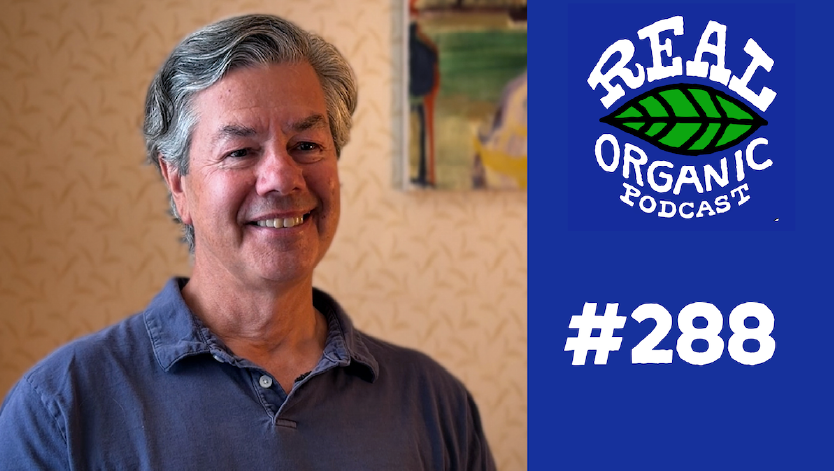
For more than a decade, Max Goldberg, founder of Organic Insider, has been one of the most trusted truth-tellers in the organic movement. Here Max breaks down the most pressing threats to organic today: the rapid expansion of hydroponic production, the rise of “regenerative” greenwashing, and the political fight over pesticide liability shields. He also reflects on how the movement is losing younger eaters – and what must be done to win them back.
Our Max Goldberg interview has been edited and condensed for clarity:
You can subscribe and download episodes of our show through your favorite podcast app, our YouTube channel, or stream the audio-only version here:
Dave Chapman interviewed Max Goldberg at Long Wind Farm in the fall of 2025:
Max Goldberg 0:00
Welcome to the Real Organic Podcast. My guest today is Max Goldberg. Max, an old friend, is the founder and editor of Organic Insider, which comes out weekly?
Max Goldberg 0:14
Every other Wednesday.
Dave Chapman 0:16
It’s a delight for me to get it, and they’ve just been getting stronger and stronger as it goes along. I really look forward to it. I encourage anybody who isn’t already a subscriber to subscribe if you can afford it, and give a little support to keep Max going.
Dave Chapman 0:35
Max, you’ve been an organic champion for a long time. How long? When did you become an activist and enthusiast?
Max Goldberg 0:45
Even though I worked in a natural food supermarket in high school outside of Boston, I really found organic food in 2001. I was with a former girlfriend of mine, and we went to visit her naturopath in New Mexico. For some reason, I just started asking about organic food. I’m like, “Don’t we need all the chemicals to kill the bugs?” She was like, “No, we don’t.”
Max Goldberg 1:16
I left that trip and went back to New York City, and ever since 2001, I’ve been eating close to 100% organic. It wasn’t until several years later, in the interim, that I had a guy who was very into organic living in New York City. I had a guy who wanted to back me to open an organic coffee shop, Starbucks but organic.
Max Goldberg 1:39
I went to work at Starbucks for three months, and I realized I didn’t want to be in the coffee business. I thought that my days of being involved in organic business were over and that I would just be an organic consumer for the rest of my life.
Max Goldberg 1:51
Several years later, blogging became popular. This was just in the early days of Twitter, and I launched this organic food blog called Living Maxwell. That was really my foray into organic.
Dave Chapman 2:11
I’m curious, Max. Was there anything in your personal life, health issues, anything like that, that brought you to organic that’s so common that people have?
Dave Chapman 2:21
Anthony Suau, I interviewed him right here, and he came back from 20 years in Europe, and he got sick eating what he thought was the same food, and it wasn’t the same food. It was considerably more laced with pesticides than what he was used to eating.
Dave Chapman 2:39
So he started investigating and exploring, and he discovered that if he went to an organic diet, he felt much better, and he was much healthier. Did you have anything like that?
Max Goldberg 2:50
I did. At the time, I was on antidepressants and had been on them for close to 11 years. When I started learning all about organic, I didn’t have a health issue per se, like I was really sick, and I found organic, and it made me feel better. But it was at that time that I found organic food and had switched overnight to all organic as much as I could, driving people crazy. This was 2001.
Max Goldberg 3:20
At the time, I had been on antidepressants. It was right around then that I really started to give thought to why I was on this drug. I said to myself, “I’m running around New York City looking for food every single day that doesn’t have these chemicals, and yet I’m popping a chemical into my mouth each morning with these antidepressants.”
Max Goldberg 3:43
That was one of the motivations for going off the antidepressants, because I wanted to live a chemical-free holistic lifestyle. Organic played a very big role in my going off antidepressants, because I knew at the time I said, ‘I just do not envision ever giving up organic and going back to conventional food and GMOs. I just don’t envision it.'” So organic did play a very big role in my going off the medication.
Dave Chapman 4:11
That’s great. People talk a lot about the health of the body, but they don’t talk as much about the impact on the health of the mind, which, of course, is part of the body too. That’s an important thing that I think is true for a lot of people.
Dave Chapman 4:33
I know people who believe that the destruction of the microbiome in our bodies through things like herbicides is really messing with our moods, our sanity, and our ability to make good decisions.
Max Goldberg 4:50
Absolutely. At the time, if you told me about the microbiome, I would have looked at you with a blank face. That wasn’t a consideration at the time. But I just knew the whole chemical aspect of “why am I putting a chemical into my body every day, and yet I’m trying to eat food without the chemicals.”
Max Goldberg 5:11
Those things didn’t add up for me at all. But I have been in complete agreement with you about the impacts of glyphosate and other chemicals, and how they impact our health and our gut’s ability to affect our mood as well.
Dave Chapman 5:31
You started Living Maxwell. What was that?
Max Goldberg 5:34
This was an organic food blog. I said, “Well, I love organic, and I’m just going to start writing about it and interviewing CEOs and going to organic restaurants,” and that was it. What happened was, in 2009, I was living in Boston, and the second biggest trade show in the industry, Natural Products Expo East, was literally going on that day in Boston.
Max Goldberg 6:04
I got her cell phone number somehow – and I called her and told her who I was. I said, “I’m launching this organic food blog. I have no website yet. I have no business cards. I have nothing, but can I come?” She said, “Sure, just come and call me and we’ll get you in.” That was really how it started – at that show. I launched Living Maxwell.
Max Goldberg 7:15
Then the following year, in 2010, I moved to New York, and I made a decision: I am just going to show up everywhere and make myself known. That’s what I did. I went to every event in New York City. I went to every trade show, whether it was Natural Products Expo East, Natural Products Expo West, or Fancy Food. I just started showing up everywhere.
Max Goldberg 8:19
At first, people would give me this look like, “Who are you? Who is this guy?” Then they started seeing me everywhere because I would go anywhere. Then what happened, I think it was 2011–2012, that’s when the GMO labeling movement really started to take off with Prop 37 in California. I participated in marches and rallies around the country.
Max Goldberg 7:56
Food Babe, Vani Hari and I, who is a good friend, put on fundraisers around the country for Prop 37 and different GMO labeling movements nationwide. That’s really when activism started to take hold for me. Before that point, I wasn’t much of an activist and didn’t really understand it.
Max Goldberg 7:56
I wasn’t involved with it. But that’s when the light bulb went off for me, and it really guides everything I do to this day. I became much more of an activist. For me, organic became much less about what I’m putting into my own body and much more about how it is impacting the environment as a whole, farm workers, the water, and everything like that.
Max Goldberg 9:13
Living Maxwell continued, and at the time, I was running the organic food industry group on LinkedIn. We now have over 40,000 members. What I did was organize meetups at Natural Products Expo West. The first year we had six people, then 13, and then it grew to, I think, 90. We capped it. That was the last year we had it. I was still running the organic food industry group.
Max Goldberg 9:13
Back then, LinkedIn allowed you to send out weekly emails to the group. I would send out a few links and maybe a few sentences of commentary, nothing in depth at all. What I realized was, when I would interview CEOs and founders of organic food brands, they didn’t have any idea what was going on.
Max Goldberg 9:13
Politically, most of them had no idea what glyphosate was. They wanted to know all these things. They were just very busy running their businesses.
Max Goldberg 9:13
So I thought, “If I can take what I’m doing on LinkedIn and expand it offline, the LinkedIn group will stay, it still exists, and if I could create a newsletter that they actually spent five to ten minutes a week to read, they would have a good idea of what’s going on,” because there were very critical issues going on in the industry, and they didn’t know what was going on.
Max Goldberg 10:10
That was how Organic Insider was created. Organic Insider is where the majority of my focus, time, and energy is spent. It used to be weekly. Now it’s every other Wednesday. Activism is still important. I don’t talk about political issues in every newsletter because I try to have a balance.
Max Goldberg 10:10
If I went too much with political stuff, I think people would get turned off. They want to hear about trends, trade shows, business issues, politics, and regulatory issues. So, I try to have a mix of everything.
Dave Chapman 10:16
I just want to take note of the fact that you came into this conversation from a very different door for me. You came into this conversation both as an eater and then looking at the industry, at the trade, at the brands that are trying to supply eaters with different organic foods.
Dave Chapman 10:40
These are mostly processed in some way, as opposed to carrots or tomatoes. These are people who buy carrots and make carrot juice out of them, or tomatoes and make tomato juice or tomato sauce out of them.
Dave Chapman 10:54
It’s really a different thing. I love that you were not primarily talking to farmers. You are going to trade shows. I told you earlier in our conversation, most of the farmers I know have no idea what Natural Products Expo West is. They have never heard of it. In your world, everybody knows what Natural Products Expo West is. Could you explain what Natural Products Expo West is?
Max Goldberg 11:18
Natural Products Expo West is the big organic trade show in the US. It’s in March every year. It’s anywhere from – I think pre-COVID, it maxed out at 86,000 attendees and 3,300 booths. I think it’s a little bit lower now, though it’s recovered since COVID, maybe 70,000–75,000 people, roughly, and a little under 3,000 booths.
Max Goldberg 11:45
It used to be four days, and now it’s two and a half days. It’s very overwhelming. It’s a lot. But people come in from all over the world. All the brands are there, and they have booths, and they’re showing their new products. This is where we see people in the industry and then the non-farming part of the industry. This is where you see people, is at the trade shows.
Dave Chapman 12:19
Also included there are the distributors and retailers, I’m assuming.
Max Goldberg 12:24
Oh yeah. The distributors, retailers, all the consultants, and the ingredient suppliers – it’s everyone. Now, they do have panel sessions during the show. They’re not as well attended as you might imagine, because everyone’s at the booths and trying to do business. But they do have plenty of panel sessions. This is really the heartbeat of the industry.
Max Goldberg 12:55
Now, the show is not all organic. They call it Natural Products Expo West. One very big point of contention is that they are allowing GMO 2.0 brands at the show. I was on a panel with a handful of people a few years ago, and it got very contentious because we were going after the GMO 2.0 companies.
Max Goldberg 13:21
I don’t know where these people were coming from, but they were advocates for GMOs, and it got incredibly contentious a few years ago.
Dave Chapman 13:31
Those advocates were in the audience?
Max Goldberg 13:32
They were in the audience.
Dave Chapman 13:33
They were asking hostile questions?
Max Goldberg 13:36
It got very hostile. I’ve never seen a panel at Natural Products Expo West get this hostile. There was a lot of tension in the room. That is one controversy: GMO 2.0 is allowed at these shows, and it’s a point of real controversy. This is not an all-organic show. It is the biggest organic show we have in the industry right now in the US.
Dave Chapman 14:12
In the US. BIOFACH being probably the biggest in the world.
Max Goldberg 14:12
BIOFACH is the biggest in the world, and that’s all organic.
Dave Chapman 14:12
Yeah. That’s in Germany.
Max Goldberg 14:12
That’s in Germany, yeah.
Dave Chapman 14:12
Do you go to that? do you go BIOFACH?
Max Goldberg 14:23
I’ve never been.
Dave Chapman 14:24
Oh, wow. Linley has been several times now, and it’s quite something. She goes because of Naturland and to connect with them. Do you feel that Natural Products Expo has gotten a little less organic in recent years? Is there a shift in the culture of that event?
Max Goldberg 14:48
I don’t know if it’s gotten less organic. I would say organic has probably increased, but you’re also seeing more GMO 2.0 brands.
Dave Chapman 15:00
What does that mean, “2.0”?
Max Goldberg 15:00
They are using synthetic biology. The Impossible Burger is there. That’s an example. We’re not seeing a flood of those companies, but they’re there. There’s plenty of “natural brands,” which I don’t really know what that means at the show. They supposedly have their own standards. It’s not a strictly organic show by any means.
Dave Chapman 15:28
Has regenerative become a much bigger thing in recent years?
Max Goldberg 15:31
Regenerative has become much bigger at these shows, definitely, yeah.
Dave Chapman 15:35
I think I told you that the first kind of huge invasion into a space that had previously been more organic was at Natural Products Expo West with General Mills. They had a gigantic stand advocating their support for regenerative, although when Aaron Stevens asked them what that meant, they were pretty uncertain, the people who were working the booth.
Max Goldberg 16:07
Regenerative is making very big headway. It’s a threat to organic. When I interviewed at the Summer Fancy Food Show, which takes place in New York City, that’s another big trade show in the industry. It’s a show I really enjoy going to. In my recap, one of the things that the show did was hire a Gen Z trend-spotting panel, people in their 20s, to basically report on what the trends are.
Max Goldberg 16:39
So what I did in my recap was speak with one of these Gen Z trend spotters, a graduate student from Drexel University, with the Drexel Food Lab. I said, “When you were looking at the show, tell me about the trends through the lens of organic.”
Max Goldberg 16:57
He basically said to me, I’m paraphrasing here, but “Organic is really not as important. It’s not doing that much for the environment. My friends and I, we look for things like regenerative that really can have data to back up their activities.” That was a real concern to me, and that’s one of the concerns that I’ve been having a lot lately.
Max Goldberg 17:26
I feel like in organic, we are really losing the younger generation. It’s really worrisome that so many younger people that I meet, they don’t understand organic, they don’t see the value, and they think it’s losing credibility in the marketplace. I think this is a very serious issue, because if younger people are not paying attention to this, organic is going to have even more problems going forward.
Dave Chapman 18:01
Every generation wants to have their own cause, their own activity that creates meaning in their world, different from their parents. Do they look at that and go, “Organic is what my parents did”? Or do you think that’s not it? Do you think that they’re genuinely just excited because it appears that regenerative is responding to needs that organic doesn’t respond to?
Max Goldberg 18:28
I don’t think it has anything to do with rebelling against what their parents prefer. I think they’re very concerned about the environment, and they’re really unclear about what organic means. That’s the fault of all of us in the organic industry, that we have not done a good job branding and communicating to the public what organic means.
Dave Chapman 18:57
I have to say that it seems to me that they also don’t know what regenerative means, because it means very different things to very different people and very different things to very different companies. Do they understand that most regenerative agriculture uses herbicides?
Max Goldberg 19:18
I would say, no, they don’t understand that. If I had had a conversation with this person – well, the interview was all over email, and I was really just trying to get his reaction, not necessarily get into a full-blown debate with him.
Max Goldberg 19:33
But if I had really pressed him, and if you really pressed a lot of these younger people about regenerative, “Well, are you okay with glyphosate, which was just shown by a global glyphosate study to cause cancer? Are you okay with a chemical that causes cancer being sprayed on your food?”
Max Goldberg 19:50
I think they would really think otherwise. But I think most of them are in the dark. I think most people are in the dark – young people and older people – about what regenerative means, because there is no widely agreed-upon definition of regenerative.
Dave Chapman 20:04
I just want to say I don’t think that that is the fault of the organic movement.
Max Goldberg 20:10
About regenerative?
Dave Chapman 20:11
Even about what organic means. When I look at the forces that are arrayed against the organic movement, they are staggering. We are talking about the biggest economic enterprises in the world. Cargill is one of the biggest privately held companies in the world.
Dave Chapman 20:11
Walmart, Syngenta, Bayer, PepsiCo, and Coca-Cola are just inordinately powerful companies, and it is in their interest, all of them, to undermine organic.
Max Goldberg 20:11
I don’t disagree with that, and they’re doing a very good job at that, but I also think it’s incumbent upon us to really promote, market, and educate people about the organic label. I don’t think we, as an industry, have done a good job with that.
Dave Chapman 20:11
We, as an industry, are very divided, aren’t we?
Max Goldberg 20:11
Very divided.
Dave Chapman 20:11
Our industry includes Aurora, Driscoll’s, King Grove Organic Farm, and Full Belly Farm.
Max Goldberg 20:11
Yes, and we don’t have one big company writing a check and saying, “This is what we’re doing,” like Monsanto used to do, or Bayer does now. So yes, there’s disagreement within organic about everything.
Dave Chapman 20:11
I think that it’s interesting. It was actually Melody Meyer who came up with this observation when she was working for UNFI, and she said that the debate around hydroponics was a debate between the trade and the movement. I thought, “That’s right, Melody. You got that right.” I don’t think there is a lot of disagreement within the movement.
Dave Chapman 20:12
No. You started the Real Organic Project, and it was started by farmers. Now, Regenerative Organic Certified was not started by farmers. It was started by Dr. Bronner’s, Rodale, and Patagonia, companies and organizations. But I think both organizations understood that the foundation of organic is the soil.
Max Goldberg 22:32
This is not a view held or endorsed – I think endorsed is the right word – because I think if you had to ask a lot of these big companies, “What do you think about hydroponics?” I don’t think they would fundamentally disagree with us. The problem is, many of them have built their supply chains around organic hydroponics, so switching their supply chains to all soil-based might be impossible.
Max Goldberg 23:07
If we go to them and say, “We will give you a full supply of whatever you’re looking for, but soil-grown and at the same price,” I think they’d switch tomorrow. I don’t think we have that supply chain or the same price.
Dave Chapman 23:27
Yeah. That’s right. It’s partly because hydroponic production is cheaper. It is, just like concentrated, CAFO production is cheaper. It is. It costs less to produce milk in a factory than it does on a farm. So if you then say to the organic producer, “Well, can’t you match their price?” Well, actually, they can’t. When they try, they go out of business, which is what’s happening.
Max Goldberg 23:57
The hydro sector has pushed a lot of producers out of business, so that supply isn’t there. It’s a conundrum. I am constantly beating the drum about hydroponics. I think consumers resonate with it, but it really takes time for them to get it. I think a lot of them say, “Well, what’s the big deal? If this doesn’t have chemicals, and we have to embrace technology.”
Max Goldberg 24:20
I think some of them get it, a lot of them don’t. It’s a little complicated, because you really have to dig into it a little bit more. You know better than anyone – this is the foundation of organic. You and I have had so many conversations about this, and this is what I really try to convey in my newsletter and social media: we as consumers are losing choice.
Max Goldberg 24:55
That’s the scary thing that tomatoes, berries, and an increasing number of greens, peppers, and cucumbers. It’s on and on. The organic hydroponic market is growing, and we are losing choice at the supermarket to buy soil-grown organic produce. That’s a frightening thought.
Dave Chapman 25:29
When I interviewed Ladd Harris, who’s the wellness coach for the Houston Texans football team, a wonderful person, he said his greatest challenge is being able to locate real organic food. They’re perfectly willing to pay for it. That’s not the issue. He’s completely sold on it.
Dave Chapman 25:48
He believes that this gives his athletes their best shot at health, their best shot at peak performance as athletes. He just can’t find it. I’m going to talk about it a little bit at Churchtown this year – how many markets we have lost because of the hydroponic invasion. It’s a real thing.
Max Goldberg 26:13
It’s a real thing. When I go into my supermarket in the winter and the only thing there is hydroponic cucumbers, I’ve refused to buy them, even though they’re organic. I cannot justify morally supporting it, and I cannot justify it economically because they don’t provide the taste.
Dave Chapman 26:37
Yeah, that’s right. I want to go to food is medicine, but before we do, in continuation of this, can we talk about the Vani Hari’s rally at Kellogg’s that happened a year or two ago?
Max Goldberg 26:58
It was, I believe, last October, 2024. Yeah, I believe it was October.
Dave Chapman 27:04
Tell people about what that rally was and why it happened. Vani Hari is also known on the internet as the Food Babe.
Max Goldberg 27:14
As the Food Babe, yes. Vani Hari and I put on GMO labeling fundraisers. We’re very good friends. She was going after Kellogg’s, because Kellogg’s was selling cereal with all these artificial ingredients in the US, and that same version in foreign countries did not have any of these ingredients.
Max Goldberg 27:34
She organized this rally in Battle Creek, Michigan, the home of Kellogg’s. There were about a thausand people there. We were going to go and show up at the headquarters of Kellogg’s and demand a meeting, and say, “We want you to remove this. We want the same ingredients that you’re giving to kids in other countries.”
Max Goldberg 28:05
There were a bunch of speakers, and I was just going to go and support the rally. She’s like, “Do you want to speak?” I said, “Yes, I do want to speak, but the only thing I want to speak about is hydroponics and organic,” because I knew everyone else would be talking about the artificial colors, and that’s not really my thing, because we don’t have that in organic. But I also knew this was going to be a very big platform and an opportunity to spread the message about hydroponics.
Max Goldberg 28:35
So I got up there and talked about… The founder of Kellogg’s. He really understood the body as a system. This was many years ago, and he understood the foundation of health and treating the body as a system. I talked about the irony of being at Kellogg’s, and that the founder of Kellogg’s understood the systems approach.
Max Goldberg 29:04
I said, “That is exactly what organic is.” But organic hydroponic completely breaks that paradigm, because it does not treat the way of growing as a system. It removes the soil. That was the speech I made, and I think it landed well, and I got a lot of positive feedback.
Max Goldberg 29:25
I know for a fact it opened up the eyes of a lot of people, because many said, “We had no idea,” and that was really the point of me doing this. I knew it was a big platform, and it could raise awareness about hydroponics to people who were unfamiliar with it.
Dave Chapman 29:44
I heard you, Max. I wasn’t there, but I watched it online. It was great. You were very strong.
Max Goldberg 29:51
Thank you.
Dave Chapman 29:52
It was good. That was a kind of food activism.
Max Goldberg 30:02
Yeah.
Dave Chapman 29:59
Do you think that movement has been… Did you get a meeting with the executives at Kellogg’s?
Max Goldberg 30:05
We did not get a meeting. What they actually did was send all their employees home that day. They knew we were coming. There was no one there. We saw a handful, maybe like two or three people in the windows, but they sent all their employees home. They would not meet with us, and they put up a fight. They just relented. I think it was two weeks ago. They agreed to remove the artificial colors.
Max Goldberg 30:31
Now, the big story in this, which has not gotten a lot of attention and which I’ll be writing about soon, is that they’ve agreed to get rid of artificial colors. They have not necessarily agreed to avoid replacing them with genetically engineered colors, and that is what’s coming.
Max Goldberg 30:51
There are companies using synthetic biology or gene editing to create “non-artificial colors,” and I think this is exactly where the food companies are going to be going.
Dave Chapman 31:05
I’ve not been swept away with the movement to stop the artificial colors in Froot Loops, because I don’t think people should be eating Froot Loops with or without artificial colors. It’s just ultra-processed junk food.
Dave Chapman 31:25
I thought, “We need to think a little bigger.” I understand. I don’t criticize at all. That rally is a first step, but I imagine that most of the people at the rally weren’t interested in buying Froot Loops without artificial colors either. They wanted to have a healthier food system.
Max Goldberg 31:47
I think that the majority of the people there really just wanted change in the food system. This was a start of it.
Dave Chapman 31:55
That’s right. It’s a tough one. It is genuinely a tough one. It’s funny. There is bipartisan support on this issue of removing junk food from our lives. You see Bernie Sanders and Senator John Kennedy – is he from Louisiana? – and they were the two chairs of Senate committees, and they were agreeing on this. Of course, the guy from Wisconsin.
Dave Chapman 32:42
Ron Johnson.
Dave Chapman 32:35
Yes, Ron Johnson. Thank you. I was amazed that he was there. The way he was talking, he could have been Cory Booker. I don’t know if he believes it. I don’t know where it’s going, but I see that there is something happening right now where there’s some conversation – not so much a bipartisan conversation about chemicals, but a bipartisan conversation about junk food – and that this is not serving us well.
Max Goldberg 33:02
I agree with that. I think that where the rubber meets the road is it has to be about the chemicals, and we cannot get healthy as a country unless the chemicals are addressed. Many of these same people who are talking about improving the food system are also voting for the pesticide liability shields in Congress.
Dave Chapman 33:24
Can you explain the pesticide liability shield? I know what you mean, but I’m sure many people don’t know what that is.
Max Goldberg 33:24
Yes. A piece of legislation, I think in one of the appropriations bills, the chemical companies have gone to Congress and said, “We can’t absorb these multi‑billion‑dollar lawsuits anymore, and if you don’t protect us and give us protection from these lawsuits, we may close up shop, the farmers are going to be in huge trouble, and there won’t be any food.” That’s essentially what they’re telling Congress. They’re saying, “We need protection.”
Dave Chapman 34:08
These are based on things like the Monsanto lawsuits, where they lost billions?
Max Goldberg 34:15
Ten to fifteen billion dollars.
Dave Chapman 34:17
Because people with cancer that was traceable to the use of glyphosate were suing and winning.
Max Goldberg 34:24
They were winning. Courts were saying, “Yes, you’re responsible for causing cancer,” whether it was Dewayne Johnson, the groundskeeper in California, or other people. The chemical company said, “We have put on this big PR campaign. We’re vital to food production in the US, and we’re not sure if we can make it any longer if we have to deal with all these lawsuits.”
Dave Chapman 34:49
They seem to be aiming their messaging at farmers in these states. It seems to me it’s not so much aimed at eaters as at farmers, saying, “You need to step up and support us here.” It’s big ag. It’s the people who sell them all the chemistry that they put on their land. It’s passed in how many states now, do you know?
Max Goldberg 35:14
It was passed in, I believe, two states. But really, what they’re doing is they’re using those two states to get this passed on a federal level, and they’re very close at the time of this recording.
Dave Chapman 35:27
One state was Mississippi?
Max Goldberg 35:28
No, it was Georgia, and I believe either North or South Dakota. I don’t know…
Dave Chapman 35:33
But do you think they’re working hard on getting this passed federally?
Max Goldberg 35:37
It’s very close.
Dave Chapman 35:39
You were naming – I know you’d prefer not to get too specific – but a senator who has come out strongly in support of a better diet for Americans, and yet is voting to enable these companies to be immune from lawsuits.
Max Goldberg 35:58
I think there are many of them who are doing that, who have talked about the need to improve our food supply, and yet they’re protecting the chemical companies. This is something that activists on both sides of the aisle are very aware of.
Max Goldberg 36:21
This is a complete sellout for the American consumer. This is not protecting American consumers; this is putting the needs of the chemical companies ahead of consumers. This issue has gotten more attention than any that I can remember before about the chemical companies basically controlling policy in this country.
Dave Chapman 36:47
Whose attention has it gotten?
Max Goldberg 36:49
I think it’s gotten a lot of attention from a lot of people on the right – a lot of people in the MAHA movement.
Dave Chapman 36:55
They’re challenging it.
Max Goldberg 36:56
Oh, they’re furious about it.
Dave Chapman 36:59
Some of them are also part of it. I’m just saying, the guy who was the chair of the MAHA round table that I just saw just voted for this. Let’s say that MAHA is very divided about this as well.
Max Goldberg 37:15
Very divided about it. I firmly believe if we can’t address the chemicals in this country, we cannot get this country healthy. It begins and ends with chemicals.
Dave Chapman 37:29
Right. Maybe we should step to food is medicine, because this is what we’re talking about. You and I have had this conversation, Max, but I’d like to share it with people, which is: can you describe your understanding of your observations of this movement that is growing in America and in academia, I would say.
Dave Chapman 37:57
There are activists and nonprofits very involved in this concept of food is medicine, and what do they mean by that?
Max Goldberg 38:05
Instead of taking a pharmaceutical, you’re using food to heal the body. I think what’s really getting lost in this conversation is that it’s very much about your body. That’s it. That’s the only thing we’re concerned about in general. What is getting lost in this conversation is the food production methods used, and that sort of gets bypassed.
Max Goldberg 38:31
Not thinking about, “If this food production method is very deleterious to the environment,” oftentimes that’s not considered at all or strongly enough. We as a society are only going to improve our health if we look at how food is produced and how it’s impacting our body.
Max Goldberg 39:01
These are not two separate arguments. The reductionist approach is completely wrong and a short-sighted way to look at it.
Dave Chapman 39:12
One thing I just want to clarify: food is medicine isn’t only looking at food as an alternative to taking a drug to heal a problem. It’s also talking about preventative measures to keep health. So eating a good diet isn’t just to cure cancer; it’s to not have cancer in the first place. Just so we’re clear, it can be both. It can be either.
Dave Chapman 39:41
I don’t think it’s all that confusing that our modern agricultural system is creating a lot of ill health. Of course, ultra-processed food is creating a lot of ill health, and that’s going to be more and more accepted by most of the people having the conversation that they understand that eating Twinkies – I know Twinkies don’t even exist anymore – or Doritos isn’t good for you, and it’s creating all these health problems: this incredible wave of obesity, heart problems, and cancer problems.
Dave Chapman 40:25
But what to do about it is a pretty big issue. How to talk about it is a pretty big issue. I agree, and I support all those efforts, but I also think that many of the people who are prominent in this are completely leaving out of the issue the chemical use in agriculture and how the food is being grown.
Dave Chapman 40:48
Even before we talk about the climate, just talking about the food that you’re going to put in your mouth, how it’s grown very much impacts the nutrition of that food.
Max Goldberg 40:58
Definitely. A story I’m working on is about cane sugar Coke. A few weeks ago, Coke announced that they’re going to offer this fall a different version of Coke that uses, instead of GMO corn, instead of high fructose corn syrup, cane sugar, which is non-GMO.
Max Goldberg 41:22
The analysis in the media, I think, got it completely wrong, because all the nutritionists said, “Well, from a molecular level, cane sugar versus high fructose corn syrup, it’s the same thing. The body sees it in the same way.” That appears to be true. Yet what they don’t consider is, “Well, what is the pesticide load impact of the difference between the two?”
Max Goldberg 41:53
I haven’t seen one analysis from a nutritionist who talked about that, not one. You also have the other factor, which is the lack of genetically engineered ingredients like GMO corn. We just were in a massive trade dispute with Mexico, because Mexico sees GMO corn as posing a massive threat to their people.
Max Goldberg 42:18
They actually put it in their constitution that you are not allowed to cultivate GMO corn. That’s in their constitution. That’s the type of threat that they view it as, because the GMO corn has contaminated their native heirloom corn.
Max Goldberg 42:35
You’ve got the pesticide load impact. Independent studies show that GMO corn has all these negative impacts on animals, organ health, linked to cancer, things like that. Yet, for so many people in the U.S., they have been completely normalized or numb to pesticides and GMOs. That’s what we saw with the Coke made with GMO corn versus Coke made with cane sugar.
Max Goldberg 43:08
None of the analyses from nutritionists – a few of the newspapers didn’t acknowledge it, but they didn’t go deep into it at all. They didn’t give it adequate consideration or evaluation. It’s, “What about all the glyphosate impact?” Now cane sugar uses plenty of very pernicious chemicals, so it’s not like cane sugar is a completely clean alternative, but its impact is less.
Max Goldberg 43:35
So when you think about how we’re going to get this country healthy, we can’t do it if the farmers who are spraying these chemicals are exposed to it, and the people who live near these farms are exposed to these chemicals.
Max Goldberg 43:49
I just did a story in Santa Cruz County, in Watsonville, California, which is where Driscoll’s controls a lot of farms in that area, and they are spraying the non-organic berries with very toxic chemicals like Malathion and others. They’re spraying them right near schools – about a hundred yards away from some of these schools.
Max Goldberg 44:19
So when people think, “Well, that piece of food, even if it gets sprayed with chemicals, it doesn’t affect me,” well, it affects all of us because someone is paying the price. I think that’s where a lot of people miss the analysis with this cane sugar Coke: we need to be thinking about how these chemicals are affecting all of us, and not just one person’s body in terms of the sugar impact.
Max Goldberg 44:49
I think that’s really missing in the conversation about food. It’s very difficult. It’s a challenging one, because organic food is more expensive, and so you’ve got that whole cost issue. But what gets forgotten all the time is that conventional food might be cheaper, but someone’s paying the price.
Dave Chapman 45:13
You might pay the price 20 years later too. It might be cheaper now, but if you’re on the installment plan, you’re going to pay for it in the end. I think people’s health is truly priceless to them. You can’t put a value on it, but because you don’t drink the Coke and fall down sick, it’s easy to postpone that reckoning.
Dave Chapman 45:45
I would say that the Coke is a little bit like the Froot Loops with no artificial dyes. It’s great if it has cane sugar instead of something that has even more pesticides in it, but it’s still essentially a poisonous drink that’s destructive to kids. It just is.
Max Goldberg 46:05
Well, no one’s arguing, and I’m certainly not arguing that Coke with cane sugar is a healthy drink.
Dave Chapman 46:10
I get that. It’s just an example.
Max Goldberg 46:12
Yeah, but I think the big takeaway from this example is if companies – and I don’t want to let Coke off the hook here – are making a positive step in the right direction, that’s going to lower the pesticide load on the country. If they do it, and if we can give them acknowledgement and support, then maybe other companies will do the same thing. That could have a real cumulative effect.
Max Goldberg 46:43
That is what I don’t think got nearly enough recognition or acknowledgement. This is a tiny step. Is it going to change the health of the country? No, but it’s a step in the right direction. If the government is going to protect the chemical companies, I think we need to acknowledge when these food companies are moving in the right direction to limit chemical use.
Dave Chapman 47:10
That’s right. I think that the food companies have tried a few times to make ultra-processed food a little less bad, and the customers did not applaud. For sure, there’s a thing here. I think there are a lot of issues around antitrust and monopoly that need to be addressed, but they’re going to be just as hard to address as every other issue. It’s pretty hard to take down a monopoly.
Dave Chapman 47:45
Lina Khan was making a start. She made a start. She didn’t allow Kroger and Albertsons to merge. She was taking on Microsoft. But these are hard battles, and we’re going to have to be pretty organized to make progress.
Dave Chapman 48:04
You’ve talked about the need to do a better job of messaging, and this is what you do. You’ve created a newsletter that is reaching out to eaters, but it’s also reaching out to brands – to companies – to try and do a better job, to understand the lay of the land and what the issues actually are.
Dave Chapman 48:30
A lot of people get into being an organic brand. They have actually no idea what organic means, except they go, “No pesticides,” which is good. That’s why most eaters turn to organic food. They don’t want the pesticides, and that’s good. I support that. I don’t want the pesticides either.
Dave Chapman 48:50
But organic is much more than that. Real organic is. What’s your dream of how we go about creating this Velvet Revolution? What are your thoughts about how we might move what seems to be an immovable rock?
Max Goldberg 49:14
I think the big thing that is on my mind these days is really, how do we engage the next generation, the younger generation? How do we really engage them so that they take a real vested interest in organic? That is both a concern, and it’s also, I think, an opportunity where we can engage them, because this is going to be their food system one day, and I don’t want to lose them.
Max Goldberg 49:42
I think trying to engage this next generation of eaters is really the dream that I have. I think it is going to be our best path to success, because when young people care about something, they get very involved. I think we need their energy and enthusiasm.
Max Goldberg 50:04
When we would go to National Organic Standards Board meetings, pre-COVID, the youngest person there was maybe in their 40s. It’s people my age and older.
Max Goldberg 50:19
And I feel like what’s really missing in the organic industry is getting them politically engaged in the movement and educating them about what’s going on in organic, because getting their participation is really vital, and is really sort of the dream that I have over the next 10 years – trying to engage this younger generation, educate them about what’s going on.
Max Goldberg 50:44
Particularly about the real challenges that we face in organic. It’s not just hydroponics; it’s factory farms. We have issues with fraudulent imported grains. We have real issues with enforcement – enforcing the rules. A lot of people think that the rules are all broken.
Max Goldberg 51:05
I don’t think that’s the issue at all. I think it’s really the enforcement of the rules. So to me, it’s really, how do we engage the next generation?
Dave Chapman 51:16
Okay. How do we engage the next generation? That’s not easy either. I will say, when you talk about the people at that organic meeting, if you go to any corporate meeting, there are no young people there either. It’s people who tend to have authority and sometimes power, and they tend to be older because they’ve gone through a lot of hoops to get there.
Dave Chapman 51:44
But how do we reach and connect to that young influencer who really didn’t know what he was talking about? He had an opinion, God bless him, but he had no idea what he was talking about.
Max Goldberg 52:01
Well, I think this is the challenge. I think what we really need to do is have a more coordinated social media campaign to educate people. Because what I’m seeing a lot on social media is organic. An MD with close to 2 million followers on Instagram is telling people, “I no longer prioritize organic.” She’s like, “Local is what I’m prioritizing.”
Max Goldberg 52:29
Other people are saying, “The biggest gaslight in the history of America.” Literally, that’s what these people are saying. I think we need to do a better job. I think it can be largely online. We need to have a coordinated campaign online to really educate people about why organic is better and how it’s hurting farm workers.
Max Goldberg 52:51
Like this piece I wrote about Driscoll’s and how these farm workers in Santa Cruz County are so sick because they’re exposed to all these chemicals. These are the stories that I feel are not reaching many people, including younger people. I think we need to be more strategic, and then we need to do a better job of storytelling.
Dave Chapman 53:13
I would say that the other side is very good at storytelling. They aren’t a few volunteers like us; it’s a squad of professionals who have been trained, and when they get tired, they hire another squad of professionals to come in.
Dave Chapman 53:26
I’m going to interview Naomi Oreskes in September. She was one of the coauthors of “Merchants of Doubt : How a Handful of Scientists Obscured the Truth on Issues from Tobacco Smoke to Climate Change” about the tobacco industry. They were very strategic and calculated in how to stretch out and protect people from the truth.
Dave Chapman 53:26
How it can stretch out because tobacco advertising is totally unregulated, and they had quite a run of it. They knew that tobacco was incredibly bad for people, but they were like, “How can we create enough doubt in the public’s mind that they won’t take action?” They did it for a long time.
Dave Chapman 53:26
Ultimately, they failed, and they had to shift all their marketing overseas to other countries that didn’t have those protections built in yet. They did a great job of expanding their market in other countries.
Dave Chapman 53:26
I just say that because I want to remind us that it’s not just that we’re not competent or we’re not working hard; it’s that we’re up against some companies that have gotten a great deal of our money and are using it to protect their industry. This will be a difficult thing.
Dave Chapman 53:26
Social media was your first thought. Do you have any other thoughts about how to reach people?
Dave Chapman 53:44
I think what we need to do is really engage these younger people – some people who are influential in that world – and ask them, “How do we reach your colleagues?” Instead of us telling them what we should be doing, we can educate them about the problem and say, “How do we reach your colleagues? How do we reach your peers?”
Max Goldberg 55:24
That is what I think we need to do, and really listen to them, because they know how to speak to that audience.
Dave Chapman 55:30
Okay. You’re suggesting that we need to connect and have a serious dialogue with the influencers who already have an audience, who are young, and who are talking to other young people, and see if they can have a deeper understanding of these issues?
Max Goldberg 55:53
Yeah. Like at the Real Organic Project Symposium 2026, we should have all the people who’ve come, and they should bring their children who are in their 20s, early 30s, or in college. Let’s start talking to these people about why they get organic, because their parents are into the Real Organic Project, and they’re at the Real Organic Project Symposium.
Max Goldberg 56:19
Let’s start having the conversation with them about how we can advance this conversation with their peers. I think that’s really where we need to go with it. I’ll been lobbying you offline too for this, Dave.
Dave Chapman 56:34
Yeah, I know. We just need a few more resources.
Max Goldberg 56:38
Yes, but everything’s got to start somewhere, and it’s not entirely on the shoulders of the Real Organic Project. I think if we can start having more and more of these conversations, it will help. I have been having more of these conversations with people, and I think there’s a lot of energy around it, especially among the younger people who get it. They’re like, “Yes, we’ve got a lot of friends.”
Max Goldberg 57:01
I think if we can empower and educate them, they can do things that we can’t. I think it’s really just giving them the platform, educating them, and saying, “We need you,” and really trying to engage them and listen to them.
Dave Chapman 57:21
Do you see that as possibly happening, in addition to what’s happening in academia, in high school, in college, working with courses, teachers, or groups of students? I get a lot of college students who come and tour the farm. Dartmouth is always sending three classes a year, and I go speak there. I happen to be 10 miles from Dartmouth, so that’s an easy connection for me.
Dave Chapman 57:51
But it occurs to me, geez, there are thousands of Dartsmouths out there, and never mind the high schools – hundreds of thousands of them. Why don’t we figure out how to create something that would be truly engaging in a place where people already gather for the purpose of learning?
Max Goldberg 58:10
Yes. I think working with colleges is a great idea. I’ve written about organic in colleges, and part of the problem is that these students are there, and then they leave. That’s the issue. You get them maybe for a year or two, maybe when they’re juniors or seniors, and then they’re gone. That institutional capital is a bit of a challenge on campuses.
Max Goldberg 58:33
But I agree, we need to reach them when they’re in college and in high school. Schools in California now – school systems that were at Expo West – I think it was Contra Costa – are districts that Nature’s Path and Straus are working with to get organic into schools.
Max Goldberg 58:56
Those are the types of initiatives where, even in high school, we can engage students with organic, talk about its importance, and get them involved. Yes, we need to be doing all of that.
Dave Chapman 59:09
All right, Max. Before we go, any last words? Any things that you wish we had talked about that we haven’t gotten to?
Max Goldberg 59:21
Yeah. One thing that I’ve been posting a lot about lately, another big threat to organic, is gene editing, and something people really need to understand. They need to know about it. So what is gene editing? Gene editing is often referred to in our world as GMO 2.0. Traditional GMOs use DNA from bacteria and insert it from one organism into another to get, for example, Roundup-resistant corn.
Max Goldberg 1:00:59
One of the next generations of GMOs uses something called gene editing. This is a very advanced bioengineering tool. They’re not inserting anything foreign. What they’re doing is rearranging the genetic code of a seed. Many countries and companies are saying, “This is non-GMO.”
Max Goldberg 1:00:59
Now, the Non-GMO Project will not certify any gene-edited foods. Companies have tried to get certification, and they’ve said, “No, we’re not certifying any gene-edited foods because that’s genetic engineering.” So these companies and countries around the world.
Max Goldberg 1:00:59
Canada has said gene editing is non-GMO, which is absolutely ridiculous. You can speak to Dr. Michael Hansen at Consumer Reports, and he’ll say this is totally misleading and false. This is a big threat, because a lot of propaganda is showing up convincing people that we should be using gene editing in organic.
Max Goldberg 1:01:03
And that we can meet the European Union’s target of 25 percent organic if we embraced gene editing, which is absolutely preposterous, because one of the reasons we choose organic is because it’s not genetically engineered.
Max Goldberg 1:01:20
One of the things in their playbook is to tell people in organic, “You should be using gene editing. It’ll be more sustainable. You can develop crops that are more drought-resistant.” But what people need to understand is this is genetic engineering.
Max Goldberg 1:01:41
You were talking about the chemical industry and their deep pockets and very sophisticated playbook to combat any resistance to chemicals in this country. The same playbook is being used to push gene-edited foods, not only into organic, but everywhere.
Max Goldberg 1:02:00
Gene-edited foods are going to be flourishing very soon. So the gene editing piece is something people really need to be aware of. Gene editing is GMO. People are going to be seeing a lot of that. A former USDA official, Greg Ibach, testified in 2019 in a congressional subcommittee hearing, saying that organic should be considering the use of gene editing technologies.
Max Goldberg 1:02:31
So if people don’t think that genetic engineering is a threat to organic, they are absolutely mistaken. They want genetically engineered foods in organic. I don’t want people to think, “Oh, organic is just always going to be there. You’re just sounding the alarm unnecessarily.”
Max Goldberg 1:02:11
No. They want genetic engineering in organic, and that’s documented in the Federal Register with that testimony.
Dave Chapman 1:00:08
I’ve heard Greg Ibach. He’s not our friend. I understand that. Jenny Tucker also is clearly working from somewhere to push this. We were being told that we should reconsider gene editing being allowed. I thought, “Where’s this coming from?” Somebody was paying the bill.
Max Goldberg 1:01:39
Dave, at the National Organic Standards Board, two members who are no longer on the board because they termed off. I wrote a story about this. They were very upset because the board would not even have a conversation about it. These two members did not feel heard. They couldn’t express their opinions. They were upset they couldn’t talk about genetically engineered foods.
Max Goldberg 1:02:55
People need to understand that they think that Whole Foods around the corner is always going to be there and organic is always going to be there. The threat against organic is real. It is very real, and we’re facing very serious challenges, but I remain optimistic, because there is no other way.
Max Goldberg 1:01:39
The only thing that I want to say in closing is how grateful I am to you and all the people at the Real Organic Project, because that is one of the real bright spots we have in our industry. The Real Organic Project and all these interviews you do, you’re creating a library of some really important voices and incredible information for people to hear from people who are on the ground, and all the farmers and advocates you interview.
Max Goldberg 1:02:06
So, the Real Organic Project is an amazing organization. I am so grateful for it. Going to the ROP Symposium is one of my favorite events of the year. I get asked a lot about organic and similar things you’re asking me.
Max Goldberg 1:02:48
People ask me what I’m hopeful about, and without fail, one of the things I’m most hopeful about in the industry is the Real Organic Project. It is so valuable. I’m so grateful for everything that you have done.
Max Goldberg 1:02:48
Because hydroponics and factory farms are two massive issues that we face, and because of all the work that you and Linley and your team have done, there’s a very strong voice fighting against these issues. Dave, I’m so grateful to you for having me here and for everything that you and your team are doing at the Real Organic Project.
Dave Chapman 1:03:00
Thank you, Max. I can’t beat that, so we better close. Thanks very much.
Dave Chapman 1:05:49
Thank you, Dave.
More Podcasts
View All Podcasts ➔