
Episode #256
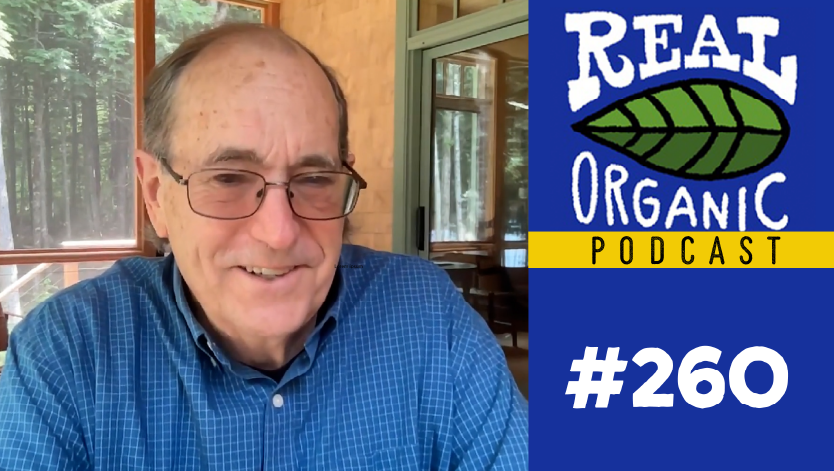
Will Brinton: Rethinking Carbon Sequestration – It’s The Plant Canopy!
Soil scientist Will Brinton joins us to challenge long-held assumptions about carbon sequestration, offering a radically clearer picture of how carbon truly moves through a farm system. Drawing from decades of soil respiration research, European long-term trials, and new canopy-focused insights, Will explains why living green cover – not bare soil – is the real engine of CO₂ capture.
Our Will Brinton interview has been edited and condensed for clarity:
You can subscribe and download episodes of our show through your favorite podcast app, our YouTube channel, or stream the audio-only version here:
Dave Chapman interviews Will Brinton in Maine, August 2025:
Dave Chapman 17:51
I interviewed you. It was a great interview, and anyone listening should go back and listen to it. But you said a lot has changed since then, and a lot of important things have changed. Could you talk about some of those changes?
Will Brinton 18:05
Well, it’s interesting. I rode the carbon wave up with my laboratory. Last year, we visited one of our analytical machines. There was a robot that just processed samples, dumped them into a red‑hot oven, blasting the carbon out of the soil and captured it all. So, it was like a machine that created a world‑ending event where all the carbon is suddenly turned into CO₂.
Will Brinton 18:33
I used to run the numbers on it, like, “If you heated the soil rapidly enough, how quickly would it fill the air with too much CO₂ to survive?” We would run scenarios like that. I did your soil test recently. For some of your soils, you had 92,000 pounds of carbon per acre from that test. It’s just an unimaginable amount of carbon.
Will Brinton 19:06
We thought this would go further. Four years ago, we got some large USDA grants to start carbon monitoring around America in different cropping systems to distinguish the differences.
Dave Chapman 19:18
Can I just interject here that the kind of goal of this attention was to understand the relationship between climate, carbon sequestration, and the soil as mediated by farming practices.
Will Brinton 19:36
A brilliant project.
Dave Chapman 19:39
The plants would do the gathering, and then…
Will Brinton 19:41
Pretty much. We wanted to find out, do they gather it differently in different regions? We found that it depended on the soil geology, weather, the heat, the moisture, and so on. My whole specialty in it, and how I got involved, was that I studied soil respiration for so long. I studied under one of the German scientists who invented the field of respiration testing. They wrote the original methods in the 1950s to analyze soil.
Will Brinton 19:57
He would tell me, “This is what you’re going to have to learn how to do.” I came at it from the point of view that in normal biology, soils are giving up their carbon constantly. That’s a loss, but the loss is your gain, because it releases the nitrogen and other associated nutrients that were packed in that little compound, and releases them to the plants.
Will Brinton 20:36
If we didn’t have that destructive cycle of building and decaying, you wouldn’t have your organic system.
Dave Chapman 20:45
That respiration is always due to what is living in the soil – what is alive. That’s why the carbon compounds in the soil are being released – because somebody is digesting them.
Will Brinton 21:00
Right. We’re getting a little bit off track here, but the whole premise of that is, if we can shift farming to gaining more carbon, we’ll have more natural cycling going on and the need for less fertilizer. But what has happened in four years is that the link that was going to lead towards organic has sort of been severed. All these projects that had the word “climate” attached to them got canceled, as you probably know.
Dave Chapman 21:32
In the last eight months.
Will Brinton 21:39
The farm that I was leading lost a lot, and people lost their jobs over it, too. What I experienced that surprised me was some of the scientists I knew just retooled and went in the new direction. They didn’t even miss a beat. I said, “I don’t feel good about this. So, how do you make carbon now something that’s palatable to new right‑wing farming?”
Dave Chapman 22:10
Let me ask a question first before we go there, because that’s a good place to go. But were you learning? The work that you were doing, were you going, “Oh, we’re getting to understand this better, that this is important, that this is an actual tool for carbon drawdown around the planet, and there are ways in which we can do this more skillfully and more impactfully?”
Will Brinton 22:37
I suddenly felt I was learning more than I thought I would. When you dig into a field in science, you think you already have 98% of it, and then you get into it and say, “Whoops, I’m only at 80% or something like that.” What I started questioning is, what is that real carbon cycle in the soil? What is leading to the accumulation?
Will Brinton 23:02
I remember we had this conversation four years ago that people were saying carbon is streaming out down through plants and out into the soil. I said, “There’s a little bit getting away, but plants are way more efficient than we think, and it’s only a tiny fraction.”
Will Brinton 23:18
It bothered me that a certain group of farmers and proponents of new farming were mischaracterizing something that nature is doing, because that’s not honest. Maybe it’s an honest error, but they were saying the accumulation was happening because CO₂ is like being pumped into the soil, and that mechanism does not exist. So, I said, “Well, how do we better characterize it?”
Will Brinton 23:50
I wrote a paper. It got rejected from three journals, but not by all the reviewers. So, if one reviewer rejects it, you’re basically out, even if the other two say it’s a good paper. But I’m thinking of picking it up again. What I decided that I had learned is that it’s the whole life of the canopy of plants. It’s dictating the carbon balance in the soil.
Will Brinton 24:16
The other thing we learned is that by reviewing some earlier studies, particularly done in the Amazon tropics, all the carbon that’s being produced as CO₂ at the soil level is not getting out of the canopy. It’s all being absorbed in the canopy before it gets to the atmosphere. They have tracked this very carefully.
Will Brinton 24:40
Now we know that plants growing right on the soil are able to absorb all the CO₂ that’s coming out of it at the moment that it’s being released in a diurnal cycle.
Dave Chapman 24:52
So, the respiration in the soil is releasing CO₂, and that CO₂ is being immediately taken up by the plant canopy.
Will Brinton 25:06
If it exists.
Dave Chapman 25:07
If there is a plant canopy, yes.
Will Brinton 25:09
Yes. If there’s a monoculture, it’s a very limited plant canopy. It suddenly made me realize the problem with the herbicides is they were destroying the plant canopy. They were simplifying it down to the one intended crop.
Will Brinton 25:24
The problem was tillage; it’s ripping out the plant canopy. You’re intentionally destroying the complexity of green things growing this close to the soil that are capturing the CO₂ from the soil as soon as it comes out.
Dave Chapman 25:42
And returning it.
Will Brinton 25:43
It returning immediately. Isn’t that a great new way to describe organic farming?
Dave Chapman 25:48
Yes.
Will Brinton 25:49
We capture CO₂ immediately and put it right back into your food.
Dave Chapman 25:54
I don’t want to interrupt you, but you just keep bringing up this interesting stuff. You know Helen Atthowe’s living mulches. I’m going to interview Helen next month. I love her work. I love the exploring and the researching she’s doing.
Dave Chapman 26:16
There are many, many models of how one might do this, but do you think that having a living mulch in an annual garden is viable, feasible, and preferable in terms of the carbon cycling?
Will Brinton 26:33
Well, the more carbon you have in your soil, the more carbon cycling there is, the more CO₂ is being released, and the more you need to capture. I found an early Swedish researcher from the 1920s who raised that question, saying, “As we enliven soils…” and he kept mentioning use of manure. He measured that manure drives the CO₂ cycle to be 10–20 times higher than it is without it.
Will Brinton 27:03
He showed that the productivity of plants from it is not only ascribed to the nutrients in the manure. It’s the huge amount of CO₂ that drives photosynthesis. He started mapping out plants that are photosynthesis-limited because of CO₂ supply.
Will Brinton 27:23
To me, that was a link. I tried to pull that together in this new paper that I’ve been writing, saying it’s time to shift our focus to the plant canopy from just the soil, and look at whether we are actually capturing enough CO₂.
Dave Chapman 27:40
I just want to repeat what you just said to see if we get that right. You’re saying that adding manure to the soil increased the respiration. The microbes went crazy. They loved it. It wasn’t just the nutrients that were in the manure that were significant for the impact on the crop, but the added respiration was releasing CO₂, which increased the rate of photosynthesis of the crop.
Will Brinton 28:09
Because the crop was CO₂ limited. This early worker, Linde Gord, quantified this. To write this paper myself and a few other scientists re‑quantified all these numbers. It was so much fun. Soils can release over 100 pounds of CO₂ per day per acre.
Will Brinton 28:34
It’s a huge quantity, but the plants at full growth cycle – and corn is the number one example – are absorbing between 80 and 200 pounds of CO₂ a day, which makes it the number one nutrient, if you think about it.
Dave Chapman 28:52
When you reduce the CO₂ in a big corn field on a hot, sunny day, you’ve limited the growth of the crop.
Will Brinton 28:58
Growth is limited. If the soil is poor in carbon, which most farmland is, the plants are actually asphyxiate
d to a slight degree. Scientists argue whether it could ever be proven. I found a few papers recently that tried to prove this. People have been noodling around with this thing for quite a while. I think it’s time to shift the whole discussion to the canopy dynamics.
Will Brinton 29:26
Again, it brings this whole concept of green manuring back into full focus, and the absence of monoculturing. We need to study… People will argue with me that corn is already capable of absorbing so much CO₂ that it’s going to benefit anyway, without yet another ground cover underneath it that might be competing with the corn.
Will Brinton 29:52
But not early in the season and not late in the season. Late in the season, the corn is finished growing and the soil is still warm in the fall, and it’s just pumping out all this CO₂, which is not being captured. There’s no green cover. So, we have long, late falls.
Dave Chapman 30:10
To the detriment of the next crop as well. Even if you’re just a greedy person who just wants yield, you’re losing your prime nutrient, because if you’re cycling it, then you’re building the life in the soil. More life means more CO₂. If you can capture it, it goes back to building more life. So, it’s a very virtuous circle.
Will Brinton 30:30
Yes, it is. You could see how one could attack this from a number of different angles. There would be really good agronomy, botany, and biology all combined, which could help us better understand the carbon cycle. I became critical of other scientists being too reductionistic about it.
Will Brinton 30:51
One scientist commented to me, he said, “It’s still going to get the CO₂ from the atmosphere. It doesn’t matter where it comes from.” It’s disappointing to me that somebody would just brush it aside like that when the canopy dynamics are so fascinating. It makes you realize the earth should always be green because of this.
Will Brinton 31:16
A plant could be growing green, it’s warm enough to be respiring a lot of CO₂ from the soil. We have to start thinking about that CO₂ cycle. This is partly coming out of what we talked about four years ago. I think I’ll come back to trying to write that paper. It needs to be published somewhere.
Will Brinton 31:42
I sent it to Plant and Soil, which is a very high-ranking journal, and one of the reviewers loved it, and the other said, “This is just his opinion.” That was disappointing to me, but scientists are hard on each other, and they want you to show a lot of empirical evidence.
Will Brinton 31:59
So something we realized we’d be forced to start re‑measuring. You could use carbon-labeled compounds to watch where the carbon is going. How much is the plant actually getting? It’s a complicated objective and it slows down the development.
Dave Chapman 32:17
In your imagination, as you think about the impact of this kind of thinking as it gets developed, do you think that it will lead to multi-species cropping, even in things that are not forbs, legumes, and grasses, but also in things like vegetables, that you will find some way to get more than one layer of canopy there, and that ultimately it will lead to greater health, or greater production even?
Dave Chapman 32:43
I can tell you, because I’ve explored this idea with farmers, and they go, “Yeah, well, of course, if you undersow your crop, you’ll have a reduction in yield.” I thought, “Well, I don’t know about that.”
Will Brinton 32:56
A reduction in yield and a gain of carbon into the system and a reduction of CO₂ in the atmosphere. Think about it. We should be thinking of farming for the whole world, not just selfishly for food. Farming is actually an act of landscape management.
Will Brinton 33:18
I mentioned to you earlier, when you came, I shifted my focus in my retirement more to horticulture, because horticulture is the art of landscape development, where you create a diversity of plants that yields an emergent property of health, well-being, balance, and stability.
Will Brinton 33:43
The best horticulturalists will tell you, you cannot bring a chemical into a system like this without having devastating effects. You have to really know what you’re doing. Now, when I say “chemical,” I mean mostly a pesticide. Inorganic fertilizers have a very minor effect compared to pesticides in a diverse horticultural system.
Will Brinton 34:11
Like this big project in the desert in Arizona, where they closed the whole greenhouse and put people inside of it. It failed twice for interesting reasons. I toured it recently, and they said, “The thing about this system is we can’t introduce any chemicals here. You have devastating effects in a closed system.” I said, “That’s the true organic story.”
Will Brinton 34:37
When we say this, people don’t believe us. But when it’s been studied in closed systems, they can see that it immediately goes to one part, then it goes to another part, and then it affects a plant or a host-predator relationship that they had nothing against, and it gets out of control. You have to have these systems being clean and pure.
Will Brinton 35:04
Horticulture teaches us that, and when you have these diverse gardens, they are almost by nature. We did a big garden tour in England recently, and every one of them said, “We are in a completely reduced chemical program, because anything we bring into a complex whole system like this, you have no idea the harmful consequences for it.”
Will Brinton 35:28
You might lose two or three genera and species because they can’t tolerate it, but those were necessary for both the healthful impact and the beauty of the scene. It’s very interesting. I’m always looking for ways that we can show that organic is not an ideology, although people are saying it is.
Will Brinton 35:53
It’s actually the way nature would do it if you just let it happen. The issue is, how much saleable crop are we producing? That’s the rub.
Dave Chapman 36:04
Well, it is an issue, of course, if you’re a farmer, because no crop, no living. I had just the best tour of Hugh and Lisa Kent’s farm in Florida in the last year, the blueberry farm. Hugh just gave this beautiful description of their crop just getting better and better. Their quality keeps getting better. The insect problems are completely disappearing.
Dave Chapman 36:39
He said, “It’s not that we don’t have the insect pests. We see them. We see them come in here. We see them come in there. If we call the people from extension, they say, ‘You need to spray right now or you are going to be screwed.'” They never have sprayed, and the problem always disappears because they have such a massive balance going on in their fields.
Dave Chapman 37:06
They’ve got this whole living mulch between the rows of blueberries, which they mow, and it’s a diverse understory. They mow them at different times, at different heights, and they blow it as a thatch at the base of the plants, and that’s kind of it.
Dave Chapman 37:24
That’s about what they do, and it just keeps getting better. But it’s not that they’re micromanaging their problems, it’s that they’re enhancing the diversity of the system in their practices.
Will Brinton 37:41
Yeah, it leads in so many directions, doesn’t it? One of the pleasures of my life was to work with the late viticulturist, Alan York, in California. You probably know the name. He was featured in that popular film, “The Biggest Little Farm.” Remember that?
Dave Chapman 38:01
Yeah.
Will Brinton 38:04
He had worked his way up the chain as probably one of the most renowned consultants in California. His last project before he died was working with Sting in Italy on his vineyard. Sting had been sold a really bad vineyard, and he tells a funny story, like none of the Italians told him, “This is really bad land.”
Will Brinton 38:31
Alan, with his characteristic pizzazz, came in and said, “We can fix this.” His whole thing was, he had a premise of what he called “horticulturally intensive agriculture.” This is what we need.
Will Brinton 38:48
He would show me what he had done at vineyards around California by developing this high level of diversity of non-agricultural crops that interacted with the vineyard to increase the life of birds. They were trying to attract raptors naturally and all kinds of levels of interaction.
Will Brinton 39:17
But I always liked that “horticulturally intensive agriculture.” I know organic people would say, “Yeah, we believe in that,” but I’ve gone to so many farms and counted what I recognize as genera and species, and there’s so little going on.
Will Brinton 39:41
I showed you, we’ve worked here over the last 25 years building a diverse horticultural surrounding here. I’m in the process of categorizing everything, but we have 250 different species of plants in one acre here around the house. They’re all coexisting. You do have to interact with them. You cannot bring chemicals in without devastating effects.
Will Brinton 40:09
You can bring fertilizers in just to boost certain things in the plants; you can do that all organically, but they don’t have the same far-reaching effects that anything that can be volatilized would have, for example.
Will Brinton 40:27
My idea is to take this horticulturally diverse landscape and then bring the commercial vegetable growing into it, but it’s like a subset of the horticulture instead of the other way around.
Dave Chapman 40:41
I get that. Do you think that either the yields or the economic viability of doing it that way is going to be punishing, and that it needs to be supported because it’s doing all these good things for the climate and for the biodiversity of species, or do you think that it can be designed in such a way that it will just work better?
Will Brinton 41:06
I think both are operative. In some areas, it will work better than in others. I know this gets us close to the theme of the self-fed farm. I just wanted to throw that in there, because everybody wants to achieve this goal of a farm being somehow inwardly healthy. That’s really what we’re saying when we say “self-fed.”
Will Brinton 41:29
Human organisms, or even plants to some extent, are self-nourishing, but a truly healthy, diverse farm acquires the ability to manage so many nutrient flows that otherwise you have to work really hard at. I think it’s just something that we’ve underdeveloped in this whole field.
Dave Chapman 41:57
Yeah. The the farm that you’re imagining would be truly sophisticated in its design. It becomes incredibly design intensive.
Will Brinton 42:12
They are design-intensive. We visited some of the greatest farm garden parks in England and spent quite a few weeks there. They were designed around being fully operational farms, but they were horticultural beauties.
Will Brinton 42:30
Anywhere you went on the farm, you felt you were in a nice place. There were stone seats positioned in places where you’d say, “Now, this is exactly the place I’d like to pause and rest.” And, “Oh, I hear water.” The water was designed. They opened up springs and had them flowing. But they were still farms. They were serious farm operations, most of them either cattle-based or sheep. We had this integration.
Will Brinton 43:08
The designers – these are famous landscape designers of 100 to 200 years ago – set all this in motion in England. They wanted things that related to what I call productivity boundaries, like fences for cattle. They wanted those to disappear so that the eye was not offended. They designed ways of doing that so you can look out across the landscape at this cattle grazing, and you can’t see why they’re confined to an area.
Will Brinton 43:44
They designed these landscape features. It has a funny name, ha-ha. A ha-ha is a ditch that comes down and up, and the cattle will not go into it. And then no stone wall was necessary, no fence. They didn’t want any wiring in these gardens. I just thought that was an example of horticulture as a design feature impacting a farm to make it more pleasing to the eye.
Will Brinton 44:12
Now, some people today would say, “What’s that got to do with anything?” But I think it has a lot to do with it. These were environments that have been found to be therapeutically healing for people to go and be on these farms because they’re so beautiful. You smell and hear the insect life, and you’re always hearing… They always wanted a sense of water moving somewhere.
Dave Chapman 44:35
Yeah, it reminds me, Will, of Paul Hawken, who once said that in California, before the Anglos or Europeans came, the apparently wild landscape – every square foot of it – was intentional and had been manicured by the people who lived there for all the various purposes of their lives. It’s an interesting idea, how to take all of this to a higher level that isn’t necessarily straight rows, but is still highly productive.
Dave Chapman 45:13
Let me ask you another question – a slight change, but not really. We were talking earlier about nutrition. You’ve done a lot of nutritional testing. In fact, we were talking about bread. I just had a tremendous sandwich between two pieces of bread that you baked, and it was delicious.
Dave Chapman 45:42
We were talking about the quality of the wheat, not just how you bake it, or even what your sourdough culture is, but the actual quality of the wheat really changing what it was like to eat that. Of course, there’s pleasure – I had a lot of pleasure eating it – and there’s also nutrition, which ultimately leads to pleasure too, because you’re not sick, you’re healthy, and you feel good.
Dave Chapman 46:09
You had done testing about that, I think it was in Europe. Could you talk about that?
Will Brinton 46:14
Yeah. One of the very interesting impacts of me getting involved with the biodynamic farming movement early on was that they were doing all the early science. Some people say, “Well, I thought they’re not scientific,” but they were the ones that started these food quality testing labs very early in Europe, in the 1950s.
Will Brinton 46:39
One of the longest-running soil quality and soil health research plots was started in Sweden in the 1950s, at the same time that a long-term carbon study was created there by Uppsala University. They had these two plots, and these people discovered each other later. One was being run by biodynamic scientists asking, “What are the long-term effects on the quality of the crops?”
Will Brinton 47:08
The other group of scientists were asking, “What are the long-term effects on carbon sequestration?” Whenever I visited those plots over there, I was like, “This is a little bit boring. It’s just about carbon sequestration. Can we talk a little bit about the food coming?” “Well, the food doesn’t matter. We’re just experimenting with systems to sequester carbon.”
Will Brinton 47:31
That’s why later I developed this skepticism about carbon sequestration as this final theme. Because on the other side, the scientists were showing that depending on how you manage your crop rotations and your choice of varieties, you can have higher and higher quality.
Will Brinton 47:51
Well, what’s quality? Quality had to do with the bionutrients in the plant, but with wheat, it was particularly interesting. It had enormous ramifications on the quality of baking. We would actually do bakeout trials with different wheats. Some of the analysis for protein was okay, but two could be the same, and one loaf was pleasurable, and the other was not.
Will Brinton 48:21
What happened? What was going on? It was the difference between the quality of the gluten. I know gluten is frowned on these days, but it is the backbone of the food protein – the capability of gluten to swell and expand.
Dave Chapman 48:44
Can I interrupt you just a moment?
Will Brinton 48:45
Sure.
Dave Chapman 48:46
Why is gluten frowned on these days?
Will Brinton 48:52
That’s an interesting question, because I have never had, or even done, the test to see, “Do I have any gluten sensitivity?” I know a lot of people claim they do. To me, it’s just one of those things that happened – suddenly it emerged as an issue. It’s hard to see what’s wrong with gluten.
Will Brinton 49:17
We’ve been eating bread for 10,000 years. How did we suddenly get sensitive to it? Could it be the chemicals that are coming along with it, and we haven’t noticed that? I think that’s what it is. It’s not actually the gluten.
Dave Chapman 49:37
You think it’s like the glyphosate.
Will Brinton 49:40
We know there’s a lot of glyphosate floating around in grains – we know we’re ingesting it that way. Back in my composting days, we got involved in trying to find out where the herbicide residues in compost were coming from. I worked all the way back.
Will Brinton 49:59
It was coming from crop residues that happened to be fed to the cows, and the herbicides went right through the animal in tiny amounts, right into the compost, and had an effect on young seedlings but not on full-grown plants.
Will Brinton 50:20
I don’t know if you ever experienced it with tomatoes. They’re sensitive to certain herbicide residues, but I developed these bioassays to see it at the level of contamination that the EPA says is not a contamination. It’s below any threshold level, yet it still had biological effects.
Dave Chapman 50:45
We can only imagine going through your gut.
Will Brinton 50:48
Going through your gut, the microbiome of the gut being exposed to herbicides? It’s really stunning to think that this could be involved in some of these modern syndromes. I don’t want to say they’re not real; they might be real, but for different reasons.
Dave Chapman 51:10
They’re misunderstood. I believe they’re real. I see people get genuinely sick, and they go, “Well, what did I eat?” Then they say, “Oh, my God, that had gluten in it.” But I have suggested, “Are you sure it’s the gluten?”
Will Brinton 51:24
Yeah. We’ve launched a whole health movement based on gluten-free, and there’s a lot of money to be made in that too. I always get uncomfortable when I see how the money moves through all these issues and themes. Humans are very quick to pick up on something and build enterprises around it. There’s good and bad science to that.
Will Brinton 51:47
But going back to our story of testing it, we could see different qualities in gluten coming from different farms. We would tell the grower, “This will bake a really good loaf of bread, and this probably won’t. You should put this into biscuits or something like that.”
Will Brinton 52:05
The complaint in Northern Europe at the time was they couldn’t have the high-quality gluten that the Americans and Canadians had, because of our plains, because of the heat development. The only ones that were as good were grain from Turkey.
Will Brinton 52:20
The gluten in that was amazing. It was almost too stiff. You could blow these huge bubbles with it, with these air machines that we used before it would pop. That kind of bread was so elastic, you could have these hugely voluminous loaves. It was interesting how you could get carried away with it too and create the ultimate Wonder Bread, which is just all air.
Will Brinton 52:48
The gluten is so finely divided. They even put pure gluten into some of these breads to get all the air bubbles. That’s going too far when you start baking with gluten itself. You can buy a bag of pure gluten, and it’s extracted. It’s maybe 10% to 20% of the original grain. It’s been extracted, washed out, and then purified and dried, and it looks like flour.
Will Brinton 53:18
That could be another side of this gluten sensitivity thing – that we’re now feeding it back to ourselves in ways that it never existed before. It’s been extracted, concentrated, and put into food to give it that rise.
Dave Chapman 53:33
But you were also suggesting earlier that there are taste differences based on the grain and the soil in which they were grown. Again, that connection is not just about variety. I had this very interesting conversation with Dan Barber, and he said, “I had become a real champion of genetics.”
Dave Chapman 53:54
He’s got his seed company, which is really working to get great cultivars that taste so good and make them available to people because they’re disappearing. But he said that after becoming truly intimate with King Grove Organic Farm down in Florida, “I’ve seen these same varieties grown at other farms there, and they’re not great, but at King Grove Organic Farm, they’re great.” That’s about the soil.
Dave Chapman 54:22
He’s realizing that it’s both genetics and culture, and the soil – the whole thing together. Were you discovering nutritional differences as a result of, “Yeah, when we get this variety from this farmer, look at what we’re finding in our testing compared to some other farmer.”?
Will Brinton 54:46
Yeah. We found that a lot, and it was sometimes disappointing. I’ll give you an example. One of the labs I worked in in Sweden looked at not just grain quality, but they were taking particularly carrots and beets, and we’d run them through the lab from all these different farms. They allowed conventional farmers to send in samples too; it wasn’t just for the Demeter and the organic and bio groups there.
Will Brinton 54:45
Every now and then, we’d get carrots that tested top quality, high vitamin C, high sugar content, very sweet. The lab director would say to me, “Well, where do you think these are from?” I knew it was a trick question, but it wasn’t like he was going to say “They’re from a chemical farm.” He said, “These are from the island in the Baltic that has the most moderate climate, and always we get the highest quality products, no matter how they’ve grown.”
Will Brinton 54:46
We would compare them. We would do spoilage tests to see how fast food would spoil. This got really popular in Sweden and Germany, and then somebody sort of just killed it. But it was found that depending on what soil and fertilizers were used, when you harvest carrots – particularly potatoes, it’s a problem – they would start sprouting early and/or decaying and browning.
Will Brinton 54:46
The browning – when you cut a potato, sometimes see how fast it turns brown. Those are enzymes that are activated by imbalances in the growing. We would measure the darkening of tissue when exposed to air, and we found it correlated with soils that they were growing on and the management. But both were interactive.
Will Brinton 55:34
So, it wasn’t always true that organic was the best, but the soil and the climate was the best. The whole arrangement was the best, and that’s what we’ve lost sight of here. I started speaking at conferences saying, “I’m just going to talk about different soils. How many of you know what kind of soil you’re on?”
Will Brinton 57:00
Most people know the common family name like “Windsor loam,” but those names don’t relate to anything in terms of true soil taxonomy. They don’t know taxonomically whether they’re in one of the 12 soil orders or not, or which suborder. Of course, that already sounds boring to people, but I say it’s like, “Do you recognize plants on your farm?”
Will Brinton 57:27
You should. You should be able to say, “This is in the family of this. This is in the nightshade family, this is the nettle family,” particularly if it’s a weed, you should know it. Most people don’t. But the taxonomy of these soils is so different. You have to believe it’s exerting a major impact on the quality of the crop.
Will Brinton 57:51
The only way I can explain it is to mention the word ‘terroir,’ which is something prized in the world of vineyard management and wine quality, particularly from wine tasting trials. They have successfully built this concept of terroir, only in that field. Why can’t we apply it to vegetables? Why can’t we apply it to grains?
Will Brinton 58:21
It’s not like it should be exclusive to winemaking, but the good wine tasters can distinctly identify the conditions under which these grapes have been grown, particularly in France. They can say, “Well, those are grown on these gravelly soils, or those are grown in the Rhone Valley.” How do they know that? How do they taste that?
Will Brinton 58:47
Well, I once read a book about an old German farmer who got a name for himself because he could taste any variety of potato and tell you where it was from, where it was grown, and probably what the varietal name was. He could do this for dozens… They used to have dozens and dozens of different potato varieties being grown, and now it’s down to three or four or five. It was a great story about how he developed this ability.
Will Brinton 59:16
So, people would bring the potatoes to him and say, “Can you taste this?” He would say, “Yeah, this is a good quality. I know it’s in this family, and it’s probably being grown on these heavy soils, because I can taste that as well.”
Will Brinton 59:30
So, what have we lost? This sense of terroir, which unites the plant with the soil. It completes the whole picture, that the flavor quality for us, the pleasure, as you mentioned, is all tied up with this.
Dave Chapman 59:47
Do you believe that the nutrition is also tied up with it?
Will Brinton 59:51
Nutrition has very much to do with the body’s whole reaction to eating something. I recently discovered people who don’t like peaches, and I inquired why. They said, “They’re hard and tasteless.” Can you believe that?
Dave Chapman 1:00:11
That all they do. You’re right.
Will Brinton 1:00:15
Hard and tasteless. They’re being picked in a way that’s harmful to quality, of course, too early to be shipped green and hard so they don’t get damaged, but they don’t ripen fully. It doesn’t develop all the qualities and the compounds that have been studied.
Will Brinton 1:00:34
There are all these different flavor compounds that are naturally produced in plants that excite us when we taste them, and we produce more enzymes. The whole flavor sensory apparatus when eating is something that’s underappreciated. This is a whole emerging field right now.
Dave Chapman 1:01:00
Speaking of what nutrition means, you’ve spent a lot of your career figuring out how to test for things. Do you think that we have the sophistication in our testing to determine food and say, “This food is nutritionally superior?” Or do you think that’s really just beyond us at this point?
Will Brinton 1:01:24
I think we had an opportunity to develop that, and we lost it. Let me explain what I mean by that. In some of the early work that I saw coming out of Europe, there was a truly, highly interesting concept of wholeness, and I don’t mean this in a silly, light way, that the integration of whole constituents within the nexus of what the plant means and its connection to the soil has been lost.
Will Brinton 1:01:56
It’s because we’re completely reductionist today. So, what we do when we approach nutrition is look for a single compound – more or less, is it high? Is it low? We don’t look for its relationships. We don’t look for, “Should it be high only if something else is low?” People do a little bit of that.
Will Brinton 1:02:19
One of the great studies that was done in Germany earlier on was the relationship of nitrate levels in vegetables and vitamin C, and they found they were inversely related. The higher the nitrate went – and it was always a sign of heavy fertilizer use or very high soil turnover, I can explain that – the lower the vitamin C.
Will Brinton 1:02:43
So, what is that negative interaction there? The more sunlight plants had versus shade, the more vitamin C. Vitamin C was tied up with the whole photosynthetic cycle. Well, how do you just knock this all down reductionistically and analyze one thing without looking at all those other factors? It’s very, very difficult.
Will Brinton 1:03:08
I think our intent today to reduce everything to biological mechanisms is going to deter us from putting together a good nutritional picture. For example, we don’t include flavor in it as anything other than pleasure – kind of a sideline, right? If it tastes good, well, that was just icing on the cake. But what if that’s essential for your nutritional well-being, that it tastes good?
Will Brinton 1:03:39
Your tomatoes taste better than others, I would say that’s essential for your enjoyment and the nutrition that comes with it. I just don’t think we’re there yet, and I’m wondering if we will get there. If we turn it into molecular genetics, I mean, God knows where it’s going to go.
Dave Chapman 1:04:01
We’ve been trying to do some testing, comparing berries, because I believe, without a doubt, that hydroponically grown products taste inferior. Everybody says, “Well, can’t you test and prove it?”
Dave Chapman 1:04:20
I said, “Well, we can try, but I’m not convinced that the laboratories – God bless them, no evil intent – but I just don’t know that they have the sophistication to discern things that are genuinely important.” I don’t think, in that case, our tongues are lying to us.
Will Brinton 1:04:35
No, they’re not. Scientific naïvism has it that the facts speak for themselves. Well, they don’t. To test, you have to have a guiding concept of what you’re looking for. Now that’s your theory or your hypothesis. We don’t have the right concepts, I don’t think. We’re not looking for what we should be looking for.
Will Brinton 1:05:02
People would say, “Well, what do you mean?” I say, “Well, look at some of these relationships.” I mentioned earlier spoilage studies. We did spoilage studies in Sweden on potatoes from different farms, including conventional farms. Conventionally grown potatoes, which had very high nitrogen inputs, for sure, would spoil about 20% to 30% faster than lower-yielding organic and biodynamic potatoes.
Will Brinton 1:05:34
When you measure the yield at the end of the year, the chemical ones were superior. You’ve heard this drummed out again and again. But when they measured it after three months of storage, which is normal for some of these crops, we were yielding more on the organic side, because the spoilage losses and the resorting – it was done later – took away all the potatoes that were spoiled. Your net yield was less at the end of that period of time.
Dave Chapman 1:06:02
That’s so interesting, Will. Of course, you saw the Nature article that says that conventional agriculture, meaning chemical agriculture, is better for the climate because it has higher yields, and so it takes less acreage to produce the same amount of food. You don’t put it into agriculture; it is in forest or whatever, and it’s sequestering carbon.
Will Brinton 1:06:27
That’s such a narrow, narrow angle on it. It’s ridiculous, because if in that high-producing land, you’re seriously destroying the underpinning structure, including loss of carbon, fewer microbes, and more leaching into the soil. I just saw a recent report on nitrate losses in farming in America. It’s at an all-time high.
Will Brinton 1:06:56
Nitrate poisoning in waterways is at an all-time high, and nobody’s flagging it anymore. It’s really very, very serious. The system is leaking in every direction to get this high production, and it’s having eutrophication effects in water. We now know that those big algae blooms in the Great Lakes were caused mostly by phosphorus getting out in tile drains under conventional farms. Why don’t we get it?
Dave Chapman 1:07:29
Those might well be no-till farms.
Will Brinton 1:07:32
Yes, actually, I know a scientist who says no-till is a big culprit in water pollution, and it just shocks people when he says that. He qualifies it, saying, “You’ve got to know your soils, because heavy soils crack when they’re dry.” He said, “Those are the soils you shouldn’t be just no-tilling.”
Will Brinton 1:07:55
He supports it, but he says there should be some light tillage, because you can break up the surface cracking and prevent the fertilizer pellets from just going down to China, so to speak, and they get into the tile drains that way. That’s an interesting sort of holistic puzzle where you just have to think a little bit outside the box, and you begin to see the connections and say, “Oh my God.”
Will Brinton 1:08:21
But you have to be the kind of person that doesn’t immediately turn it into an alarm and a new movement. Like he said, “We’re going to go farm to farm, and the farms on these heavy soils that tend to have dry periods – those are the number one targets that we should work with to bring some tillage back into it.”
Will Brinton 1:08:42
But the strict no-tillers would just be like this, and you cannot do that, because no-till got oversold as a general theory that fits all problems or something.
Dave Chapman 1:08:59
Okay. Connected to our nutrition talk – food is medicine. It’s a big deal right now. It’s good that people are looking at food as something that really promotes your health. I’m not necessarily talking about food as a medicine you take because you have cancer. I’m talking about food that, if you eat properly, makes you much healthier – you’re much less prone to a whole host of illnesses that we know about.
Dave Chapman 1:09:32
I think I told you I talked to Bob Quinn, who went to the conference at Tufts a year or two ago, and there were 150 people in the room, and only two of them were farmers. They were not talking about how food is grown; they were only talking about how food is processed. Did you know Joan Gussow?
Will Brinton 1:09:56
Yes. Not personally.
Dave Chapman 1:09:59
Her work was all about the connection between how food is grown and how it is distributed, how it is eaten, and the impact on all of those systems. It was pretty radical when she started that in America.
Dave Chapman 1:10:15
When we talk about food as medicine, do you think that it’s critically important that we take into account how food is grown – whether it’s grown organically or chemically, or different kinds of organic, deep organic, or very shallow organic?
Will Brinton 1:10:35
All of the above. There was a great study in Germany a few years ago on milk quality. You know what they found out? One of the most important things was, in the long term, how many times milk was transported and pumped and then repumped and then repumped. They showed studies where, by the time it gets to you in a jar, it’s been pumped 20 times through different high-impact machines that are destroying the structure of the milk.
Will Brinton 1:11:06
We worry, is it pasteurized? Is it raw? And they’re doing all that on top of it. Most people say, “What the heck does pumping have to do with anything?” The same with grains and processing of wheat and flour and the machines that are being used to do it.
Will Brinton 1:11:26
There’s so much mechanization of the food process. We don’t really know what’s happening in that whole thing. That’s just an example of one of these contextual issues that we need to more fully appreciate.
Will Brinton 1:11:42
It all goes down to the mechanization of farming, with or without chemicals. The mechanization is just really shocking. We’ve done that to make farming big, to make it highly profitable. I shouldn’t say profitable, but high-yielding, sometimes with almost no profit, by the way.
Will Brinton 1:12:05
Some of the biggest farmers – I have a friend who has a brother who’s a big chemical farmer – and his profit margins are just like this. He says two bad years would completely wipe them out. The banks would be there, and you’re out. The idea that we have a healthy, productive, sustainable farming system just is not for real.
Will Brinton 1:12:34
But my theme, and I brought this up with you several times, is, why are we only at 1% organic in America, of the land? The retail value of organic in this country is listed at $40 to $50 billion a year?
Dave Chapman 1:12:55
About $60 to $70 billion last I saw.
Will Brinton 1:12:59
How much of that did the farmers see? How much of that relates to the real production? What happened – and this is my fun theme about Europe versus America – is that in Europe, it’s not a couple percent. On the continent, it’s 6% to 25% of land area now in organic. What’s the difference? What did they do right?
Will Brinton 1:13:27
This may sound like heresy today, but government was involved in that all the way through – good government. Government making sure that rules and regulations were fair, and that they didn’t just favor the big over the small. We hear this talk today that we have to get the government off the farmers’ backs.
Will Brinton 1:13:49
No, we have to have the right kind of government. We have to have people that are independent of corporate interests and political interests – completely independent of those – making decisions based on the quality of the land and the life of the people. That’s the difference.
Will Brinton 1:14:06
Europe somehow got over that, and I believe it’s because they had these very, very, very early organic-type farming movements – twenty years before anything in the English-speaking world. They got on the ground early, and it spread, and they’ve never lost that cultural impact from them.
Dave Chapman 1:14:31
The last question I want to ask, and it’s connected to that, is we were talking about the critical importance of community. I think this brings together the idea of humanistic science – what it was that the Nazis feared, and why they were burning down laboratories.
Dave Chapman 1:14:53
Community, which is you and me talking, and the people that we know talking, and there’s a conversation, and we shared a meal together. We can’t get more intimate than that. Tell me about your thoughts about community and its role in the organic movement.
Will Brinton 1:15:14
I think all the early movements in Europe that I’ve investigated in Denmark, Germany, and Switzerland in particular, were all associated with community building. It wasn’t just “Let’s be organic.” It didn’t start as “I’m opposed to the chemical industry.” That came in later. It was about community building and people being on the land.
Will Brinton 1:15:42
This woman, Mina Hofstetter, in Switzerland, wanted more feminist interaction on the land. This is 1910 we’re talking about. She was a radical, and she was one of the first people who enunciated vegan type of farming, which is really interesting. She wanted to remove the animals out of it all. That made her very interesting to a lot of people.
Will Brinton 1:16:10
We have these early precedents that were formed. We visited a museum for one of the early communities in northern Germany that formed around everybody working the land. It wasn’t just everybody in the community working the land – they had their own workshops. They built all their own furniture. It was like an early American Shaker community or the early Quaker communities that my family came from in Pennsylvania.
Will Brinton 1:16:40
Everything was done by them: by their family, and by the extended members. We’ve lost all those communities. I think we all yearn to get them back. I think that was the original attraction of living the good life. That really included a community message, but people came here and felt isolated. We created little farm homesteads, and there was nothing community building about it, because everybody had to go out and get jobs eventually.
Will Brinton 1:17:20
A lot of the people left. Although I will say there are a lot of new young farmers coming in in Maine. Certainly, statistically, it’s been measured that there’s renewed interest. But how do we bring back those early community structures that have been eroded?
Will Brinton 1:17:41
I have a community of sorts here; I know a lot of people, but I still don’t know where most of our food is coming from. I go to local markets, and they’re not all local food. I’m not sure we’ll get it back. I think some form of it will come back. But something very, very valuable was lost.
Will Brinton 1:18:06
One of the best books on this was written by Leo Marx, called “The Machine in the Garden: Technology and the Pastoral Ideal in America.” If you want to read the history of how we took a beautiful garden that was this America that we discovered – an absolutely lush, productive, beautiful garden – and trashed it with machinery, he’s written that book.
Will Brinton 1:18:27
He died recently, but he was at MIT for many years. There’s this sense of loss that you really can’t explain. Why did we do that to ourselves? Was capitalism the drive, or is there something higher than that, which is this ultimate desire to be mechanical?
Will Brinton 1:18:48
Which brings us now to this whole theme of artificial intelligence – interfering with everything or helping or harming, we don’t know. But there’s this drive to mechanize and molecularize structures and processes, and I don’t know what’s driving it.
Dave Chapman 1:19:15
All right, Will, you’ve given me a lot to think about, as always. I really appreciate you giving me your afternoon and feeding me, and I’ll be back. We’re not done, so thank you.
Will Brinton 1:19:30
It’s been good talking again.
More Podcasts
View All Podcasts ➔