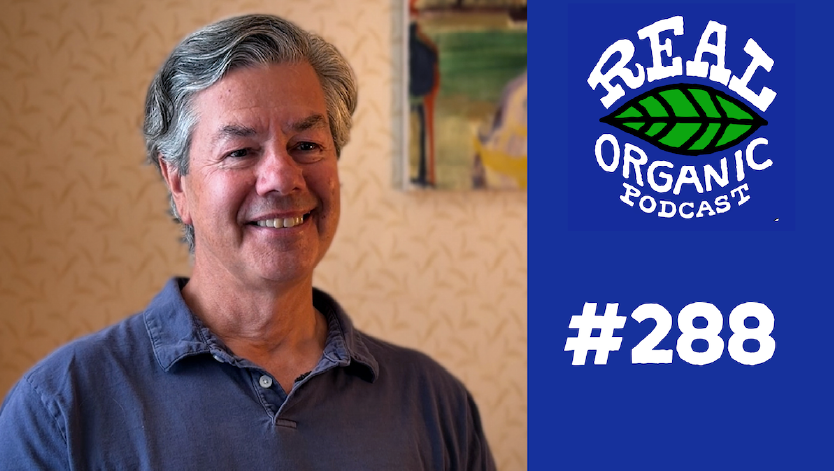

Episode #296
László Barabási: The Nutritional Dark Matter in Our Food
Physicist and network scientist László Barabási has spent much of his career studying complex systems, from cells to social networks. This lifelong body of work eventually led him to ask a simple question: what is food actually made of? While nutrition science has identified the components we need for energy and survival, László’s lab has documented roughly 135,000 other molecules in food that sit largely outside the traditional nutritional picture. He believes that network science could eventually help us understand these molecules and food in general (including food-related diseases) with far greater precision.
László Barabási’s interview has been edited and condensed for clarity:
You can subscribe and download episodes of our show through your favorite podcast app, our YouTube channel, or stream the audio-only version here:
László Barabási was interviewed by Dave Chapman in September of 2026:
Dave Chapman 0:00
I am very pleased today to be talking with László Barabási, who is a Hungarian-American physicist. He’s had pioneering discoveries in network science and network medicine. He has positions at Northeastern, Harvard Medical School, and Central European University. It’s been said that his contributions have altered the study of complex systems. László, thank you for taking the time today.
Laszlo Barabasi 0:33
Dave, it’s a pleasure.
Dave Chapman 0:35
I’m going to start with a few really foundational questions, and then we’ll get into what drew me to you, which was your consideration of nutritional dark matter, which is just a brilliant term. Just for people, this is not a science seminar, but what is a complex system? How would you explain that to somebody?
Laszlo Barabasi 1:00
That’s a good question. Most systems that are offering still puzzles to us are complex: society, the cell, and the brain. What it means typically is that it’s made of many, many different components that interact with each other in some predefined fashion, and the behavior of the system is often unpredictable, given the number of the components and the very diverse nature of the interactions between them.
Laszlo Barabasi 1:33
But it’s often easier to think of examples. I said society, the cell, socioeconomic systems, and the brain. Communication systems are often considered to be complex because they are indeed made of many components, and often their behavior is very unpredictable to an outsider.
Dave Chapman 1:59
Now, as I understand it, systems thinking is a way for us to try and digest reality. We create a boundary. We say within this boundary there is a system, and it is complex. I’m curious: are there such things as simple systems?
Laszlo Barabasi 2:19
A car is a simple system. Even a computer is a simple system. We have a full understanding of each of their components, and we can very accurately predict what happens if you push the gas pedal or what happens if you push a certain button on your computer.
Laszlo Barabasi 2:39
Those are human-engineered systems, and they can be complicated, but they’re not complex because they don’t have what we call emergent behavior. That is behavior that simply does not naturally follow from what I know about the components.
Dave Chapman 2:56
If you put the components in a box, that’s not emergence, but when they interact with each other, something new emerges.
Laszlo Barabasi 3:02
Yes. This is not to say that in a complex system we would not be able to know the components. But the number of components is so large, and the type of interactions between them is so diverse, that it’s virtually an impossible process or dream to really map it all out.
Laszlo Barabasi 3:04
We never stop that dream, and we continue to try to map these systems out. But fundamentally, so far, we have been unable to really get a complete understanding. We cannot think of society at the level we think of a computer. With the computer, every move can be complicated, but it’s deterministic.
Dave Chapman 3:43
Isaac Newton – I don’t think he was the first; maybe Descartes – but Isaac Newton imagined the universe as a clock.
Laszlo Barabasi 3:51
Yeah. Descartes was the one who, as a philosopher, formulated that, but it was based on Newton’s findings. Newton brought us mechanics, and Descartes imagined the universe as a clock, yes. To some degree, the computer is a clock. It even has a clock that makes it work and tick. To some degree, a car is a clock. Society is not.
Dave Chapman 4:17
When we talk about reductionist science, which is a term that’s thrown around, would that be science seeing whatever you’re studying as a clock?
Laszlo Barabasi 4:30
I don’t want to be critical because what’s absolutely necessary for us to understand nature and biological systems is to understand the components, how they each look, and what they do. What happens in complex systems is, once you put these components together, that knowledge is not enough to predict how the system will react to certain conditions.
Dave Chapman 4:57
Okay, that’s helpful. In more recent years – of course, the idea of a holistic understanding is very old – but as we look at a holistic science, that would be a science that embraces complexity.
Laszlo Barabasi 5:15
Yes. You are, and we are now in the Network Science Institute, and we did put a big stake into this thinking, into the heart of that thinking, because one of the things network science does – and we’re probably going to talk more about it – is to unveil the components and the interactions between them. You mentioned the term systems thinking.
Laszlo Barabasi 5:35
The limitation of traditional systems thinking was that it always thought of it as a black box problem: that you have a complicated system or a complex system that is in a black box. If I understand very well what the inputs and outputs are, I will be able to figure out how it behaves.
Laszlo Barabasi 5:54
What we understood, thanks to networks and network science, is the fact that the way these components interact is very varied, and it has so many dimensions that it’s virtually unmappable. This is not to say not to try to map it, but it’s virtually unmappable. The number of components and the number of interactions between them are so diverse.
Laszlo Barabasi 6:22
Therefore you need a science that allows you to capture the behavior of the system, despite the fact that you will never know all the components, and you will never know all the interactions between them. Network science provided the path towards that by helping us understand how networks form in these complex systems. The reason why it works and why it has now become indispensable in the way we think about complexity is because every single system that I mentioned as a complex system, and every single system that you perceive as a complex system, is a network-based system. The agenda now is, let’s acknowledge that complex systems are not black boxes that simply react to inputs and create some outputs that are arbitrary, but rather they are deeply networked systems, and let’s understand what the rules are that govern the interactions between the components, and let us start making predictions about the system while acknowledging that we will never have a complete description of the system.
Laszlo Barabasi 6:44
The reason why it works and why it has now become indispensable in the way we think about complexity is because every single system that I mentioned as a complex system, and every single system that you perceive as a complex system, is a network-based system.
Laszlo Barabasi 7:00
The agenda now is, let’s acknowledge that complex systems are not black boxes that simply react to inputs and create some outputs that are arbitrary, but rather they are deeply networked systems, and let’s understand what the rules are that govern the interactions between the components, and let us start making predictions about the system while acknowledging that we will never have a complete description of the system.
Dave Chapman 7:42
Okay. One thing that you mentioned a moment ago was that you talked about the purpose of the system. I became interested, László, in systems thinking when I read “The Limits to Growth,” a famous book now that came out in 1972, the first edition, and 30 million copies have been sold. It’s had an impact on our thinking.
Dave Chapman 8:00
It was Donella Meadows who actually, when she was at Dartmouth many years ago. She has since passed but one of the things she said is that every system has a purpose, even though the system or the people in the system might be unaware of the purpose or have a different idea of what the purpose is.
Laszlo Barabasi 8:20
There’s a big difference between the physical and the biological systems. The way we try to think about it is that biological systems have a purpose. There are lots of evolutionarily encoded purposes, like the desire for survival. It’s harder to talk about the purpose of the sun. What’s the purpose of the sun, and what’s the purpose of an elementary particle. I would distinguish between living systems and non-living systems.
Laszlo Barabasi 8:51
For living systems, evolution has provided a purpose, which is mainly driven by the desire to survive and continue life or create new life forms, and selection has allowed us to reach that level. But once again, does the sun have a purpose? From our perspective, it does because it gives us heat. But in reality, that’s not the sun’s purpose. We adapted to that.
Dave Chapman 8:43
That’s right. That’s helpful for me. I’m trying to sort it out.
Laszlo Barabasi 9:31
Sure.
Dave Chapman 9:30
The distinction between living systems and non-living systems is helpful. Donella did apply systems thinking to things like the economy. A guy named John Fullerton has said that he believes the economy is actually a living system.
Laszlo Barabasi 9:50
There are lots of thinkers who approach it that way, yes. I’m not well versed in that space, and it’s a very complicated space. But on the other hand, certainly economic systems have many signatures of a complex system that one could actually view as living. But in the end, we live, not the economy, and we are the driving forces.
Laszlo Barabasi 10:20
The more interesting question for most of us is not whether the economy is a living system, but how the individual actions of you and me contribute to what we call the economy.
Dave Chapman 10:33
Yeah, indeed. We could go a long time, but I would like to switch over to food as a system and as a complex system, I believe. How did you get interested in that?
Laszlo Barabasi 10:52
It’s a good question. It did not start with food. It started with a long research program in my lab that’s now 10, 15 years old, which tries to understand how the cell works and the cell as a complex system, and in particular, a network. Because, of course, we do have this canonical picture that we have DNA, and the DNA produces RNA, proteins, and other molecules, and life is about DNA.
Laszlo Barabasi 11:15
But in reality, DNA is not alive. The cell is alive. We are alive, and the reason why we are alive is because the molecules produced by the DNA are not inert molecules, but they interact with each other. They form machinery. They interact. They take energy from the environment. They use that energy to achieve certain functions, or you may call them purposes.
Laszlo Barabasi 11:22
What we’ve been doing in the last 10-15 years is to map out this network that is within the cell. That is, go beyond the list of genes that genomics provides, and start asking the question, who is interacting with whom and how, how that leads to life, and ultimately, how the breakdown of those interactions leads to disease?
Laszlo Barabasi 11:22
We tend to think that mutations lead to disease. Mutations are just a way to break a component that cannot interact the way it did before. Really, many of the things that we perceive as diseases are coming from the fact that a component no longer interacts in the way it should, so it doesn’t fulfill its role in the network.
Laszlo Barabasi 11:22
Network medicine’s role is, on one hand, to understand what these networks look like, map out the networks within the cells, and on the other hand, to understand how the breakdown of this network leads to disease, which ultimately allows us to say, where do you want to intervene in this network to cure a disease?
Laszlo Barabasi 11:40
That has been a long journey in my lab. Much of that journey is based on genomics because genomics gives us the proteins. It eventually tells us the metabolites that the proteins can process as catalysts, as enzymes, and so on. We know that if we have complete genomic information, we still have limited information about the likelihood that the person will get a disease.
Laszlo Barabasi 13:14
That is, there are specific numbers showing that typically maybe 10% to 20% of disease occurrence can be explained by genomics alone. The question is, where is the rest? About 10 years ago, I started to ask that question: How could we figure out where the rest is? The answer is very clear: the rest is what we call the environment.
Laszlo Barabasi 13:39
We have a cell that is defined by our genes, but that cell and we interact with the environment. The environment has multiple dimensions, from sleep to stress to exercise, but the biggest gorilla in the room at the cellular level is food. Why? Because through food, we are sending a large number of molecules into our cells.
Laszlo Barabasi 14:05
Primarily, we tend to think of that as an energy source, but nevertheless, a large number of molecules are really reaching our cells and modulating their activity. I started to ask the question: How could we build this knowledge base that we have about food into the picture that we have about network medicine? That was the journey that eventually led me to start thinking about what food is made of.
Dave Chapman 14:37
What is food made of?
Laszlo Barabasi 14:38
Good. I thought we knew that. It was a big surprise because I said, “Well, there is a field of nutrition; they know everything there is to know about food.” We ourselves also had a project years before where we looked at the flavor of different foods, and we had a big database with thousands of molecules that are flavor components. I said, “Oh, we know what’s in the food.” I said, “Let’s make a list.”
Laszlo Barabasi 15:05
I was shocked to realize that we don’t. What do I mean by that we don’t, or we do? What do we know? Nutrition has done a huge amount of work in understanding the composition of food from one particular narrow perspective: What is in the food that provides us energy, and what are the components that are indispensable for our existence? These are typically the energy sources: sugars, fats, and other things, and vitamins.
Laszlo Barabasi 15:41
The reason they focused on that is because they realized if any of these are missing, you either don’t survive or you get some disease. Lack of vitamins means you get some disease. Lack of energy means you die. Nutrition has gone through a systematic path of figuring out what the molecules are in the food that we must have to exist. That’s what we call nutritional components.
Laszlo Barabasi 16:08
They are about 150 to 200, depending on what database you look at. What they have as a characteristic is that most of them are engaged by our metabolism because they are energy sources. They provide the energy for our cells to survive on a daily basis.
Laszlo Barabasi 16:30
I was shocked to realize that many chemicals that we know are in the food are not there in the nutritional list. We started to dig: what are these chemicals? When we first published on that, we had a list of 20,000 chemicals that are not on the 200 list. This cannot be – 20,000 cannot fit on the 200 list – that are known to be molecules in the food, but yet they’re not present in any database that you could actually search as a consumer.
Laszlo Barabasi 17:08
Many of these chemicals actually had very clearly known consequences for food. One example that other people have worked out is how red meat actually affects heart disease, and that involves several molecules that are known to be components of red meat that are not actually considered to be nutritional components. Then we started a big process because we needed these molecules to understand what that list is.
Laszlo Barabasi 17:41
When we first talked about it, we had a list of 20,000. Currently, in the lab, we have 135,000 molecules that have been documented to be in one or multiple foods that are not nutritional components, yet we get them into our body. That’s how our journey began.
Dave Chapman 18:04
Just to clarify for people, when you’re talking about 135,000 chemicals, these are not human-made chemicals that were added to ultra-processed foods. These are chemicals that exist in natural foodstuffs.
Laszlo Barabasi 18:18
Yes. Let’s give an example so everybody can bring it home. One big class of molecules that are not considered nutritional components, but we need them, are polyphenols. Polyphenols come from plants. Animals don’t have them, so if you eat beef, you’re not going to get polyphenols. The reason plants have polyphenols and animals don’t is because plants don’t know how to run.
Dave Chapman 18:44
Don’t know how to?
Laszlo Barabasi 18:45
How to run. Therefore, they use chemical defense. All the animals’ defenses are mechanical. We fight. We run away. We fight back if we are in danger. We hide. We have muscles. Muscle is the basis for our defense. Plants don’t have muscles, so their defense is chemical. It’s color, it’s taste, it’s texture, and it’s shape.
Laszlo Barabasi 19:08
In order to produce that wide diversity of color, texture, shape, and all of those things, they need a giant secondary metabolism, a set of metabolic pathways that humans or animals don’t have. Those metabolic pathways, which can be much bigger than the normal metabolism, are producing many chemicals.
Laszlo Barabasi 19:32
One big class of chemicals is polyphenols, which include, for example, the flavonoids that are typically responsible for the color of the plants, as well as the taste of the plants, and the flavor. These are essential for our cells. They have lots of well-documented effects. They’re antioxidants. They are protective against many diseases. Yet they are not engaged by our metabolism.
Laszlo Barabasi 20:01
Our metabolism does not take energy from them. Our metabolic pathways don’t see them. They do get into the bloodstream first. The bacteria typically break them up, then they get into the bloodstream, get cleaned a little by the liver, but the rest goes in, and they start moving in the blood and reaching our cells.
Laszlo Barabasi 20:23
The question is, what do they do if they are not a source of energy or they are not seen by the metabolism? They regulate processes. They act like drugs. They bind to proteins. They bind to DNA, and they activate or deactivate sites on the proteins and the DNA. They turn on processes or turn off processes.
Laszlo Barabasi 20:47
They’re not as black and white as a drug that simply blocks something. They’re a little bit softer binders. They’re not so strongly binding, but their role is to modulate the cell’s activity. Think about it: we have about 8,000 chemicals that are polyphenols.
Laszlo Barabasi 21:08
A fraction of them do end up in our cells, and they are constantly like a fine watcher, turning on and off processes in a very fine way to modulate our cells’ activity. That is not part of the nutritional picture, and yet, for us, it is essential for life.
Dave Chapman 21:35
That is indeed a different vision of nutrition from what is commonly held. It’s a different way of seeing things. I’m curious. I’m not trained in this. When you say that we don’t metabolize these secondary compounds, what does that mean, to metabolize? Forgive me. I don’t understand.
Laszlo Barabasi 22:00
Much of the food, once you eat it, gets absorbed by your gut for energy. In the end, it’s a game about ATP, the energy source. Why do we eat? I often used to say all we eat is the sun. Why is that? Because all the energy that we consume comes from the fact that plants have taken the sun’s energy and turned it into matter – turned it into energy sources.
Laszlo Barabasi 22:28
We take that and break it apart – the molecules – through metabolism, so that we can get the ATP necessary for cell survival. We have billions of ATP molecules created every second in my body through the food that I eat, and that’s the energy source. That’s the gas for our existence. Metabolism does that. It gets the fat, it gets the sugar, or whatever it has, and breaks it apart for a single purpose: to get the energy. A secondary purpose is that some of the components are building blocks for the cell. You need to build a cell wall. You need to build DNA, but the vast majority of the food, the reason we eat it, is not as building blocks, but as energy sources. Our metabolism – that is, the metabolic reactions that take one chemical and turn it into a different one using enzymes as catalysts – is responsible for grabbing the energy from the food and turning it into the molecules that our cells can use to build things, to fix the DNA, and to do their daily activity. There is one big energy source, like gas in the tank, which is ATP, and that needs to be always supplied. That comes from the food, and eventually comes from plants, and they get it from the sun.
Laszlo Barabasi 22:49
Metabolism does that. It gets the fat, it gets the sugar, or whatever it has, and breaks it apart for a single purpose: to get the energy. A secondary purpose is that some of the components are building blocks for the cell. You need to build a cell wall. You need to build DNA, but the vast majority of the food, the reason we eat it, is not as building blocks, but as energy sources.
Laszlo Barabasi 23:18
Our metabolism – that is, the metabolic reactions that take one chemical and turn it into a different one using enzymes as catalysts – is responsible for grabbing the energy from the food and turning it into the molecules that our cells can use to build things, to fix the DNA, and to do their daily activity.
Laszlo Barabasi 23:40
There is one big energy source, like gas in the tank, which is ATP, and that needs to be always supplied. That comes from the food, and eventually comes from plants, and they get it from the sun.
Dave Chapman 22:37
Everything’s making sense so far. There are all these many, many other compounds besides the 200 that everybody was studying, because it was fairly obvious that those 200 are where we get our energy, and those are where we get our vitamins, and if we are lacking in those things, we get sick. But there are all these other compounds, and what was the number, 135,000?
Laszlo Barabasi 24:23
One hundred thirty-five thousand, correct. Probably the number is much bigger. This is how many we have evidence for.
Dave Chapman 24:27
Okay, we have evidence for 135,000?
Laszlo Barabasi 24:32
Yes.
Dave Chapman 24:32
Do we have names for them?
Laszlo Barabasi 24:36
They all have chemical or non-chemical names. If you are a chemist, you will have a name. The field is not short of names.
Dave Chapman 24:46
Okay. So, but we, by and large, don’t really understand what they do. We understand they do something.
Laszlo Barabasi 24:53
Correct, yes. For some of them, there is quite a bit of biological work to understand their role. I would say for a few thousand, we know what they do, or we have some idea of what they do. For the vast majority, we do not. That’s one of the things we do in this lab, which is to develop the tools of network medicine to understand, for each of these molecules, what molecules it engages with in our cells, and then what it potentially does.
Dave Chapman 25:23
Could I ask? It’s been very popular in the last 50 years to put together those compounds in laboratories and sell them to people in pills, saying, “We’re pretty sure this is good for you,” but it often seems that it does not work out …
Laszlo Barabasi 25:45
Often is a very nice term.
Dave Chapman 25:47
Say that again.
Laszlo Barabasi 25:48
Often is a very nice term. I don’t think they ever worked out. Vitamins are only useful for you if you have a vitamin deficiency. Multivitamins are typically useless, and there are many, many, many studies, long-term clinical studies, that show that that’s the case. I’m not inventing this. We know that. If you do have a vitamin deficiency, then you must take that vitamin. Indeed, that is essential.
Laszlo Barabasi 25:57
Now the question is: Is it useful to give you this cocktail of molecules? We don’t know that. There are different schools. We know that multivitamins don’t work because, typically, if you eat healthily, you do get most of your vitamins from the food, and they are only necessary if you have a clear lack of something. If you were a sailor back then and you didn’t get vitamin C because you didn’t get fruits and vegetables on the road, which was traditionally the way, then you had a problem. We have access now to that, so that’s not a problem.
Laszlo Barabasi 26:17
The question for us is really, why would you package these molecules together? I’m not against that. I’m just saying you have to have a purpose, and you have to demonstrate that. To some degree, I think along those lines because I think that if we start understanding the role of each of these molecules, there is a possibility that we will realize that there are combinations of molecules that are beneficial for certain diseases.
Laszlo Barabasi 26:32
That’s what we do in the lab. For example, we just published a big paper on drugs that are known to affect different aging processes. One of my students in the lab right now is finishing up a paper about finding the food molecules that affect the same aging processes. Would it be possible for us to think of a future where we would have combinations of molecules extracted from plants that act as drugs?
Laszlo Barabasi 28:10
Of course, and this is not the future. This is the present. There are about 8,000 drugs out there on the market currently. About one-third of them once were food or plants, like vitamin C. Even aspirin has its origin in a plant molecule. Because traditionally, the way we discovered drugs is that we extracted them from plants and typically from food.
Laszlo Barabasi 28:37
The other one-third of drugs out there are molecules that were once plant or food molecules that were slightly modified for stronger binding, so that they’re more effective. Maybe roughly one-third of the drugs out there are de novo molecules that don’t exist in nature, but they have a beneficial effect as a drug for us. We already use food as a drug, except it’s synthesized.
Laszlo Barabasi 29:08
The question is: Are there many, many more molecules in the food that have beneficial effects on our health? I think there are. I bet there are. We are searching for them. Could there be a future where you will get a supplement of those particular molecules for a certain disease? Perhaps, and we are working towards that.
Dave Chapman 29:34
There’s this movement. It’s a very old movement, but it’s regained life. Food is Medicine. It’s interesting. It seems to me that most of the movement is about not eating ultra-processed food, which I completely support. Stop eating things that are actually bad for you. There’s another side to it that suggests that some foods might be better for you than other foods. Some carrots might be better for you than other carrots.
Laszlo Barabasi 30:08
It’s interesting. When I think of food as medicine, I think of the many cases where you have diabetes or you have rheumatoid arthritis, and then you develop a particular diet that would at least lower the symptoms or make the disease go away, or the symptoms of the disease go away. Not as much the ultra-processed food, which is an important part of the picture. When I think of food as medicine, I think of that part.
Laszlo Barabasi 30:36
On one hand, can you tailor your diet in a way that is beneficial for a particular disease that you may already have, number one? Number two, can we learn from that to distill what molecules are having that positive effect for you, and could we down the line provide them to you as a cocktail or down the line as a drug? As I said, one-third of the drugs came from that perspective. They came eventually from food.
Laszlo Barabasi 31:06
I think that would be the more potent one. Then, of course, we can talk about the ultra-processed piece as well, which is also very interesting. But even if you put the processing aside, there’s an increasing awareness of the fact that certain diseases can be helped by diet, and that is food as medicine.
Dave Chapman 31:11
Okay. Let’s step over for a minute to ultra processed food because that’s a big one. 60% ofthe food in the grocery store is is autraprocessed,
Laszlo Barabasi 31:36
Sixty to 70% of the calories of the American consumer. Yes, it’s scary, right?
Dave Chapman 31:46
It’s huge.
Laszlo Barabasi 31:47
Yes.
Dave Chapman 31:49
I’m guessing you don’t think that’s very good for us.
Laszlo Barabasi 31:52
Well, I don’t, and many other things. We have lots of evidence that it’s not good for us, but I can tell you how we arrived there. We talked about the fact that there are 135,000 molecules out there in the food, but we didn’t talk about how much of each of them. Of course, the composition of these molecules can be tiny or a lot.
Laszlo Barabasi 32:16
What’s interesting is that if you take 100 grams of food, whatever you want to pick, when you look at the individual molecules, their relative composition spans nine orders of magnitude. That is, in 100 grams of food, you have 10 to the minus seven grams of vitamin E, typically, and you have about 70 grams of water. You go from 10 to the minus seven to 10 to the second. That’s nine orders of magnitude.
Laszlo Barabasi 32:52
There’s a giant variability in how much of each of these molecules is in there, and that is relatively fixed. You cannot produce a food that would have two grams of vitamin E in it. The food that has the most vitamin E has maybe 10 to the minus eight grams. It will never be one gram because the metabolic pathways of the plants that produce the vitamin E can only produce that much.
Laszlo Barabasi 33:22
You think of it as the vitamin being produced on a small road, and you can never turn that into a highway. It will never fit through that. We started to ask the question: How much variability is in the chemical composition, and how much do foods differ from each other? Which food has more or less vitamin E, which has more water, and which has more or less vitamin C?
Laszlo Barabasi 33:48
We discovered a particular law that there is a very narrow variation. You go from one plant to another. One meat to another. They are all going to be very, very similar. If they have the chemical, the composition of that, how many grams of that or milligrams, will be very, very similar from one plant to another.
Laszlo Barabasi 34:10
We published a paper in “Nature Food,” even explaining why that is and so on. There is a biochemical reason why they have to be very similar, but then we realized that in some foods we have outliers. That is, some chemicals are much more abundant than you would expect across all the foods. We started to look at what they are, and we realized that they had to do with the processing.
Laszlo Barabasi 34:34
One example that we worked out is actually onion. When you look at onion, and we can just now focus on the nutritional components, the 150, mainly because nutritional components are very well measured, so we know the precise composition. You look at them, and you realize that most of the chemicals that are in onion are very close to how much of that chemical you find in other plants, from pepper to garlic, and so on.
Laszlo Barabasi 31:15
There’s not much variability. Onion is not so different from the other ones. If it has the chemical, the composition is similar. But once you start cooking onion, just boiling it, some chemicals will start changing dramatically in composition. Then, when you start actually frying it, even more chemicals will start differing from what you get normally in plants.
Laszlo Barabasi 31:15
Then, when you get to the ultra-processed version of the onion, like onion rings that you buy in the supermarket, it’s no longer recognizable as onion. The composition of these chemicals is all over the place. It was very unexpected for us. Then we started to dig into why that is. We realized that this has to do with the fact that when we process food, we actually change its composition.
Laszlo Barabasi 31:15
Now let’s see what we mean by processing. There are many different types of processing. Actually, processing by itself is not bad. The term processing is normally used for things that you can do in your kitchen: cooking, frying, and chopping. Everything that you can do in your kitchen is a processing step, and it does not fundamentally change the chemical composition of the plant or whatever, or the meat.
Laszlo Barabasi 36:43
Ultra-processing is when you actually start fundamentally changing that. You cannot do that any longer in the kitchen. You need chemical factories, effectively, to achieve that. There is a reason why we have ultra-processing, and we can talk about that. There was a need for it to some degree when that emerged, and this seemed to be the answer. But the end result is that the food is chemically deeply altered.
Laszlo Barabasi 36:58
When we realized that, we said, now we can just look at these alterations and detect whether something is processed or ultra-processed or not, and we indeed ended up building an AI tool that allows us to look at simply the information on the box about the nutritional components because, by law, those need to be released by every manufacturer.
Laszlo Barabasi 37:24
Even if we’re well versed in food, when we look at those nutritional components just by themselves, we cannot figure out to what degree it is ultra-processed or whether it is ultra-processed at all, because it could be just packaged. Something that is put in a can. Bulbs in a can or beans in a can are not ultra-processing. It’s just packaging. During the packaging, you may add some chemicals for preservation, but you’re still not ultra-processing it.
Laszlo Barabasi 37:53
When you look at the nutritional components, you cannot simply decide whether it is ultra-processed or not. But the AI can decide that because there are fine changes during processing and ultra-processing that we humans cannot pick up, but the machine can. We ended up building what we call a classifier, a very simple AI system that looks at the nutritional components of any food and will tell you the degree of processing. This works with about 98% accuracy.
Laszlo Barabasi 38:28
This was first a research tool for us, and then we decided to put it out as a website and apply it to a couple of grocery stores. I think now it’s out there as GroceryDB. That’s how we call it. It used to be TrueFood, but we changed the name now. We were shocked that when we put it out, three million people came daily to use it. It’s a tool by which you can go into Whole Foods or you can go into Target, and you can take something off the shelf and say, “Let me see how ultra-processed this is.”
Laszlo Barabasi 39:06
And most important, “What else is on the shelf in this store that gives me the same product but is less ultra-processed? Like I need canned beans. Which one is ultra-processed, and which one is not? Macaroni and chips. Which one…?”
Dave Chapman 40:08
Your app tells that by basically scanning the the nutritional label?
Laszlo Barabasi 39:24
In this case, it’s even simpler. We have actually uploaded the full inventory of these stores. You just have to tell me what the product is, and we’ll tell you how ultra-processed that is within its own category. Then, what are the other items in the store in the same category that are less or more processed, so you can make a choice?
Laszlo Barabasi 39:51
This is actually habit-forming. We find that people don’t have to constantly use it because you just change your habit. I’m going to change from this brand to the other one, and then from now on, I’m buying that. I don’t have to check it every single time. But we really put it out not as a consumer product. We put it out as a research tool, and we were shocked at how many people are using it as a guide.
Dave Chapman 40:14
That’s very interesting, and I’ll make sure to list that in the program notes. But let’s step over to the concept of organic. We are the Real Organic Project. I want to be clear that I am not interested in an organic Twinkie. To me, that’s not organic. That has nothing to do with what organic means to me. It does not mean ultra-processed; it means whole foods.
Dave Chapman 40:53
People always say to us, “Can’t you just test it and show us the nutritional differences between something that was grown in a living soil and something that was grown hydroponically?” We said, “Well, I’m not sure that we can. I’m sure there’s a difference, and we can taste the difference.”
Dave Chapman 41:11
We did blueberries as a test last year. We got four samples, and one of them was grown in a very living soil, one of them was grown chemically, one was certified as organic from Mexico, and one was certified as organic from Peru. The worst-tasting by far were the Mexican ones, and the best-tasting were the ones grown in the real organic living soil. Second was the chemically grown one in soil. I think that soil has something magical there.
Dave Chapman 41:46
We had a taste panel of the chefs at Blue Hill at Stone Barns. They all voted for the real organic ones grown in the living soil. They tasted better. We could agree on that. We tested them for nutrition. The tests were all over the place. It was crazy.
Dave Chapman 42:05
But one lab said, “Well, we’re sure that these must be the ones grown in living soil.” No, they were the ones from Mexico, and they were the worst-tasting. But they were smaller berries, so they tested higher for various elements. All it taught me was that I trust my tongue more than I trust the laboratory.
Dave Chapman 42:24
We also tested for pesticide residues, and the best-tasting ones were totally clean. The worst-tasting ones had a lot of illegal chemicals on them. They were not organic. They were fraudulent. The ones from the chemical place, they had the chemical residues that were to be expected. They still tasted pretty good.
Dave Chapman 42:45
That’s a very confusing test, I think. What do you think? Can we trust our tongues? Can we find a way to use laboratory testing for nutrition that is meaningful?
Laszlo Barabasi 42:59
Let me tell you the human perspective, and then we’ll give you the scientist perspective. I grew up in Transylvania, and at my grandparents’ place, everything but salt and sugar – even sugar, actually – was produced in the garden because they had sugar…
Dave Chapman 43:16
Sugar beet?
Laszlo Barabasi 43:18
Yes, that’s right. The chicken was around. Whenever we went home, my grandmother just cut the chicken. They had the pork fat in there. Virtually, other than salt, nothing had to be purchased. They never really bought anything. It was a very interesting environment. One of the things I noticed as I started traveling around the world is that the further west I went from Transylvania, the less taste food had. It’s still true.
Laszlo Barabasi 43:59
If I go back to Transylvania, I find the original tastes. The tomato tastes like tomato, and the apple has this whole range of tastes that you just don’t get any longer in the supermarket. Not even in a supermarket in Transylvania. You have to buy it at the market to get those tastes.
Laszlo Barabasi 44:18
There’s clearly something going on, and we know what’s going on: big agriculture is really growing for looks and shelf life, and not for taste, and not for the many other components that we appreciate on a daily basis as humans. We’re all, including myself, always hunting for good-tasting food – good-tasting ingredients.
Laszlo Barabasi 44:45
Do we know how to capture that based on the chemical composition? No, we don’t. This is not because people haven’t tried. We have access to measurements of, say, carrots in different environments. The differences between them are minor, at most random-looking. We cannot interpret that. That’s mostly because these measurements are limited to nutritional components, and the nutritional components are not the taste of the thing.
Laszlo Barabasi 45:17
The taste is coming from the volatile components and the flavonoids, which are not being quantified right now in food. We don’t know how much they have, and so on. When I said we know about 135,000 molecules, we have evidence that these are in the food. We don’t know in which food they are. We have evidence from one food where they’re detected. We don’t know if they are present in the other foods. We don’t know how much they would have.
Laszlo Barabasi 45:42
How would you figure out if the chemical composition is responsible for the differences between organic and non-organic, or responsible for this rich taste versus the lack of taste? Well, it would not be enough to get a complete panel of what’s in a tomato, but you would also need to quantify that, and we don’t have that information.
Laszlo Barabasi 46:05
We estimate that a tomato probably has about 10,000 chemicals, of which the vast majority are what we call unquantified. If 500 of these 10,000 are quantified, then I’m exaggerating. The rest are unquantified. We don’t know how much there is.
Laszlo Barabasi 46:25
When you look at the organic tomato and a big agro-farm tomato, the difference is not going to be in what chemicals are there because they’re going to have the same set of chemicals, because that’s what makes a tomato. But how much are they going to have of each of them? That’s where the differences are going to come. Because outside of the 500, the rest of them are not quantified, we don’t even know how to start asking that question.
Laszlo Barabasi 46:56
Ultimately, if we had really detailed methods to measure and quantify all the chemicals in a tomato and other things, and we did that across many tomatoes, then we would be able to ask the question: What are the quantities that actually correlate with organic versus non-organic, with good-tasting versus not-good-tasting, and then we could even optimize for good-tasting foods? We are so far from that.
Laszlo Barabasi 47:28
As I said, polyphenols and flavonoids are non-nutritional components. We don’t know whether they are present in a certain plant and how much of them is there. There’s not even a program, either at the U.S. level or worldwide, trying to get to that. Right now, there’s not much effort to quantify those things.
Dave Chapman 47:54
I can imagine it might even be a problem for most of American agriculture if we could quantify it because they wouldn’t necessarily do well.
Laszlo Barabasi 48:02
I don’t think so. To the contrary, I think it would be very good for them because then they can start diversifying. If we had good quantification of the chemicals, they could optimize for better-tasting food, number one – the growth process. Right now, they’re just optimizing for looks and shelf life. They have no target, number one. Number two, it could open up totally new lines of business, which is health-conscious food.
Laszlo Barabasi 48:31
If I can show that heart disease requires this combination of chemicals, if you could make a tomato that has that, and I’m at risk of heart disease, I want that. You could have very diversified, much higher-value food that is helping certain diseases that you may be predisposed to genetically. Right now, we can’t do that because no one has invested in the process of really developing the technologies to measure what’s in the food.
Laszlo Barabasi 49:09
Trust me, we tried. We sent in so many proposals to different agencies to at least get us started. We don’t have traction in that space yet. Humanity has not arrived to understand how important food is for health, and we’re still riding the genomics paradigm, which is very important. But it’s only a tiny slice of the story.
Dave Chapman 49:38
László, what about pesticides? We know that food has residues, and we know that at certain levels those residues are very damaging.
Laszlo Barabasi 49:51
Yes. We know that, but we don’t know what the 135,000 molecules do. This is where I think that we’re misled. We are putting our efforts in the wrong place. We spent $3 billion mapping out the Human Genome Project. We’re not willing to spend a few million dollars starting a project actually to map out what’s in the food.
Laszlo Barabasi 50:17
Genomics is responsible for 10 to 20% of disease causation. Roughly 40%–50% is really diet. We’re still spending half of NIH money on genomics and genomics-based tools, and we’re spending almost nothing trying to understand what’s in the food and how it affects our health. We’re totally misaligned.
Laszlo Barabasi 50:42
If we would really start saying, “Let’s spend our research dollars towards where disease comes from,” half of the money should be about understanding the role of food in health, or much more, and we get a few percent of the money going into nutrition only, and not into the full picture.
Laszlo Barabasi 51:00
Right now, I think if we’re going to go back 100 years from the future, we’re going to laugh about what we’re doing right now in terms of priorities in research.
Dave Chapman 51:11
For you personally, you do a lot of science, and you have a lot of people working with you, and it’s exciting to hear what you’re doing. You remember your family in Transylvania. You remember what real food tasted like. What do you do? What are the choices you make?
Laszlo Barabasi 51:31
Obviously, working with food helped me understand, actually, a little bit how I should eat healthily. What’s interesting is that we know how to eat healthily. You don’t need me to tell you. There’s a Mediterranean diet and variations of that. Heavy on plants, heavy on fruits and vegetables in general, use meat as a spice, and you have a healthy diet.
Laszlo Barabasi 52:01
I don’t think that there’s a secret about what a healthy diet is. There’s lots of evidence for that. We also know, at the same time, that most of the diseases the American population suffers from are self-induced, mostly due to diet and other habits. They’re easily fixable.
Laszlo Barabasi 52:25
You said, “What am I doing?” I have something close to a Mediterranean diet. I always have for lunch…. Actually, I eat only two times a day. I skip breakfast. Lunch is a salad for me, and dinner typically is whatever they cook for me. Because I think a healthy diet is not something where I must only eat this and that. A healthy diet is really a very varied diet, but it should have a sufficient amount of fruits, vegetables, and polyphenols in it.
Laszlo Barabasi 52:57
By getting the fruits and vegetables out of the way, the salad, the lunch, if you want to give me a steak, I’m okay with that. Would you want to convince me to eat only steaks? No matter how organic that cow is, it would be the wrong path for me.
Laszlo Barabasi 53:16
If anything, this research – and also the fact that we have a long line of research on longevity – has convinced me that the rules of longevity at the current state of science are very simple: eat healthily, sleep, avoid stress, exercise, don’t smoke, and don’t drink. These are very, very simple rules that anybody could follow, and yet we don’t. You asked me, “What do I do?” I try to get as close as possible to these very simple principles.
Dave Chapman 53:54
László Barabási, thank you so much. This has been really great. I hope someday we will have another conversation, and I’ll ask you all the things I didn’t get to today.
Laszlo Barabasi 54:03
By then we will have food composition data, maybe.
Laszlo Barabasi 54:08
Thank you.
Laszlo Barabasi 54:09
Thank you, Dave. I appreciate.
More Podcasts
View All Podcasts ➔