
Episode #291
Corinne Hansch: Small Farms Can Make a Great Living
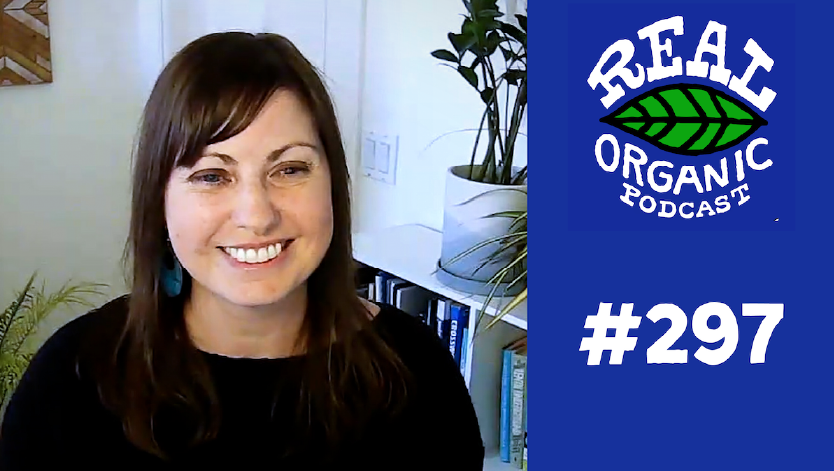
Corinne Hansch is proving that small farms can make a great living without getting big or surrendering control to wholesale markets. At Lovin’ Mama Farm in Amsterdam, New York, Corinne and her husband Matthew Leon have built a highly diversified organic farm that now grosses close to $700,000 a year, with most of their intensive production concentrated on just two and a half acres. Their model relies on direct sales, six farmers markets each weekend, year-round production, a diverse selection of crops, value-added products, and a willingness to continually rethink what actually makes the farm profitable. Corinne also shares what she has learned about managing employees, avoiding burnout, raising children on a farm, and using diversity as both an ecological principle and a business strategy.
Corinne Hansch’s interview has been edited and condensed for clarity:
You can subscribe and download episodes of our show through your favorite podcast app, our YouTube channel, or stream the audio-only version here:
Dave Chapman interviewed Corinne Hansch in Amsterdam, NY on June 22, 2026 after the Lovin’ Mama Farm Solstice Dinner:
Dave Chapman 0:00
Welcome to the Real Organic Podcast. I am talking today with Corinne Hansch. Corinne, thank you for taking the time on a very busy morning. I know you’re getting ready for market. Corinne, with her husband, Matthew Leon, runs Lovin’ Mama Farm in Amsterdam, New York. I had the privilege of being at one of your community gatherings last night, and we both spoke a little bit. First, tell me a little bit about your beautiful farm.
Corrine Hansch 0:35
Thank you so much for taking the time to come to our event and having me on your podcast. It’s a total honor. We’re so blessed to be on family land. I know it’s an incredible privilege, but we actually started our farm in Northern California in 2010 at a super rock-bottom moment in our lives.
Corrine Hansch 0:57
Our house was in foreclosure. My husband had lost his job, and we were just completely financially ruined. We thought, “We have nothing to lose, so we might as well start vegetable farming.” It had been a dream for a long time. He studied farming at The Evergreen State College in Olympia, Washington, and I had grown up on a very small market farm in Northern California. We just grew massive gardens for ourselves.
Corrine Hansch 1:19
We definitely had the farming bug, so when a friend bought some land, we asked him if we could lease a few acres. He said yes. We transformed an abandoned field into a really thriving farm by adding tons of compost. Then our landlord had a change of plans. We went through the whole losing-your-land thing that so many first-generation farmers go through, and we ended up falling back on family land, which we’re incredibly privileged to have.
Corrine Hansch 1:46
For that, I give thanks every day for access to land, but I’m also a huge advocate for first-generation farmers finding affordable land. It’s so hard to access land, and there are ways to get really creative working with land trusts. Here we are in upstate New York, and this land that we’re on is 120 acres. It is conserved with a conservation easement, so we are able to farm on 10 out of the 120 acres.
Corrine Hansch 2:12
I just really love farming on a nature preserve because, first of all, it acts as a great buffer. We’re surrounded by conventional farms that use treated seed and synthetic sprays. We have this beautiful buffer of trees and pastures around us that creates a buffer from the conventional farms around us, but they also are important habitat for the pollinators and the beneficials that we rely on to be organic growers.
Corrine Hansch 2:43
We started out on just a third of an acre, growing microgreens and trialing no-till here on our new farm, and we found huge success. Mendocino County is about the size of Rhode Island and Delaware combined, with a population of about 90,000 people. When we moved here to the Capital Region of New York, suddenly we were in a region with over a million people, and it just completely changed our lives, having access to that many eaters.
Corrine Hansch 3:12
Being in upstate New York, where there’s already a pretty strong local food movement, it’s just been really fast-paced growth for us on this new farm. I think having the five years of experience in Northern California really prepared us to set up our forever farm. I’m really glad we had those five years. As heartbreaking as it was to lose our land there, it prepared us for coming back here.
Dave Chapman 3:37
When you were in Mendocino, I’m curious, were you connected to a community of organic farmers?
Corrine Hansch 3:44
Yes. They had their own certification in the county called Mendocino Renegade. It was kind of similar to Certified Naturally Grown, but it was really specific to Mendocino farmers, and farmers certified each other. Actually, our certifier stored her hay on our farm, and she drove by our fields every single day.
Corrine Hansch 4:04
One day, Matthew was spreading, I think it was lime, but she wasn’t sure what it was, and she came out and grilled him. It was like, “No, this is organic lime. It’s okay.” But Mendocino Renegade, I feel, was stricter. It was probably really similar to Real Organic, definitely stricter than USDA Organic, and very focused on soil health.
Dave Chapman 4:22
Did it use the O word?
Corrine Hansch 4:26
No, because we get in trouble if you get that. We couldn’t use that word.
Dave Chapman 4:29
It was not calling itself organic.
Corrine Hansch 4:32
No.
Dave Chapman 4:36
Okay.
Corrine Hansch 4:36
Oh my goodness. No, we couldn’t call ourselves organic, but Mendocino Renegade had this really cute label of a farmer kind of doing a “yeehaw” jump with a hat on, and it was recognized in the county.
Dave Chapman 4:50
Customers, eaters, recognized it, and stores welcomed it?
Dave Chapman 4:54
Yeah. The co-op scene in Mendocino County is insane. Every little tiny town has a natural food store. I think that’s a big reason we wanted to live there. Healthy food was everywhere. People really appreciated good food there. It’s so spread out.
Dave Chapman 5:09
Were there certified organic growers in Mendocino?
Corrine Hansch 5:12
Yes, there was one or two.
Dave Chapman 5:14
I’m just curious, was there a tension between them, or did they just choose that? Why would someone choose to be certified organic instead of Mendocino Renegade?
Dave Chapman 5:29
The two organic growers that I know of were bigger wholesalers, and they were, I think, maybe sending some stuff to the Bay Area. I think it was just for that recognition in a larger market. But then the smaller-scale farmers who were just doing farmers markets tended to be Mendocino Renegade certified, or a lot of them did both because I’m pretty sure Mendocino Renegade was free, or very low cost. That was their big reasoning. It was like, “We want to be accessible.”
Dave Chapman 5:52
It was paid for by the county?
Corrine Hansch 5:54
No, it was a nonprofit. Either they got grants… It’s been a while.
Dave Chapman 6:01
Are they still in existence?
Corrine Hansch 6:03
I believe they are.
Dave Chapman 6:04
I have to look them up.
Corrine Hansch 6:05
Yeah, but it’s amazing. Even that word, “Renegade,” kind of triggers people a little bit. That is what I found, especially moving back East.
Dave Chapman 6:11
I can tell you, the Real Organic Project definitely triggers people. When we started that, we got letters from people who are now good friends, but they said, “You need to take your website down immediately because it implies that a lot of organic isn’t real,” which, of course, was what we were implying.
Corrine Hansch 6:33
Yeah.
Dave Chapman 6:34
Okay, so that’s very interesting. I’m sure there was a community supporting those farms, but there was also a community of farmers, so you were getting tips and lessons from other farmers.
Corrine Hansch 6:48
Oh my gosh, that’s crucial. Farmer to farmer, that’s how we learned everything. Then even some peers of ours who had kind of controlled the CSA scene in Mendocino, they kind of transitioned off of vegetables and into just doing pasture livestock, so they handed off their CSA list to us. The collaboration there was… it’s a very tight-knit community. There was not really competition. It was all collaboration.
Corrine Hansch 7:13
It was honestly really shocking when we moved here. We had to interview to get into the farmers market. We were so shocked. We had no idea because it was just so small-scale, and so open and collaborative out West. I know there are markets in the Bay Area that are very competitive, but in Mendocino it was just kind of an open door. If you just showed up that morning, you could go to the farmers market.
Dave Chapman 7:36
I’m sure having a low population base has a lot to do with that to be possible.
Corrine Hansch 7:43
Yeah.
Dave Chapman 7:46
Things kind of fell apart for the second time for you. First, your lives were falling apart, so you became farmers, which is kind of a funny solution.
Corrine Hansch 7:54
Right.
Dave Chapman 7:56
I have a friend. I haven’t seen her in years. She’s now a pretty famous author, and very successful. But I knew her when she was much younger, and I saw in an interview that she said, “Well, I was really broke, and I decided that, in order to make money, I was going to become a novelist.”
Corrine Hansch 8:12
A little ironic.
Dave Chapman 8:13
I was like, “Who thinks that?” And it worked. She became very, very successful. Okay, you came back here, and you started on a third of an acre.
Corrine Hansch 8:24
Yeah.
Dave Chapman 8:26
Very intensive.
Corrine Hansch 8:27
We started with microgreens. The Troy market only allowed us to bring microgreens that first year. But we were just moving. We had three small children. We were building. The field had been untouched for 20 to 30 years, besides being mowed, so we had to rip out grapevines. We had to rip out trees. We had to build a house, a pack shed, and roads. We built everything from scratch on this new farm in New York.
Corrine Hansch 8:53
We couldn’t really farm our first year. We just kind of had to build, but we were going to all the farmers markets in the area and trying to get to know the farmers because, as you said, we learned so much from talking to other farmers. We happened to meet the market manager one day.
Corrine Hansch 9:11
She had gone to The Evergreen State College as well, so we connected over that, and she was like, “By the way, we have an immediate opening for a microgreens grower.” We had no idea that Troy was so competitive to get into, but they hadn’t accepted a new vegetable grower for six years. We were like, “Sure, we can grow microgreens.”
Corrine Hansch 9:26
It was actually really hard. It took me a lot of time to figure it out, and I kind of made fun of them a lot at first, saying, “That’s rich people food. I’m just going to grow them for a little while and then transition out of them.” But we still grow them to this day. They’re a major backbone crop on our farm for year-round growing. But that was our foot in the door.
Corrine Hansch 9:43
We made $7,000 our first year just selling microgreens, which was exciting. We started in August, and then our first year on a third of an acre with the microgreens, we did $100,000 in sales, which we had never hit in Mendocino in five years of growing. Now it’s just gone way up since then.
Corrine Hansch 10:00
It’s so interesting, this question of scaling. I really think you can scale up through diversity on your farm. We manage 10 acres, and we’re slowly filling the whole 10 acres out, but our main field is a two-and-a-half-acre field. Most of our production is still in there. It’s very intensive, no-till. I don’t really fully believe in that word because we still use a rotary harrow, which is set really shallow, about an inch deep. It kind of creates the seedbed for us.
Corrine Hansch 10:36
Or we use the Tilther. We use the Iconoclast from Conor Crickmore. I love that. It just disturbs the top half-inch or inch of the soil, and kind of creates the seedbed. It basically does the raking. We were out there raking everything by hand at first, dumping the compost out of the tractor bucket, and then raking by hand. We already had the harrow. We were like, “Why aren’t we using the harrow?” We have to use some tools to be efficient.
Dave Chapman 10:57
The harrow only goes on a tractor, or is it on a walking tractor?
Corrine Hansch 11:01
We have one we imported from Italy that goes on our little Kubota, and it fits our 30-inch bed. We have two of them now.
Dave Chapman 11:09
Yeah. You do have some tillage tools.
Corrine Hansch 11:12
Yeah.
Dave Chapman 11:13
Low till and no-till I think of it as skillful till.
Corrine Hansch 11:20
Yes, agreed.
Dave Chapman 11:21
Careful tillage. There was that really interesting three-year trial of three farms in California. Basically, they had permanent beds, and they were just tilling a 10-inch swath down the middle with this little disc setup and a little chisel. Then they would flail the rest. They would flail everything, and then do their 10-inch pass and plant in it.
Dave Chapman 11:51
It seemed like it ought to work, but it didn’t. They had a 10% lower yield, and these were very, very professional farms. A 10% reduced yield was unacceptable. They did the whole trial for three years, and they really wanted it to work, but it didn’t work. There were interesting reasons why. But in this great conversation about tillage… I know at Full Belly Farm that they have more organic matter in their tilled field than they do in their fencerows.
Corrine Hansch 12:26
Interesting. If you’re incorporating cover crops, right?
Dave Chapman 12:29
That’s exactly right, and to be fair, they’re also irrigating them. It’s very dry there.
Corrine Hansch 12:36
Oh, yeah.
Dave Chapman 12:37
Okay. You have a very skillful use of tillage tools, light tillage, the top couple of inches.
Corrine Hansch 12:46
Yeah, very light uses.
Dave Chapman 12:49
Let’s talk about scale. I’ve been thinking a lot, Corinne. I’ve listened a couple of times to Jean-Martin Fortier’s talk last year at Churchtown. He talked about his basic model, which is very intensive, on a very small scale, using hand tools. He said, “We make a good living on an acre and a half.” Somebody on five acres would gross more, but they probably wouldn’t net as much. What’s the point of that? What are we doing here?
Dave Chapman 13:28
How do you think about that question of intensity and scale? He felt that when he went to five acres, not only did his productivity per acre go down, but he became his own competition in the marketplace because now he had to sell more and more, and he had to go to more mass markets, and more wholesale. How do you think about that?
Corrine Hansch 13:56
I think about it so much. Diversity, it’s kind of cheesy or whatever, but it’s so true. So, diversity on all levels on our farm, from soil health to crop selection to products to staffing to markets. The one thing I have a really strict boundary on is that I don’t wholesale. We only direct market. We made that decision a few years ago after years of running around trying to get chefs and co-ops to buy from us at a lower price. We’d rather add another market.
Corrine Hansch 14:34
My life really changed financially when we added multiple markets per day. We started doing three markets on Saturday and two on Sunday. Now we do four on Saturday and two on Sunday. We do six markets every weekend, and that just brings the cash flow to a point where you have the freedom to start making bigger investments, and making bigger decisions.
Corrine Hansch 14:54
For years now, we’ve really just focused our production on the two-and-a-half-acre field where we’re doing intensive… It was deep-mulch no-till for about eight years. Now we’ve stopped adding compost. We’ve stopped adding fertilizer. Our organic matter is so high, and all of our nutrient levels are so high, we haven’t had to add anything. We do add a little of micronutrients here and there.
Dave Chapman 15:13
What is your organic matter, just for peope…?
Corrine Hansch 15:14
It’s at 12% the last time I checked, which was three years ago. So it might have changed, but I’m not a huge soil tester. I love using intuition and common sense, like, “Are the plants looking healthy? Okay, good. We don’t need to do anything.” I think people can really overthink it and really get caught up in the science and the data, and it’s really helpful to have those things, but it’s also just helpful to use observation.
Corrine Hansch 15:40
But yeah, as far as scale, we are experimenting with kind of field crops and perennials. As we get more developed and as we get more established, we are adding more and more perennials: asparagus, raspberries, rhubarb, blackberries, and peonies. We planted 1,000 peonies a few years ago. They just came in this year for the first time, and major cash flow from the cut flowers.
Dave Chapman 16:06
All retail.
Corrine Hansch 16:07
All retail, yeah. I can get $4 to $5 a stem for peonies, times 1,000 plants. Each plant produces five-plus stems. They just get bigger every year. They grow for 40 to 50 years, so this is something my kids can inherit, this peony patch. It costs maybe $5,000 to buy all the stock up front. Then there’s the labor to keep it all maintained, but eventually they’re pretty hands-off. They don’t need irrigation. We planted them into tarps.
Corrine Hansch 17:16
Then we have living pathways in our bigger fields, in our perennial patches. We do a clover-based living pathway. The clippings we send onto the beds, so they act as mulch and a nitrogen input. That’s been really fun to experiment with. I think really focusing on the two-and-a-half-acre intensive annual production, and then, as we can add more perennials, we’re slowly experimenting with some field crops out in a bigger five-acre unirrigated field, but that’s slower.
Dave Chapman 16:56
Do you do CSA?
Corrine Hansch 17:16
We are trying to transition out of CSAs. We don’t do a traditional box. We do “Friend of the Farm,” we call it, where it’s like a buy-down CSA model. People pay $500 up front, get a $50 bonus, and then they can just buy whatever they want at our farm stand because we set up this stunning display, and everyone comes to market to get our stuff.
Corrine Hansch 17:39
For a long time, we were trying so hard with nine members coming up to the farm. It took me all day to harvest for nine people, and at the market I’m serving hundreds, or even thousands, of people every weekend, so it just made sense to transition them to the market.
Dave Chapman 17:05
The CSA is at the farmers market, and they basically have a membership, and they get a discount.
Corrine Hansch 17:58
We just have a simple spreadsheet. We just keep track of purchases, and it deducts them from their total. They have to spend it by the end of the year.
Dave Chapman 18:06
You don’t do it electronically. That’s fascinating.
Corrine Hansch 18:08
We will figure it out someday.
Dave Chapman 18:10
Yeah. I see some people where it seems that their computer… You just use a credit card, and they go, “Is that Chapman?” And you go, “Yes.”
Corrine Hansch 18:19
There’s just huge fees for all of those. We thought about getting the Square credit card system, or gift cards, but such a huge chunk of it would go to processing fees. It’s small enough. We keep it at under 50 members maximum, so we still know their names and recognize them. I love that, keeping it small. But it’s still 50 members times $500. That’s $25,000. I’ve met a lot of farms that take out an operating loan every spring. We just have 50 CSA members. That’s kind of like our operating loan. That’s how I see it.
Corrine Hansch 18:54
Another thing about scaling is the value-added products. When we decided to go year-round, it was because we got really tired of laying off our employees in the fall, and it just felt morally wrong. But it was also very scary. I put all this investment into these people and trained them. I really wanted them to come back, and it was the most horrible feeling to be like, “Sorry, we don’t have work for you for the next three months.”
Corrine Hansch 19:17
We made the decision to go year-round for our employees. We basically pass everything off to them. They run all the markets. Matthew and I get a break from doing markets. That’s the most labor I have, really, in the winter, running markets. Then we do winter greens, microgreens, and then we’ve slowly been building out a line of value-added products: just dried herbs, some canned goods, salsas, tomato jam, but mostly the dried herbs and dried flowers.
Corrine Hansch 19:45
We have a little line of merchandise now. But all those things really add up all throughout the year, especially in the winter. That’s another way to scale up. You don’t have to be a large farm to do it. You get a huge yield of dried herbs from a 50-foot bed that you can then sell year-round during the winter, and you can sell them online. We started an Etsy shop as well, and we sell dried flowers and herbs online.
Dave Chapman 20:09
All right. We have to make sure that works out for the Real Organic Project. We’re working on getting a marketplace online for Real Organic farms that are doing what you’re doing. We would not take the money. We would send them to your site, but they could go there if they wanted to say, “I want to find Real Organic dried herbs,” and they would go right to you. We’re working on making that stronger because a lot of farms now are doing direct sales.
Corrine Hansch 20:32
Online?
Dave Chapman 20:58
Yeah, online. King Grove Farm, the blueberry farm, does 100% of its sales online now. That’s in just three years. They went from essentially zero to 100%. It’s pretty amazing.
Corrine Hansch 20:59
It’s pretty cool, and it’s really empowering. I think we have to use technology to our advantage as small-scale farmers, and a lot of us got into farming because we’re just like, “We don’t want to be a part of that world. We just want to be on our farm and connect with nature.” But then you realize, “Oh, I have to run a business. I have to pay my employees. I want to pay my employees a living wage. I want to pay myself a living wage.”
Corrine Hansch 20:59
You have to get really creative in your marketing. Being able to access the entire nation as a market is so easy now by just using our phones. All you have to do is really just get brave, get on your phone, and make a video. You can create a whole following of customers who really care. You think about the population of our country. It’s a lot of people.
Dave Chapman 21:41
It’s 360 million, I think.
Corrine Hansch 21:44
There we go. There’s got to be a small percentage of that number that cares about Real Organic. It’s just about connecting with them and telling your story.
Dave Chapman 21:53
You’ve really been very innovative, and you’ve turned away from the way in which most people buy their food. Most people go to the store, or go to a supermarket, not a co-op. Even in Vermont, which is considered sort of an organic haven, most of the food is still bought in supermarkets, which means that most of it is not being bought from food grown in Vermont because the supermarkets are fairly closed to local suppliers
Dave Chapman 22:28
They’re getting more so all the time. As the stores get consolidated, it gets harder and harder to sell to them unless you’re a big national-level producer yourself. First of all, are you comfortable talking about your gross sales?
Corrine Hansch 22:49
Yeah.
Dave Chapman 22:49
Okay. What are you selling me here?
Corrine Hansch 22:52
We’re pushing 700,000 in sales. All direct market at farmers markets.
Dave Chapman 22:58
All direct marketing at farmers markets, with a little bit of CSA at the markets. People don’t come here to the farm to get their food, which is quite an exciting driveway.
Corrine Hansch 23:10
Yeah. That’s why our next project is that we just started a new business. We bought an old abandoned diner in the heart of our city, which is a really economically depressed city. It’s one of the poorest cities in New York State. It has more than twice the poverty rate of the average in New York State, Amsterdam. But we have beautiful architecture.
Corrine Hansch 23:31
It really had its heyday in the early twentieth century. It was a carpet mill city, so we have beautiful buildings. We have mansions. It was a very wealthy city up until the 1940s and 1950s. We have the infrastructure. We have these gorgeous brick buildings. But then they did urban renewal downtown. They built a mall right in the heart of the downtown strip and ripped out the downtown.
Corrine Hansch 23:52
Now the mall went under, and the Health and Human Services office is in there. It’s where people go to get their food stamps. There’s a dialysis center in there. It’s a very poor city. One in three people is food insecure, so there are very few businesses. There’s almost no businesses downtown.
Corrine Hansch 24:12
We’re taking a big risk, but because, as you said, our driveway isn’t accessible, we can’t have a farm store on our property. But our customers are ravenous for our goods. They’re always asking us, “Can I get your stuff midweek? Where can I get your stuff? Where can I get your stuff?” We’ve been hearing from our customers that they want access to our stuff more than just at the farmers markets.
Corrine Hansch 24:32
When this opportunity came up to buy this old abandoned diner, it was like our dream to have our kitchen where we could make our value-added goods, and then a retail space where we could sell our produce, cut flowers, and our canned goods. We’re also going to open a very small, simple café, basically just serving espresso and some pastries, while featuring our value-added goods.
Corrine Hansch 24:56
We’re going to serve tomato jam on toast with goat cheese and arugula. Just three different toasts. It’ll be very simple. The drive for that is that hopefully eventually we can retire from farmers markets. We’re kind of creating our own store. I feel like farm stores can be very profitable. Again, you have control over the price. You get 100% of the sale. Yes, there’s the overhead, but you’re not at the whim of the produce buyer.
Corrine Hansch 25:24
For me, when I was trying to market to restaurants, they would have a huge order one week of microgreens, and then nothing for three weeks. I’d have to take away product that was going to go to the farmers market to be able to meet these orders. Then I would amp up production and get no orders from them. It was like, “Well, if you guys made a standing order, I’ll keep bringing it to you,” but none of the chefs wanted to do that.
Corrine Hansch 25:48
There’s such a high turnover rate in the restaurant industry, where you connect with a chef, and then within three weeks they’ve moved to a different restaurant. Now we’re just creating our own restaurant. We have two businesses, so the farm can sell… We can get really creative with how we sell to the café and kitchen. If the café starts really doing great, I could see it buying at retail prices from the farm to support the farm so that the farm can retire from markets.
Corrine Hansch 26:18
But for now, six markets a week is really how we bring the cash flow in year-round, along with having diverse products. We grow 500 different varieties. We do cut flowers, we do microgreens, we do all the vegetables, we do herbs. We’re starting to experiment with fruit production a little bit, and berries. It’s all about the diversity. The more different products you can have on your table, the more you can be a one-stop shop for your customer. But then also just bringing really a lot of heartfelt connection to your customers.
Corrine Hansch 26:48
It’s almost like I have to have boundaries at this point with my customers because they want to come, and they want to have a full session with me. They want to do nutritional counseling, marriage therapy, and all this stuff. Maybe my heart’s been a little too open at the farmers market, so I’m learning a lot about how to have some boundaries with my customers. But I think also just creating that connection with them is crucial.
Corrine Hansch 26:48
Our kids have grown up at the farmers market. Now my adult kids work full-time. They’re amazing salespeople. They can set up a gorgeous display, and the customers have watched them grow up, just like the other adults who are running markets by themselves. It’s this really beautiful connection when you do make direct sales, where you really get to be quite intimate with your customer.
Dave Chapman 27:33
It’s wonderful. Our farm went the opposite direction. We essentially wholesale everything. We have a small help-yourself stand. I miss that. I miss the intimacy that we had when we had a roadside stand. We changed because of having kids.
Corrine Hansch 27:56
Yeah, it’s relentless.
Dave Chapman 27:57
I didn’t know how to do it. I didn’t know how to succeed at that because the way we did it took all of us. Let’s talk about that. I know that you’re very aware of the perils of burnout and not wanting to live a life in which you’re just frantic. You talk about 500 different varieties. That’s a lot to keep track of and organize. How many people work on your farm?
Corrine Hansch 28:22
It’s about 10 seasonally and five year round.
Dave Chapman 28:35
Ten additional seasonally?
Corrine Hansch 28:37
No
Dave Chapman 28:37
Okay. Ten in the summer and five in the winter.
Corrine Hansch 28:41
Yeah, but not everyone’s full-time. It’s probably the equivalent of maybe eight full-time people in the summer. That’s not including Matthew and me.
Dave Chapman 29:02
Those are people you can trust. Those are people who are good. That’s how they got to be on the core.
Corrine Hansch 29:55
Yeah.
Dave Chapman 29:06
All right. How do you feel about that franticness? JM in his talk was saying that when you go to five acres or 10 acres of vegetables, and you’re running tractors and all of that, and many of us have done that. I did that back before we went into greenhouses entirely. It was stressful. It was a glorious stress.
Dave Chapman 29:06
I loved it, but as I say, when our son came, I was like, “How in the world do you do this?” I really couldn’t figure it out, so we started to change the farm. You have your kids. You did figure it out. Does it feel sustainable to you personally?
Corrine Hansch 30:07
You have to look at it like a whole year rather than… Especially in New York, our season is so intense when it comes on. So I feel like the six months of the warm season are very intense. But I think, especially since we decided to go year-round and passed off markets to our employees, the winter really gives us that breathing room, where I feel like that’s when…
Corrine Hansch 30:33
I homeschool my kids as well. So I still have a 14-year-old who I’m homeschooling, and we do a lot of homeschool during those six months that are the cold season, maybe seven months. Looking at it in the bigger picture, like a whole year, yes, we work really intensively in the summer, but we have a lot of downtime in the winter. We end up filling that with a lot of other projects, like restoring the kitchen and writing books.
Dave Chapman 31:05
Buying new properties and building up new businesses.
Corrine Hansch 31:08
Yeah, it’s a little bit of addiction, I guess. For example, with the flowers, I have a crew that cuts all my flowers for me, so I just have to arrange them. It’s just learning how to pass things off and really focusing on getting people in positions where they’re really good because you really want to help your employees thrive and be doing something that they’re really good, fast, and efficient at, that they kind of have ownership over.
Corrine Hansch 31:39
So greenhouse management, I’ve passed that off completely to a woman who’s been working for us for six or seven years now, and she’s just reliable. I have a basic spreadsheet that shows her what to plant that week, and she just does it. I don’t even have to think about it. Really, my job is just writing the list in the morning, walking the field every day, doing the flower arranging, and being the maestro.
Corrine Hansch 32:03
Just organizing the chaos of 500 varieties and deciding what’s getting planted where. We like to mob things, where we have a team go in. They mob a bed flip, and they just rip everything out. It’s not one person out there alone. There’s something about this mentality of when you all get in there and do it, you can get through the work.
Corrine Hansch 31:08
But I think really staying small, I agree with you. I think if we were trying to do the scale that we’re doing on five acres, I think I would be very burnt out. But I think keeping it within this two-and-a-half-acre realm… Yes, there’s some perennials and some other experimentation, but we’re not reliant on those as our cash flow. They’re more like, “If there’s time.”
Corrine Hansch 31:08
It’s kind of experimental. The cash flow comes from that two-and-a-half-acre field, and that’s pretty dialed in at this point. Yes, we still work long days, but our kids work with us now, and they always kind of have. Our house is right in the center of it all, so even when my kids were little…
Dave Chapman 32:05
Did you pay your kids wages?
Corrine Hansch 32:33
Yes. Oakley remembers when I paid him $5 an hour, and he kind of tries to taunt me about that. He was like five years old. He was very young. You have to start somewhere, kid.
Dave Chapman 33:16
Both of my kids worked on the farm, probably starting at 10 or 11 dollars an hour. They didn’t work full-time then, but it was their money. Yeah, I paid them. It was their money.
Corrine Hansch 33:20
Totally. I think that’s really important.
Dave Chapman 33:32
They were good. My daughter still works on the farm. She’s very good. Excellent.
Corrine Hansch 33:41
Yeah.
Dave Chapman 33:38
It’s interesting because I’m thinking back to that talk of JM. You’re already way bigger than he would be in his model. I think in his model, they might have two apprentices. More like an acre and a half, not two and a half. It’s just interesting that these different scales are all quite different.
Corrine Hansch 34:05
Yeah
Dave Chapman 34:06
Tell me about trying to start a stand in a very depressed town. People still have to eat, whether they’re low-income or high-income, and they have to get their food somewhere. Right now, where do they get their food?
Corrine Hansch 34:26
We didn’t even have bus service until a few years ago. People living downtown were literally walking there. All of our grocery stores are in the strip-mall area, maybe three miles from downtown. People were walking up the hill to get their groceries and walking back, or taking taxis. Finally, we got a bus service in our city. That’s been really helpful.
Corrine Hansch 34:49
But Dollar General and Stewart’s are basically where people shop. We do have a little Dominican store that’s got great plantains. We get all our avocados and plantains there. They’re really a great service to the city. It’s a city of 18,000 people, and there’s so much need. We’re going to get really creative. I’m definitely going to accept EBT. I want to get as many subsidies as I can. There’s the Double Up Food Bucks program.
Dave Chapman 35:17
What’s EBT?
Corrine Hansch 35:17
That’s food stamps.
Dave Chapman 35:17
Food stamps, okay. SNAP.
Corrine Hansch 35:18
Yeah, SNAP. We will accept all of that and have as many subsidies for people on SNAP as possible. My other dream is to start a nonprofit someday. But yeah, I’m curious to work with… We’re exploring working with National Grid, which is our electrical provider and gas provider. They have a lot of funding for community renewal programs because it’s kind of to their benefit to help people.
Corrine Hansch 35:43
If people’s food bills are covered, they’re more likely to pay their electric bills. So National Grid has an interest in food security. We’re exploring with them how we can create some subsidized food boxes. I had one private donor give us a nice little chunk of change to do some subsidized boxes. I’m hoping to start that July one of this year, where we can just open the garage door to the kitchen and just have…
Corrine Hansch 36:08
I need to recruit 20 people, but I know who to talk to about that. I want to eventually grow to 100. I think a subsidized box is the way to go, where people can swipe their SNAP card for $10, but get a $25 box. They have a little skin in the game, a little incentive, and a little reason to show up, but then they’re getting access to this amazing food grown eight minutes away.
Corrine Hansch 36:31
Can you imagine a world where Real Organic farmers were subsidized to grow for hungry people? Couldn’t we solve so many problems with that? The environmental impact. That’s why I love farming so much. It’s because it has so many impacts. I get to steward land, I get to build soil health, sequester carbon, build habitat for pollinators, and it’s like a public health service, getting this nutrient-dense food to my community.
Corrine Hansch 36:58
Then I’m also creating living-wage jobs for my employees and a safe workspace for my employees. It’s like rural renewal. It’s just addressing so many needs. It’s like economic stimulation, rebuilding rural economies, stewarding land, and bringing public health. It’s just like a no-brainer. Like, why aren’t governments contributing money to keep this growing?
Dave Chapman 37:21
Of course, when Trump got elected, the first thing he did was cut out the program that allowed small farms to supply schools. It’s just such a good program, and it was such a shame to see that go. Maybe it will come back. Okay, that’s very inspiring. Do you have a sense of what the community’s attitude is? There isn’t such a thing as “the community.” It’s a very diverse group. But how do they feel about what you’re doing?
Corrine Hansch 37:52
In general, they’re very excited because in a city of 18,000 people, we don’t have a single independent coffee shop. It’s Starbucks, Stewart’s, and Dunkin’. I think people are leaving town. That’s a lot of people, 18,000 people, in our city. They’re leaving. They have to go to a nearby city to get a good cup of coffee. There’s a lot of excitement about the café, having a space to go and eat good food.
Corrine Hansch 37:52
I’ve definitely gotten some feedback. I did a lot of videos. We did a Kickstarter campaign to help us fundraise for the renewal of the diner, the reconstruction. We basically had to completely gut the space. It had been abandoned for five years, with a leaking roof. It needed to be completely gutted, and so it’s been a huge financial drain.
Corrine Hansch 37:52
But the community stepped up. We fundraised $36,000 through our Kickstarter. I was on Instagram every day making videos. It got a lot of attention, which was great, but a lot of people were maybe hurt that I was talking about Amsterdam being a poor city, which I get. It’s your hometown pride. It’s an interesting line to walk. I’m just being honest. It has more than double the poverty rate of the rest of the state. But there’s a way to say it nicely, I think.
Corrine Hansch 37:52
Even “food insecure” or “food desert,” those terms can be harmful to communities who feel like, “This is my home, and you’re calling it a food desert?” That’s kind of a negative connotation. Yet the media, the newspapers, and everyone wanted to do a story on us. That’s like a buzzword in the media. It’s like, “A food desert. A local farm is bringing food to a food desert.”
Corrine Hansch 37:52
Our local NPR station did a story on us. A bunch of newspapers and TV stations were really excited to talk about it. But then I got feedback from some community members who were like, “This is hurting. This is painful. What you’re saying about our city.” It’s a really interesting line to walk, and there’s also people saying, “Oh, it took a Californian coming in. How come no locals are doing it?”
Corrine Hansch 37:52
They point the finger at us a little bit because we’re not born and raised here. But ultimately I think our intention is to be a very welcoming place, non-toxic in all ways. I realized one of my employees is working at the kitchen a little bit with me right now, and he comes from the restaurant industry. He said he quit because it was such a toxic work environment. I was like, “Oh.”
Corrine Hansch 37:52
Again, layers of meaning. We have non-toxic food, and we’re going to be a non-toxic culture in all ways in how we welcome people. Like being wheelchair accessible is super important to us because we have some customers who are in wheelchairs, and we want them to feel welcome when coming to our space. We want moms with strollers to be able to come in. We want to accept everybody, regardless of political background or racial or ethnic background. This is a neutral place.
Dave Chapman 40:47
Yeah, good. I think before we go on, I just want to go back to the farming for a minute. I don’t recall seeing any cover crops on your two-and-a-half-acre field. Is that right? You don’t do cover cropping?
Corrine Hansch 41:01
Not in that space, no.
Dave Chapman 41:02
You’re just producing in that space.
Corrine Hansch 41:05
The crop is the cover crop.
Dave Chapman 41:07
You’re rotating, but you’re not growing your fertility in the sense of a green manure. So for that, you’ve relied on pretty heavy-duty composting. How did you make your compost, or where did you get your compost?
Corrine Hansch 41:25
We imported it all, so we bought it all in.
Dave Chapman 41:28
From somebody who makes compost.
Corrine Hansch 41:29
Yes, from a local supplier. He has actually since died. But after he died, we bought the last 200 yards of compost that he had, kept it tarped, and that was around year five or six on our farm. The way we established our beds was with about four to six inches of compost directly on top of the native soil. Don’t till it in, just plant right into it, and then between every bed flip we would add about an inch or two of compost.
Corrine Hansch 41:58
This was beautiful weed-seed-free compost. We kept it tarped, so it stayed really great. Then by year eight, that’s when we finally did another soil test and found that our organic matter was at 12%. We were like, “Okay, I think we can stop. I don’t think we need to add compost every round.” We were also using Kreher’s poultry fertilizer.
Dave Chapman 42:23
Pelletized chicken manure.
Corrine Hansch 42:24
Yeah. We stopped using that. We stopped using compost, so for the last three years we’ve added nothing. We did use a lot of peat in the beginning as well, which I know people are kind of like, “That’s so wrong to use peat.” The thing is, peat is a renewable resource. Maybe you’ve done a deeper dive into it than I have, but…
Dave Chapman 42:47
It’s problematic. It’s renewable, but very, very, very slowly. I’ve used a lot of peat too. It’s one of those many things that we ought to think about deeply.
Corrine Hansch 43:03
It was kind of like a one-time addition to our farm, and I feel like it lasts.
Dave Chapman 43:09
It does great things for your crop. You’re on the same kind of intensity, or almost as intense as we are. Everything is a different equation then.
Corrine Hansch 43:23
Yeah.
Dave Chapman 43:25
Okay, I want to talk about women in agriculture with you. We discussed it a little before, and it’s something that you’re very aware of as a woman. You’ve kind of come into this world, and you’ve learned great lessons from books almost inevitably written by men, and you’re saying, “Where are the women?”
Corrine Hansch 43:55
Yeah. Our crew is mostly women too, and so many people I meet are women farmers. I feel like women are really attracted to farming, really good at farming, and really taking a lot of leadership on farms. Yet in the influencer space or the thought leader space, I’m not seeing the women stepping up. I think it could be just because we have so many demands on us.
Corrine Hansch 44:23
Once we have kids, we also have mom guilt, where we’re just like, “I can’t go do something. I can’t go write a book because I need to take care of my kids.” But also, we don’t have a lot of role models to show us that it’s possible. Especially for me, growing up in the 80s and 90s, there were so few women in leadership roles, just across the board in everything.
Corrine Hansch 44:47
It’s starting to shift, but it’s still underrepresented in politics, in corporations, and in leadership, just across the board. It doesn’t matter what industry you’re in. We still see men really dominating. I’m not saying that it’s men’s fault. As women, we need to take responsibility, we need to step up, and we need to realize that our voices are powerful, our voices are needed, and we need to do it. We owe it to our daughters. We owe it to the next generation to show them that it’s possible.
Corrine Hansch 45:17
I’ve definitely received a lot of discrimination as a female farmer and as an organic farmer. Going into FSA offices, they see me wearing natural linen clothes, with long hair, and a shawl, or whatever. There are a lot of assumptions made based on how I look. The fact that I’m an organic farmer, and the fact that I’m female, I think I get set aside a lot by bankers, by USDA officials, by FSA officials, even lawyers, and even other farmers.
Corrine Hansch 45:51
Honestly, a lot of farmers, especially maybe the generation before me, who I was learning from and the one I was seeking guidance from, would always connect with my husband and assume that I was at home watching the kids, when actually we both… He’s an amazing baker. He bakes all the pies and does a lot of the homeschooling, and we’re very collaborative.
Corrine Hansch 46:11
We each have our roles for sure on the farm, but I do all the books. I do all the office work, and then the bankers want to talk to my husband about things. That is shifting a little bit, but it’s still just so deeply entrenched in our culture. Having a victim mentality is not where I want to be. You have to have awareness of it, but then it’s like it’s up to us to change things. So yeah, I wrote a book.
Dave Chapman 46:41
Congratulations. Okay, we will go to the book, I promise. But this is an interesting topic to me. My wife wrote a book on women in mathematics.
Corrine Hansch 46:52
Oh, cool.
Dave Chapman 46:53
Mathematics was a very male world, and she was a young mathematician. She wrote this book, and it’s the kind of book that women who are in mathematics really like. She writes about the first women who come in, and who they are, and then the second women, and then the third. They’re different. The first ones are very tough people.
Dave Chapman 47:17
They’re in a totally male world in which they’re very judged, and they’re not letting their hair down. They’re proving that they deserve to be there. Then, by about the third generation, they’re going, “You know what? Let’s change the world. Let’s really change it. Let’s change the whole culture.”
Dave Chapman 48:08
You’re not in that first generation. You don’t have quite that bitter a fight, but it’s still a struggle. Do you connect with other women farmers warmly? Like, from across the room, your eyes meet, and you go, “How’s it going for you?” When I see young people, like young women, they tend to be dismissive of feminism and say, “I don’t even know what people are talking about because I’m offered every job that the guys are offered.”
Dave Chapman 46:56
They don’t see it, but that’s because people struggled a lot to change things. I don’t mean that it’s over. I don’t believe it is, but it is much better. If you’re a young person, you’re not confronted with that. What’s it like for you to see somebody, a woman your age or an older woman, who is farming? I’m just curious. Do you go, “Here’s a kindred spirit?”
Corrine Hansch 48:51
Oh, yeah. Women love being in other women’s presence, for sure. But I think a lot of us, too, are so swamped with work that it’s hard to find the time to connect. That’s another reason I love doing farmers markets. We have these deep, heartfelt connections really quickly, in like a 10- to 15-minute window. But I have tried to build community. We’ve had potlucks where we go from farm to farm, and it’s usually the ladies who are all organizing it, and that’s been really special.
Corrine Hansch 49:14
I was Farmer of the Year for NOFA a few years ago, and in my keynote I said the words “uterus” and “breastfeeding.” Women started crying because I breastfed for years while farming, and I went out and started farming three weeks postpartum. I think it’s just important to speak to what it is, the experience of being a female farmer. Giving birth while farming… Well, maybe not while farming, but being pregnant and farming. All of these things, it’s just a different experience being female and farming.
Dave Chapman 50:02
Yeah. It was shocking that for the women in the audience, it was such a big deal that a woman was up there talking about it.
Corrine Hansch 50:09
Yeah. It was really profound. But I do think that women are just really well suited to run businesses. I think all the juggling that we do while being pregnant, raising babies, breastfeeding, farming, and getting a meal together, means we’re very good at multitasking, and so I think it really sets us up to be great business owners.
Corrine Hansch 50:35
As far as feminism today, I think it definitely has a bad name, like it’s against men, and that’s not what it is. I think for me, feminism is just bringing equality, but it’s also being okay with being your female self, being different than a man. Our bodies are different, and it’s okay. We can still do a lot, but I’m really grateful that my husband can do a lot of things that I don’t want to do, and that’s okay with me.
Corrine Hansch 51:09
To be a feminist and to be a powerful female farmer, it doesn’t mean that you have to do all the same things that a man does. We need to work together, and we need that male energy and that female energy balance. We all have masculine and feminine qualities within us, and so it’s just finding that balance of recognizing that you can be in a softer, feminine space and still totally crush business. It’s a fun space to be in.
Dave Chapman 51:40
Okay. We could have a whole interview on this. It would be worthwhile, but we promised ourselves we would talk about your book. So, please tell me about your book.
Corrine Hansch 51:51
I got approached by Chelsea Green Publishing after presenting for years at NOFA conferences – that’s my organic certifier, NOFA New York – and they said they were looking for three books: one on microgreens, one on cut flowers, and one on business in farming. I was like, “Okay, I’d love to write a book.” It’s been a long process. I got help with editing my book proposal.
Corrine Hansch 52:17
First, you have to write the book proposal, then you have to get accepted, then you write the book. You think you’re done. Nope. Then it’s the editing. But really, my intention behind this book kind of goes back to what we were talking about earlier. Having diversity on your farm means to me, how many different enterprises can you have on a small farm?
Corrine Hansch 52:37
It’s all about farmer profitability for me. That’s really the reason I wrote this book, was to give farmers another tool for profitability, because it’s so hard to make it financially as a farmer. I don’t know if you’ve heard about this conversation going around on the internet, “F* Farming,” where all these young farmers are just like, “Screw farming.” I get it. It’s this idea that it’s so romanticized.
Corrine Hansch 52:59
“I’m going to leave New York City and come start a ranch in the Hudson Valley,” and then suddenly it’s like, “Oh my God. It’s impossible to make a living.” But I feel like, again, that’s kind of a victim mentality. We figured out how to do it. Yes, we have free land access, but that’s part of the struggle – figuring out land that you can afford and then adding different enterprises on your farm that bring cash flow to make it all possible.
Corrine Hansch 53:25
We get into farming for maybe environmental reasons, especially organic farming, and then you realize that to really be sustainable, you’ve got to have the cash flow to make it all work. Microgreens fit that purpose of year-round cash flow from a very small space. You can do it in your greenhouse. Most small-scale farms have a propagation house. They already have that infrastructure set up.
Corrine Hansch 53:48
You can use trays that you already have, you can use potting soil that you already have. It’s a really easy thing to pass off to an employee. We’re bringing in about $1,300 to $1,500 a week in gross sales on microgreens year-round. It’s like a steady $60,000 a year that I know I can rely on.
Corrine Hansch 54:12
In my book, I don’t recommend just starting a business growing microgreens. I think that would be very hard to be profitable. I’ve seen so many small microgreen businesses start up and fail within a few years. It’s one of many crops on your farm.
Dave Chapman 54:25
That’s interesting. They fail because, as an isolated thing, it’s really hard to market them and get the value, unless you’re wholesaling big time.
Corrine Hansch 54:33
You got to go big, yeah.
Dave Chapman 54:34
But if you’re part of a mixed blend of greens and other intensive market garden-type crops, then it works, and you’ve got your loyal clientele.
Corrine Hansch 54:48
We really do. We come up with all these trendy mix names. I have this one called “The Purps,” that’s all purple microgreens, and people just go crazy over it. Another one is called “Detox Mix.” In my book, I talk about everything from seed to sale, branding, and how to pass things off to employees. Like I said earlier, when I first started growing them, I’d already been farming four acres, basically single-handedly, with my husband and three small children. I thought, “How hard can microgreens be?” But I failed again and again.
Corrine Hansch 55:11
This book is the first book really specifically for market farmers on microgreens. It’s also one of the few books in the vegetable space written by women. I was trying to find somebody to write an introduction to my book, and all the suggestions were men. We really couldn’t find a female author or thought leader who could write the introduction. I got some good blurbs from some ladies for my book, but it’s a very niche specialty…
Dave Chapman 55:51
Did you write an introduction, or did you do it yourself?
Corrine Hansch 55:52
We never got an introduction. My intention is to empower people to bring more financial stability to their farms. But I think microgreens can also be a gateway for people dreaming of farming. They could start a little grow room in their apartment if they live in the city. They can still kind of produce some of their own food. They’re very nutrient-dense, they’re very delicious.
Corrine Hansch 55:52
I think people also kind of make fun of microgreens, or they’re not valued, like, “You’re not a real farmer, you’re just growing greens.” I get that sometimes from maybe bigger farms or other activist-minded people who are maybe judgmental of growing expensive greens.
Corrine Hansch 55:52
But when you eat really nutrient-dense food, you realize a little goes a long way. So these packets of greens – yes, it’s $5 for 1.5 ounces – but these greens are so potent. You can make that last an entire week. For $5, you have all this nutrition coming into your diet.
Dave Chapman 56:59
You mentioned three things: cut flowers, microgreens, and business. It’s not about cut flowers, but it is about business also, in the context of microgreens?
Corrine Hansch 57:11
Yes.
Dave Chapman 57:12
Was that fun to write about this?
Corrine Hansch 57:16
Yeah, but I did get in a little trouble with my editors when I encouraged people to use their intuition for business. They thought that was bad advice. But the editing process was so fun because the first time through, I was protesting, like, “I’m done. I wrote the book. I don’t want to have to go back and look at it again.” But it really helped me just dive deeper into what I really want to express to the world.
Dave Chapman 57:41
Who was your editor?
Corrine Hansch 57:42
Chelsea Green. Natalie.
Dave Chapman 57:44
I don’t know Natalie.
Corrine Hansch 57:45
Yeah, my editor’s great. Like, “What do you mean? What do you mean by this? What do you mean by that?” But it makes you dig deeper and really express what you mean. I changed the word “intuition” to “common sense,” because I think it’s okay to use common sense.
Corrine Hansch 57:56
Yes, you can get all the spreadsheets and all the data and crunch all the numbers, but honestly, when you’re managing 500 crops, I don’t have time to do all of that. It has served me well, obviously. Our farm is grossing $700,000 a year with me using common sense. I think that’s proof enough that it works.
Dave Chapman 58:21
It’s an interesting thing. Maybe we mentioned this yesterday, but I’ve been reading a lot about systems theory, looking at the book “The Limits to Growth.” And what is it telling us? Boy, is it a big topic. One of the things that it’s bringing up is the difference between reductionist science and holistic science. And what is holistic science? It’s a really interesting question.
Dave Chapman 58:53
But there certainly are things that are true that we can’t prove with reductionist science, or disprove. We can’t know them that way. Not to say there’s anything wrong with reductionist science. Just as Wendell Berry said, “Just don’t confuse it with reality.”
Corrine Hansch 59:10
It’s one piece, right?
Dave Chapman 59:12
It’s a way of looking at reality and learning valuable things by trying to isolate different factors and see, “What if I change that factor? What if I change that?” But when you look at the whole thing, you can get very different results, and things that make you go, “How did that happen? How did the Knicks win the basketball game?”
Dave Chapman 59:11
The chances of them winning in the last 10 minutes were like 0.4%. The likelihood that they would win was 0.4%, and the likelihood that they would lose was 99.6%, and yet they won. The numbers don’t always tell the truth. They tell one way of looking at the truth.
Corrine Hansch 59:35
Yeah. It’s helpful. It’s a tool. It’s good. Awareness is never a bad thing. Awareness is great. But like you said, I think that’s the key to success on the farm, looking at the big picture. You have to have the eagle-eye view, but you also have to be on the ground, looking at each particular crop as well. I think that’s part of the joy of it, the constant problem-solving, all the different hats that I get to wear.
Corrine Hansch 1:00:18
From the business perspective, being an employer, the community, and the environment, it’s all these different… I definitely feel like a conductor, a maestra, for sure. It’s like all these different moving parts. When you see it all working together, it’s the most amazing feeling.
Dave Chapman 1:00:41
Before we go, what’s the full name of the book, and when is it coming out?
Corrine Hansch 1:00:47
“Microgreens and Shoots,” and then it has a long subtitle that I can’t remember. “Microgreens and Shoots.” It’s very straightforward from Chelsea Green Publishing.
Dave Chapman 1:00:58
When is it coming out?
Corrine Hansch 1:00:59
The end of September. It’s available for pre-buy now. I’m just super excited to share some knowledge.
Dave Chapman 1:01:07
Good. I’m supposed to read it. I’m sorry I’ve been so slow. I will get there.
Corrine Hansch 1:01:14
It’s okay.
Dave Chapman 1:01:15
Well, Corinne Hansch, thank you so much. I’m going to release you and let you go back to your busy crew getting ready for how many markets?
Corrine Hansch 1:01:24
Six.
Dave Chapman 1:01:24
Six markets. You do all your harvesting today for both markets?
Corrine Hansch 1:01:30
Thursday, we do roots, so we do the beets, radishes, scallions, carrots, and any of the roots we can. They’re pretty hardy. We have a really amazing walk-in cooler that’s perfect. They go right into the cooler, stay there, and then today we do the more perishable crops. We do the greens, anything that we didn’t get to yesterday. The first flat of tomatoes is coming in this week. We have sugar snap peas to pick, broccolini…
Dave Chapman 1:01:54
They’re delicious.
Corrine Hansch 1:01:55
Oh, so good.
Dave Chapman 1:01:56
They’re delicious. I was grazing in your garden yesterday.
Corrine Hansch 1:02:00
Oh, good.
Dave Chapman 1:02:01
All right. Well, thank you so much.
Corrine Hansch 1:02:03
Thanks, Dave.
Dave Chapman 1:02:04
All right.
More Podcasts
View All Podcasts ➔