
Episode #285
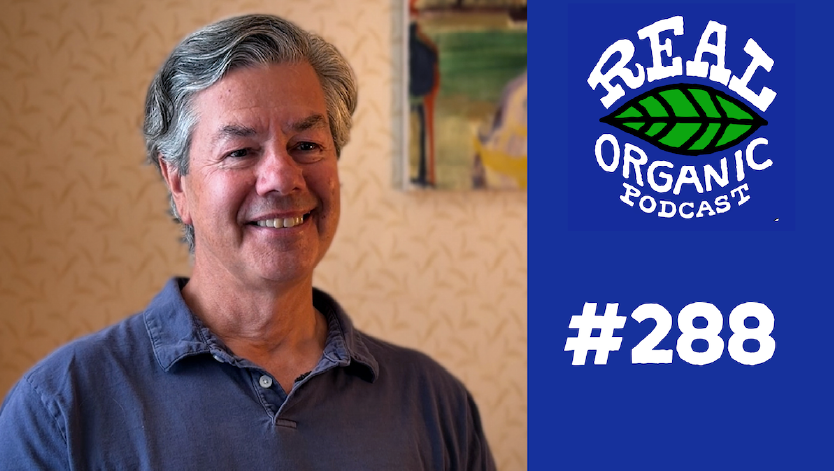
Mark Doudlah: From Glyphosate + Cancer To Real Organic
Mark Doudlah spent years as a successful conventional farmer in Wisconsin, fully committed to the chemical model he had been taught would feed the world. After his father developed mantle cell lymphoma, also called “the cancer of the midwest” Mark underwent a painful reckoning around the big cost that chemical agriculture had demanded farm families like his own should bear. A cost that includes glyphosate in their bodies, cancer in their communities, and the ongoing contamination of water and food all around them. Mark made the quick, firm decision to become a dedicated organic farmer without looking back. Today, Doudlah Farms Organics grows dry beans, popcorn, ancient grains, and milled products on more than 1,800 transitioned (to organic) acres, proving that Real Organic farming can work at meaningful scale.
Our interview with Mark Doudlah has been edited and condensed for clarity:
You can subscribe and download episodes of our show through your favorite podcast app, our YouTube channel, or stream the audio-only version here:
Dave Chapman interviewed Mark Doudlah in winter 2026
Dave Chapman 0:00
Welcome to the Real Organic Podcast. I am talking today with Mark Doudlah. Mark, thank you for making the time to talk. This is already a pleasure.
I first heard you about two weeks ago when you were in Washington on the steps of the Supreme Court, speaking at a rally, the People versus Poisons rally, and I should have been there. I didn’t know about it, and a friend, Max Goldberg, told me about it, and he said, “Yeah, I think there was a farmer from Real Organic there,” and I thought “Really?”
Dave Chapman 0:38
I looked it up, I listened to the whole rally, and I heard you speak, and I was really moved.
I was especially moved by what you said. I thought, “I really want to talk to this guy for the podcast.” You told a story of your farm’s evolution from being a conventional chemical farm to becoming a deep organic farm. I’d like to let you tell that story. I have a lot of follow-up questions, but what was life like before, and then what happened to change it?
Mark Doudlah 1:14
First, thank you, Dave, for everything that you guys do at the Real Organic Project. It’s so special. It’s sad that the seal has been contaminated, and it’s really, really difficult to do what we’re doing.
But I just want to start out with what we do here. I was a little kid on a Wisconsin farm. Moved out to the farm when I was three years old.
Mark Doudlah 1:15
The first job that I remember was my dad put me in his brand-new 1972 Chevy pickup truck to pick up bales of hay. I couldn’t reach the clutch pedal, I could barely see over the dash. The steering wheel was way above me, and he was picking up elevator bales that had gone over the wagon.
Mark Doudlah 1:21
I guess that’s probably where I got imprinted and got the disease of farming. It becomes a disease. You can’t take a pill and get rid of it. It’s just certainly embedded.
My dad, over the years, was my rock. He was really my mentor. He taught me to think outside the box. He was always an early adopter, and we did a lot of things. But tragically, in 2008, that all changed.
Mark Doudlah 2:48
We knew something was off that fall. He got diagnosed with mantle cell lymphoma, which is literally a cancer of the Midwest that we have here today. He went through some really difficult times, and we transitioned 40 acres in his honor.
Mark Doudlah 3:10
The first year, we were miserable failures. Actually, the first crop of organic beans, we combined the weeds off the top, and then a month and a half later came back and combined the beans.
Since then, it’s been drinking out of a fire hose, and we’ve really learned a lot along the way about how important healthy, nutrient-dense food is, and safe food.
Mark Doudlah 3:41
That’s been my paradigm shift. I thought I built my house on a rock, but I built it on sand. The sand washed away, and I realized that this chemical farming, and everything that I was programmed to believe, ultimately was a lie.
Dave Chapman 4:02
Mark, when you gave your talk at the Supreme Court, it really came through that you were proud farmers, that you were good chemical farmers. Just to say that you were doing it really well, and you believed in it, and, as you put it, you believed you were feeding the world.
Mark Doudlah 4:21
Absolutely. I remember my dad saying over and over, “Earl Butz.” How do I know that name? I was born in 1965. I don’t know if the Nixon administration – that’s really dating me – was in the late 60s or where it was, but “fence row to fence row,” and how proud we were to feed the world. I really bought it, hook, line, and sinker. Nixon and Earl Butz, and we got to do this, and it’s your role, it’s your mission.
Mark Doudlah 4:21
They didn’t really appreciate at the time that it was actually a chemical company’s mission. It wasn’t really our mission. I had been duped, and it wasn’t until meeting Don Huber, the godfather of the glyphosate movement, and everything that I really realized how much of a wool I had pulled over my eyes, and it couldn’t have been farther from the truth.
Mark Doudlah 4:40
Tragically, our fellow farmers are trapped there today, between buying the glyphosate and then having that bag of chemotherapy hung up that is the same company that you bought the glyphosate from.
Dave Chapman 5:41
You said when your dad was being treated that the chemo he was using was actually from Bayer.
Mark Doudlah 5:50
Yeah. We spent over a million dollars trying to save Dad’s life, and he got three really awful years. I remember dressing his open wounds, where you could see his veins, his blood vessels, and his muscles move with Manuka honey, knowing that that wound was never going to heal. The radiation burns from taking him every other week to get a different growth treated and burned off.
Mark Doudlah 6:25
Then the daily reminder when you change the saline solution going directly to his heart’s PICC line, and you change that with saline solution so that when he needed to be injected again with chemotherapy, that line was open and it hadn’t plugged itself off. It’s really scary, because when you’re doing that, you can’t get any oxygen or any bubbles in that line whatsoever, because you’re injecting it right into his heart.
Mark Doudlah 6:59
Tragically, I remember him explaining what it felt like when he got those chemotherapy treatments. He explained it as literally a lead blanket just slowly being draped over your body, and the weight, and just being trapped inside that body, not being able to do anything. Of course, that chemo is all about killing. It’s sadly more of the same, and I think we killed our dad with more of the same treatment chemistry.
Dave Chapman 7:36
That cancer he had was a kind of non-Hodgkin’s lymphoma.
Mark Doudlah 7:44
Yep, mantle cell lymphoma, and we have neighbors across the fence line that have it that don’t have any common job history that Dad had – electricians that have it. We know a whole bunch of people with mantle cell lymphoma, the identical cancer. That kind of disproves the myth that…
Mark Doudlah 8:09
Dad also worked at an auto assembly plant at General Motors in Janesville, and there certainly could have been some exposure there, but that doesn’t take away the neighbors that never had those jobs – one of them a housewife who died of the same disease. I think it’s clear that it’s agriculture, and it’s the Mississippi River Valley Basin.
Mark Doudlah 8:35
Unfortunately, we’ve contaminated most of our drinking water, a lot of the surface water, and, as a matter of fact, we have a Gulf hypoxia problem where shrimpers have to go 90 miles to get to their shrimp beds. That’s a function of what I did up here in Wisconsin. We were proud chemical farmers. Today I’m drinking what I spray; it’s in my well.
Dave Chapman 9:03
Yeah. Have you ever had yourself tested for glyphosate? I’m just curious.
Mark Doudlah 9:08
Yes, we have. I urge everybody to do it, because I’m told that the average American is about 12 to 17 parts per billion. Our test was 13 parts per billion.
The good thing is we don’t need the research. We know the fix. If you go on an organic diet, a strict one, you can change all those metrics in less than two weeks. Your health metrics change, so we know the solution.
Dave Chapman 9:42
Tell m where you learned that. Where did you learn that in two weeks there could change?
Mark Doudlah 9:46
There’s been a lot of research done on schools, and they’ve flipped their diets to organic, and their households to organic, and then they trace these kids and the mother and father over time. They did their blood work every week, and in as little as two weeks, 90% of your health metrics end up changing.
Mark Doudlah 10:11
That’s a little bit of hope that I have today in the chemical world that we live in. If we just stop with the toxicity, our bodies are God-given, miraculous machines that can heal themselves. But there is a point, we are incredibly resilient, but there is a limit. There is a toxic threshold that we need to stay below if we’re going to live up to our God-given potential.
Dave Chapman 10:42
Yeah. We see so many health problems, so many mental health problems. We see our fertility plummeting. We’re getting hit.
I’m curious, you live in Wisconsin, you live in a farm community, and you’ve made a pretty dramatic decision to farm differently, and I will talk about how you farm.
Dave Chapman 11:08
I’m curious what the community thinks. Do your neighbors look at you as a weirdo? Is there anger, or do they just go, “Hey, I think he’s maybe onto something”?
Mark Doudlah 11:21
I was a proud chemical farmer, and there is so much cognitive dissonance. I didn’t want to believe that I was killing people the way I was farming, and that’s really hard. That is a commandment: “Thou shalt not kill,” and we’re killing people with food, much as it was in the Bible with temptation with food as well.
Mark Doudlah 11:51
It’s a hard feeling when you walk into a coffee shop and it goes quiet because a lot of them don’t… Just like they’re trapped, I was trapped. I didn’t want to believe I was part of a problem. I thought I was the solution. I’m feeding the world. I truly didn’t realize at what cost that was, and so it has been difficult.
Mark Doudlah 12:23
But what’s interesting is a lot of my neighbors that come by and drive by the area, they can point out all of my fields. They say, “Well, is that your field? Because that’s the only green field in the spring around here.” That’s very interesting, that a lot of outside people can see that it’s about cover crops and living, diverse species on our landscape, really in the spring, and how important that is when everything else is brown and dead. People do notice the difference, and they can see it. I guess we are slowly making a change.
Dave Chapman 13:16
Yeah. I think organic as a food that people are turning to continues to grow dramatically every year, certainly in the general population. There’s a lot of interest in organic food – some alternative to food that’s been sprayed.
I think most people haven’t gotten as far as nutrient density. They’re still just, “I don’t want to eat something that’s going to make me sick.”
Dave Chapman 13:48
But their understanding hasn’t gone as deep as, “I want to eat something that’s going to make me healthy,” which is the other half of organic, I think of it: don’t do these things, but do these things, which is going to grow better food. That is less obvious to people.
Mark Doudlah 14:08
Yeah, I think you’re absolutely right. We’ve missed this whole thing. We have a tongue for a reason and taste buds for a reason. Nutrient density is flavor.
I guess I really became aware of that in the biodynamic Demeter movement that we’re a part of. We’re a biodynamic farm, and the wine country got it in this country early on.
Mark Doudlah 14:42
Nine out of 10 people could tell the difference between a Demeter wine and a conventional wine. That’s flavor, and flavor comes from nutrient density. That’s why we eat, and I think that’s a big, big part of it.
I’m always amazed by the dairy cow. You can free-choice minerals in a dairy cow in individual boxes, and she’ll eat just the one she needs, and when she eats enough of that, she may eat the whole box, but when she finally gets to what she needs, she stops.
Mark Doudlah 15:22
How is it possible that cows are so much smarter than humans for what we’re eating?
We’ve got to get back to some of these basics and not hijack our minds. I sadly think food scientists that prey on us for fat, salt, and sugar honestly need to be locked up.
Mark Doudlah 15:52
That’s something that we need to stop, and we need to change our food supply, and we need to get back to Real Organic and, more importantly, whole foods. It’s so critical.
Dave Chapman 16:08
Paul Hawken has called that ultra-processed industry a literal crime against humanity – not being poetic, that it’s right up there.
When your dad died, how old were you?
Mark Doudlah 16:28
Oh, let’s see. I guess I was in my early 40s, late 30s. He was 73 years old when he passed away. That was 2011 when he passed away. We had transitioned 40 acres in his honor, and since then we’ve transitioned all of it – over 1,800 acres – trying to bring the scale of organic to consumers. It’s been quite a journey.
Dave Chapman 17:19
I’m sure it was a bit of a revolution in your thinking. What changed in how you thought about farming, about solving problems? I’m really interested, because you were not a kid; you were somebody who had farmed chemically for a long time. You were good at it. Then you became a good organic farmer, and that transition, I’m sure, was pretty bumpy, but on the other side of it, what were the things that you learned? You were like, “What was I thinking? I need to think of it this way.”
Mark Doudlah 17:57
I got to step back just a little bit in this dialog here, because I remember I was still in college at the University of Wisconsin–Madison, an ag mechanical management student, in the business side of engineering. I got a phone call from my neighbor – oddly enough, his name was Bill Porter. He had been hearing from his relationship with Warren Porter about things that they had been measuring in Lake Okeechobee, including the length of penises of alligators and crocodiles.
Mark Doudlah 18:47
My neighbor wanted to get a hot tub, and he had been talking to Warren Porter, and Warren said, “Well, you better know what you’ve been soaking in if you get a hot tub.” Anyways, I remember that phone call well. It was early in the morning, a Saturday morning, and I came home every weekend to farm, and got that phone call. I have to admit that that was the seed that got planted, and I was a chemical farmer for many years after that.
Mark Doudlah 19:22
I humbly laughed about it, and my dad and I laughed about what they were talking about – penis lenghts in Lake Okeechobee alligators and crocodiles. It was like, what? I didn’t really understand at all, and thought it was a joke, because remember I was feeding the world, and we had to do that at all costs.
Now today we know that atrazine, and I believe there’s a study out of California that looked at atrazine in frogs…
Dave Chapman 20:01
Tyrone Hayes. He’s going to be speaking at our conference in September. I’m curious. Warren Porter, he’s a researcher?
Mark Doudlah 21:12
Yeah. He’s a UW Madison zoologist that did a lot of this fundamental research and worked heavily with Don Huber and others decades before anybody even knew what they were talking about, much less Trump making glyphosate a household name by signing it.
Mark Doudlah 21:39
Ironically, isn’t it interesting that it’s a national security issue, but the reverse of that couldn’t be more true? The more we use of this, the more it becomes a national security issue. It’s wiping out our military; it’s wiping out our kids. We can’t even get enough recruits who can meet military specs out of our high schools because of how we’ve contaminated the food, the pesticides we’ve put in the food.
Mark Doudlah 22:14
Sadly, the cost of this is very similar. It’s a choice. Do we want to put a police officer in every high school because of disciplinary problems and special ed teachers, or do we want to just flip it to organic food and let them have the potential to be honor students? Do we want sick care, or do we want kids living up to their God-given potential?
Mark Doudlah 22:44
I think it’s so simple. We don’t need any more research – we know the way: just flip the script, go to organic, we can do it, and we can do it at scale. I think it’s really, really important.
Long-winded here, but that was a big part, and then, of course, in 2008 when Dad got mantle cell lymphoma, all this came back to roost, and I was in denial. I didn’t want to believe it, yet I knew fundamentally that it was true, and so we learned about biology. We drank from a fire hose.
Mark Doudlah 23:30
The great thing is, thank God I can’t reach back to my great-grandpa and ask him how to farm – that’s a tragedy in this. We’ve lost that, but I also don’t have to farm the way they did. We’re using 30–40 satellites. We have RTK on our tractors, we have sub-inch accuracy, we can turn around in our tracks and drive in the same track. We have camera-guided cultivators.
Mark Doudlah 23:43
We have weed zappers now, and we also have some new things coming too: lasers, directed energy.
Now I’ve got to be careful because I don’t want to trade chemical agriculture for Silicon Valley and that corporate capture. We really have to think. But the technology that we have today is so much better than when our great-grandfathers farmed, that we’re using cover crops, we’re using prescription tillage, we’re doing all of these things to get to biology.
Mark Doudlah 23:44
Most of the things in the soil haven’t even been named. We’ve probably named more galaxies than we’ve named things in the soil. As we go infinitely vast, we’re going to go infinitely small. The more I know, the more I realize I don’t know.
Dave Chapman 24:51
Yeah. Have you developed a community of people working on this with you? I know you’re working with John Fagan from the Health Research Institute. I’m just curious, do you have a network of organic farmers who are pinging and talking to each other?
Mark Doudlah 25:11
Yeah, we do. That’s over the internet, because we’re not next-door neighbors, but that’s great. There’s a bunch of Facebook groups, organic farmers groups. The University of Wisconsin–Madison is doing a good job, believe it or not, leading this. I see it kind of coming together, and we’re getting a network of people, and that’s extremely helpful, and there’s a lot of outreach as well.
Mark Doudlah 25:45
I think we have way more tools than when I started in 2008 that are available to us, and that’s just fantastic. For us, it’s about what we call sheet composting on our fields for biology, so it’s kind of biodynamic farming. I can’t take credit for this – this is Gary McDonald out of Illinois, who taught us this.
Mark Doudlah 26:18
Basically, take a cover crop that you planted in the fall or even in the spring, but usually in the fall, and take that and shred it knee-high, hip-high, shred that down to the ground with a flail into really small pieces so your microbes don’t have any indigestion.
Mark Doudlah 26:40
Microbes don’t have any legs, so we pull a disc behind that immediately to incorporate all those sugars and all the biology, and the saps and the bacteria just rev way up, and they eat that green manure in about a week’s time.
Then we “turn the compost,” and we will go through and disk that one more time, and then we wait another week and we field cultivate and plant.
Mark Doudlah 27:12
Rather than hauling all of this material to a compost bed and the energy intensity of making a compost pile, we prefer to sheet compost in the field and rev up our biology rather than letting them be lazy. Once they eat all of that green material and the juices and the sugars, they also go after the weed seed after that. Then of course your crop’s there, and then we’ve shaded.
Mark Doudlah 27:43
We’re not talking deep tillage; we’re talking two to three inches. We’ve also done a lot of no-till crimped cereal rye, and that works fantastic with soybeans. But you’ve got to remember, we’ve bred soybeans for so long – you can drive over a soybean with a tractor tire and it’ll make a crop. You can’t do that with dry beans. We don’t have the genetics yet; they’re more like shrinking violets. Since we’re growing food, we’ve had to go back to a little bit of tillage and biodynamic farming methods.
Mark Doudlah 28:21
We’re using this sheet composting, what I call in-field sheet composting, as our way forward. Interestingly enough, you mentioned John Fagan of HRI Labs, who has the tested clean label that we use. We test for 222 pesticides, including glyphosate and AMPA at parts per billion.
Mark Doudlah 28:43
Our popcorn, believe it or not, is non-detectable at parts per billion. Simply amazing. Our dry beans test about 1.1 on the glyphosate AMPA scale, but John says anything 30 and less should probably be considered organic. On our dry beans, we’re about 1/30 of that standard.
Dave Chapman 29:08
Mark, just to explain to people, because people don’t understand – that little residue is not because you sprayed it; it’s because it’s coming in through the air, the water, and the rain, right?
Mark Doudlah 29:22
Yeah. That’s where I was headed with this conversation, because we used to use CAFO manure when we started out in this early on. We were hauling chicken manure in. We later found out by using tested clean and testing for this in your food that five tons of manure was equivalent to a glyphosate application.
Mark Doudlah 29:52
That’s why we’ve also gone to Demeter Biodynamic farming, treating our whole farm as an organism, and we no longer bring things in from the outside. I don’t want to contaminate my soil or my fields with pesticides from lawn clippings or GMO manure and whatnot.
That’s why we went to seed – the only thing that we haul in now is seeds.
Mark Doudlah 30:29
My son Jason, who would be a sixth-generation farmer, has 13-, 15-, and 17-way cover crop mixes that we do the sheet composting method with. He’s just really brought our A-game to what we’re doing and really helped with nutrient density and, of course, safety. That’s so critical. If it wasn’t for HRI Labs, we wouldn’t have figured it out.
Mark Doudlah 31:04
Now, your question about did I spray that or did I not, well, in sandy silt soil we know it’s three to five years, so maybe not on our sandy soil, but on clay soil we know that glyphosate can last for 25 years. Oddly enough, that’s why Germany rejects a lot of our organic almonds, even though they’re certified organic. They’re still testing positive for glyphosate because when you harvest almonds you don’t want a blade of grass under the trees, and so for decades they’ve used a lot of glyphosate. We’re still finding that in the food system, so it’s really important.
Mark Doudlah 31:44
Now we are learning that a little bit of drift can have a big impact, and that is one of the challenges. I’m in an ocean of GMOs and an ocean of glyphosate, and most of my neighbors know that we’re organic farmers. We also put a 40-foot buffer around most of our fields of native prairie- diverse native prairie for the habitat of bees, rare, endangered, and threatened habitat, but also to give us a little bit of buffer if there is some drift over that fence line or through the trees onto our fields. That’s very important.
Mark Doudlah 32:30
There’s a study that we’re trying to figure out, replicate, about drift. That a lot of the nutrients can be reduced in the food you’re growing with just a slight drift of glyphosate herbicide. We’re hoping that… we have to treat this as responsible farming. If you’re over 10 miles an hour spraying in the wind, you’re off-label. That needs to be enforced if we want to have clean food.
Mark Doudlah 33:08
So I really support a program like Countdown to Zero. Let’s give these chemical farmers an off-ramp, and let’s count down to zero residue in our food. Let’s give them a chance to do it the right way. Let’s spray on the right days. Let’s make sure that we’re not getting it into the food. Let’s stop pre-harvest desiccation – all these things. These are low-hanging fruit that could have a huge impact on human health in this country. And all it takes is a ballpoint pen and some political will.
Dave Chapman 33:48
The political will is the hard part. I’ve got the pen, but the political will, that’s what you were doing on the Court and the Supreme Court steps.
That’s right.
Mark Doudlah 34:01
It wasn’t that many years ago we were here with DDT and the bald eagle, and we banned DDT and saved our national emblem. I hope we have the guts to do it for our kids.
Dave Chapman 34:17
Could you describe how your farm has changed in terms of your crop mix. Were you always growing beans?
Mark Doudlah 34:30
Once again, we fell into the industrial trap of “Let’s grow corn, soybeans, and wheat as a rotation.” I realized that the corn and soy were largely going for animal feed, and we weren’t really feeding anybody. It’s like where Iowa is at today – that the great state of Iowa is not able to even feed its population within the state.
Mark Doudlah 35:07
We switched out of that model with help from, believe it or not, Chipotle Restaurant. Chipotle Restaurant wanted organic dry beans, and we wanted to grow food, not feed, so we started doing dry beans. We worked with a great company, Chippewa Valley Bean, and they helped us out. We didn’t understand specialized combines and all this stuff, how to grow them, how critical it was, how to dig them, how to combine them, and then later we swath them.
Mark Doudlah 35:42
Chipotle Restaurant had a transitional premium. Let’s say black beans were selling for 30 cents a pound conventionally; they would offer a 25-cent premium if they were transitional because they were worried there wouldn’t be enough beans to go in all the burritos that would be organic someday.
Mark Doudlah 36:06
That really helped us transition and pull, and that’s a fantastic way to help organic farmers through the transition process, which is incredibly difficult. Chipotle Restaurant actually was the pull for our farm at that time.
Since then, we’re growing 10 classes of dry beans – we’re talking blacks, pintos, dark red kidneys, cranberries, Great Northerns, navies, and yellow beans. We’re growing all of that diversity.
Mark Doudlah 36:46
Then we also grow white and yellow popcorn, and then we also have all the milled products. We have wheat flour, buckwheat flour, and rye flour.
Then my son does also a fantastic job, Jason, of all the colored corns. You eat the rainbow in fruit – we’re learning that you need to do the same thing with corn. We produce red, blue, yellow, and white corn, as well as cornmeal.
Mark Doudlah 37:06
All the antioxidants are true there as well, the same reason that you eat blueberries. We’re bringing that to the marketplace.
Then he also does all the ancient grains, so we do emmer, einkorn, and spelt, the things that are listed in the Bible.
Mark Doudlah 37:36
Actually, Jason makes communion bread the first Sunday of every month for our church, and it’s just really humbling, knowing that we were doing something that was written in the Bible for our Oak Grove church in our community, and so I’m just extremely proud.
Dave Chapman 37:57
Yeah, that’s great. You have a broad mix of crops. This was part of what happened as you went organic – you realized that, A, you wanted to grow food, and B, corn and soybeans weren’t going to be the way to build your soil.
Mark Doudlah 38:17
Yeah. Dry beans, they come off early – late September, early October – so we’re looking for windows to plant cover crops and get that biology screaming. It’s all about biomass going into the soil.
I always say, “Zero percent organic matter, zero percent human health,” and I truly believe in that. The word “sustainable,” we have to erase from our memory. It’s all about regeneration.
Mark Doudlah 38:52
The prairie soils that we farmed here in southern Wisconsin, when they turned the prairies were probably eight to 12%. Now we’re farming two to three percent organic matter soils, in some cases five percent. There’s nothing that we want to sustain about that. It’s all about regeneration and building organic matter in our soils. That’s where we’re headed. It takes biology to do that. We’ve got to stop killing the biology to make this happen.
Dave Chapman 39:26
Yeah. All right. That’s really interesting about Chipotle Restaurant. I didn’t know that they were walking the walk. I knew that they talked the talk. That’s great to hear. I’m really pleased to hear that.
Mark Doudlah 39:42
We can’t do this without our customer, and that’s where I’m trapped. My landscape that I farm is based on what people eat – whether they go to Chipotle Restaurant or somewhere else. It’s based on what they put in their shopping cart. That’s why at Doudlah Farms Organics, we give one percent of our retail sales to Moms Across America. Not being sexist at all, but moms still buy 85% of the groceries in this country.
Mark Doudlah 40:19
If we can, through a grassroots educational movement, get them to change their buying habits of what they put in their shopping cart and get them to truly realize that when they choose something off the grocery shelf, they’re choosing healthy soil, a healthy stream, a healthy Mississippi River, and bees that aren’t going extinct, all of these ecosystem services, they’re making that impact when they pull a package off the shelf.
Mark Doudlah 41:00
I can’t do it without them. Regardless of what the Supreme Court rules about Monsanto and 700 more court cases, and all of the fraud and the retraction of the Monsanto papers, at the end of the day we have to reach the consumer. We have to do it in this country because 80% of our organic food is imported, so it’s not good enough. Other countries are having the benefits of not spraying herbicides, meanwhile we’re still contaminating the United States.
Mark Doudlah 41:40
We need an off-ramp for these chemical farmers to join us to fill that 80% gap in the food system. We need them, and it’s just really critical, and they need a way off. The USDA needs a way out too. It has to happen through American demand.
Mark Doudlah 42:02
You really have to know your origin. It’s one thing to shop organic, but if you really want to change what happens in this country, you’ve got to know where it came from. Origin is key.
Dave Chapman 42:18
Yeah, I agree. It’s very dismaying to see the vast imports, and unfortunately, I don’t think that it means that other countries are reaping the benefits. I think they’re often not reaping the benefits. They’re just playing the paperwork.
Mark Doudlah 42:37
That’s the other problem. That’s why I would like to see us change to 100% testing on all imports that have the USDA seal. Let’s get real.
Dave Chapman 42:52
Yes, we’ve done a little preliminary testing, and it was not good.
Mark Doudlah 42:58
That’s eroding the integrity of the organic seal. If we lose that integrity, how is a mother that’s out of bandwidth going to figure out what to buy when she’s in the grocery store? That seal is really important. Your seal, the Real Organic Project seal, it’s on every one of our bags.
Dave Chapman 43:26
Yeah, I know. I was very pleased to see it. Now, you have another lifelong customer. It’s great. What percentage of your crops do you sell through mail order, and what percent do you wholesale?
Mark Doudlah 43:44
Oh boy, we still do a tremendous amount of wholesaling in 2,200-pound bulk bags, cleaned ingredients going all over the country. I would say right now we’re probably 60% wholesale yet, and on the retail side, closer to 40%.
Dave Chapman 44:11
That’s impressive, Mark. That’s impressive.
Mark Doudlah 44:16
It’s really hard to do. It’s daunting. When we figure out that our farm, which isn’t all that big, produces millions of servings, one pound of beans is a lot of 15-ounce cans of cooked beans. It’s two and a half times.
That’s where we’ve got to get to the consumer, and they need to cook, and they need to realize the value, because beans are very, very inexpensive. It’s really important to a household that’s struggling to manage a budget today that if they cook beans, they can stretch their food dollar a long, long way.
Mark Doudlah 45:02
The science is there too. We work with a doctor out of California, and his diet is actually 40% dry beans. That’s unbelievable, because we have some of his customers, and a husband and wife are buying 50 pounds of dry beans a month from us. His name is Dr. Joel Fuhrman, and he has a clinic, I believe, in California, and a clinic in Europe – France or Italy, one of the two. He’s a longevity doctor and has realized that 40% of the diet should be dry beans.
Mark Doudlah 45:57
I think the average American is eating maybe seven to nine pounds a year. As the price of beef – and I love beef, by the way, I’m not picking on that industry – but if it becomes unattainable for people, dry beans are a great way to stretch your food dollar organically.
Dave Chapman 46:20
Yeah. Of course, most of the beef that’s available is not the beef I want to eat. I don’t know if you’ve ever heard of Glen Elzinga. He’s my favorite beef rancher. He said, “I’ve worked in those places, and if CAFO beef was the only beef that was available, I would be a vegan, and I’m not kidding.”
Dave Chapman 46:44
I thought, “Wow,” because this is a guy whose diet is 80% meat. Glenn is a carnivore, but he meant it.
That just speaks to the animal welfare issues being so great, but also the human health issues. That beef is not good beef to eat. It’s not good for you.
Mark Doudlah 47:04
I can’t agree with you more.
Dave Chapman 47:08
We’re getting towards it. Let’s talk about the rally at the Supreme Court. You were one of the speakers. It was a very interesting event. I think it was a significant moment. It was the most bipartisan gathering of speakers and farmers that I have seen, and they were talking about this issue of the Supreme Court potentially, at the request of the Trump administration, creating a liability umbrella for Bayer, and thus for all chemical manufacturers.
Dave Chapman 47:55
Meaning, if you discover that they’ve been lying to you about what’s safe in their product, you can sue them. You’ve experienced firsthand using a product that was not safe, and the terrible consequences for your family. You were there speaking. Do you have anything to say about that moment? Working with the government, how do we do this? How do we create the change that we want to create?
Mark Doudlah 48:19
Sadly, some of the things that our lymphoma doctor said were likely causes of my dad’s cancer were not only herbicides and insecticides, but also degreasers. A degreaser is a surfactant. Dawn dishwashing soap is actually, I believe, carcinogenic as well. We don’t even test the active ingredient together with the surfactant in trials to determine, “Is it carcinogenic?” Let’s start there.
Dave Chapman 49:01
If I can jump in, you’re saying that the government – and I know different branches of government test differently, so they’ll have different answers – but when they’re testing a product, they tend to test the raw ingredient, not the combination. Is that correct?
Mark Doudlah 49:18
Yeah, much less any of the tank mixes that farmers are putting together. We know about as much as the tip of the iceberg, and there’s 85% of the iceberg underneath, and I think if we do the true, real science, it’s going to be staggering how lethal and toxic these things actually are.
Mark Doudlah 49:44
But we had just a great turnout, a great rally. We met on First Street, and we marched up to the People Versus Poisons Rally. I have to thank some of the partners. The Environmental Working Group actually paid my way there. They do the Dirty Dozen and the Clean Fifteen. People might know them from that. They have a lobbyist there that we were working with, and they’re a fantastic organization.
Mark Doudlah 50:22
We basically marched up to where the Bayer trial was happening behind us and spoke out about what was going on. Moms Across America, Food Babe, Vani Hari, was there. A lot of the legislators spoke as well. I think there was…
Dave Chapman 50:43
Chellie Pingree, Thomas Massie, and Cory Booker. Fantastic.
Mark Doudlah 50:49
Thirty-some speakers, and I’ll be speaking for four or five minutes. It was just fantastic. It was honestly a bunch of mothers, as well – a bunch of women that are just tired of being poisoned, their kids being sick, and literally becoming a lifelong burden, in some cases, of taking care of their kids. They’ve had enough.
Mark Doudlah 51:27
It was really empowering seeing them there, because they’re the driver of this movement. You never want to get between a mother bear and her cub. They are some of the most incorruptible people. Matter of fact, I think we should have a bunch of mothers on the Supreme Court, because they’re incorruptible. They’re going to stand for their kids and their families and do the right thing.
Mark Doudlah 52:00
It was just really empowering to see that movement, and that’s what it’s going to take. That’s why I think we can change this rapidly through education, mothers, and buying habits. The power of the purse and wallet is where it’s at, and let’s get this thing going.
Mark Doudlah 52:19
But it was humbling, for me being there, once a proud chemical farmer and today standing in front of them as an organic farmer, just realizing how big a part of the problem I was. I have some personal liability there, but I was also lied to. The Monsanto papers, which my understanding is that they have since been retracted, were ghostwritten by Monsanto and others.
Mark Doudlah 53:02
Wait a minute. Let me try to understand this case the Supreme Court is hearing. They’re asking for chemical immunity for 55,000 agricultural pesticides. They owe – is it $12 billion, or is it $19 billion? There are another 700 court cases in the hopper, and they’re trying to get that waived and get immunity from that.
Mark Doudlah 53:43
They’re saying, “The EPA didn’t require us to put ‘carcinogenic’ on the label.” But then when we go back to the papers, those were allegedly fraudulent papers that said, “This really doesn’t cause cancer, and you don’t need it.” Now they’re asking for that to be waived going forward when it was fraudulent science.
Mark Doudlah 54:12
Or the dermal exposure studies that they did on skin. They actually used a frying pan and a burner and claimed that there wasn’t any dermal absorption through skin that had been altered, and that’s the science that was put forth? You can’t make this up.
Dave Chapman 54:36
I know. The woman who wrote the paper that took them down in 2025 is Naomi Oreskes, and she’s going to speak at our conference in September too. After they wrote the paper, she and a co-author, Alexander, then went to the journal that published the original paper that was allegedly ghostwritten by Monsanto, and she said, “Look, this is the truth. We all know it now. You need to retract it.”
Dave Chapman 55:07
They took a month to study it. They said, “You’re absolutely right. This is shameful. We’re retracting it.” That study has been cited over 800 times – the original one that was allegedly ghostwritten by Monsanto. It’s the great justification that glyphosate has been proven to be safe. We have to defend science, just like we have to defend everything else. Everything can be used as a weapon.
Mark Doudlah 55:34
I hear this all the time: correlation is not causation. But we got here through thousands of years of farming organically. Chemistry is relatively new. We’re 37th in health among the most developed countries in the world. I see a problem with that. Where we’re headed and what we’re doing.
Dave Chapman 56:03
All right. Listen, Mark, that’s been great. It’s been great talking with you. I want to tell you, you really moved me. I so respect what you’ve done. I encourage people to go to your website Doudlah Farms Organics and see what you offer. You offer all these great things. I’m going to have some of your popcorn tonight. I’m going to have some of your beans tomorrow. So, thank you very much.
Mark Doudlah 56:30
Fantastic, and thank you for your support, and thank you for the Real Organic Project. We need this. I’m here just to offer hope. We can do this. We can do it at scale, and we don’t need any more research. The science is clear. Let’s just flip the script.
More Podcasts
View All Podcasts ➔